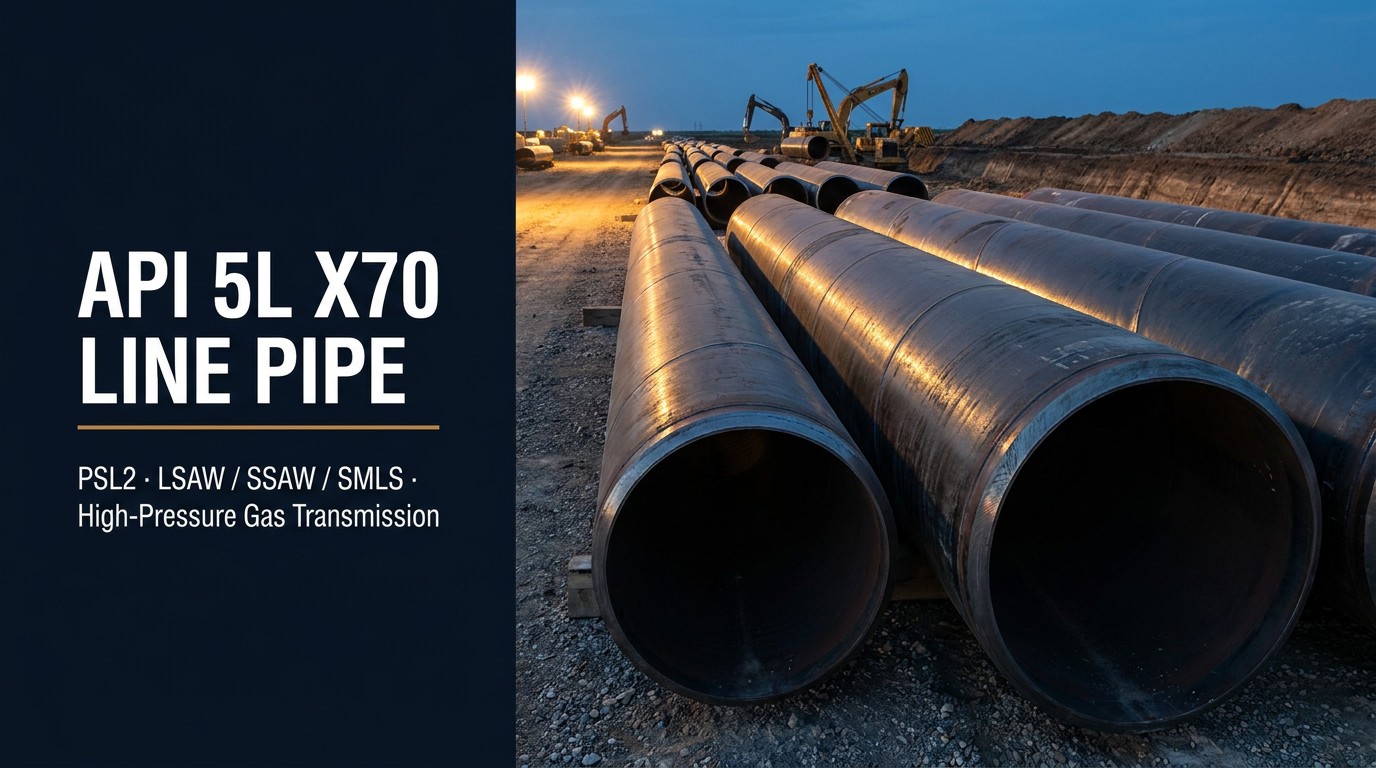
Introduction: The Benchmark for High-Pressure Energy Transport
In the demanding landscape of the global energy sector, the integrity of long-distance transmission pipelines is paramount. The API 5L X70 pipe stands as one of the most critical specifications for high-pressure petroleum and natural gas transportation. Governed by the American Petroleum Institute, Grade X70 represents a high-yield carbon steel that offers an optimal balance of strength, weldability, and fracture toughness.
At GF Steel, we provide precision-engineered API 5L X70 pipes in both Seamless (SMLS) and Welded (LSAW/SSAW/ERW) configurations. This technical guide explores the metallurgical standards, mechanical properties, and the distinction between Product Specification Levels (PSL1 and PSL2).
Understanding Grade X70: Strength and Designation
The “X70” designation identifies the minimum yield strength of the pipe material. Specifically, it indicates that the steel possesses a minimum yield strength of 70,300 psi (approximately 485 MPa). This high strength-to-weight ratio allows pipeline engineers to specify thinner wall thicknesses for high-pressure applications, significantly reducing material costs and logistical weight without compromising safety.
Table 1: Mechanical Property Requirements (Typical API 5L)
Grade
Yield Strength (min)
Tensile Strength (min)
Yield-to-Tensile Ratio (max)
API 5L X70 (PSL1)
485 MPa (70.3 ksi)
570 MPa (82.7 ksi)
N/A
API 5L X70 (PSL2)
485 – 605 MPa
570 – 760 MPa
0.93
PSL1 vs. PSL2: Critical Differences for B2B Procurement
For professional procurement, understanding the difference between PSL1 and PSL2 is essential for project compliance.
PSL1 (Product Specification Level 1): A standard quality level for line pipe. It includes basic chemical and mechanical testing but does not require mandatory non-destructive testing (NDT) or Charpy V-notch impact testing.
PSL2 (Product Specification Level 2): A higher-tier specification required for high-risk or offshore environments. PSL2 mandates strict limits on chemical composition (Carbon equivalent), requires mandatory NDT for all pipes, and involves rigorous toughness testing (CVN) to ensure the pipe can resist crack propagation in extreme temperatures.
Chemical Composition and Carbon Equivalent (CE)
The weldability of API 5L X70 is maintained by controlling the Carbon Equivalent. By utilizing micro-alloying elements such as Niobium (Nb), Vanadium (V), and Titanium (Ti), the steel achieves high strength through grain refinement rather than high carbon content.
Table 2: Chemical Composition Limits for X70 (Typical PSL2)
Element
Max (%)
Role in Alloy
Carbon (C)
0.12 – 0.16
Provides base strength; kept low for weldability
Manganese (Mn)
1.60 – 1.70
Improves hardenability and toughness
Phosphorus (P)
0.025
Impurity limit
Sulfur (S)
0.015
Impurity limit (lower for sour service)
Nb + V + Ti
0.15
Micro-alloying for grain refinement
Manufacturing Processes
GF Steel offers X70 pipes manufactured through various methods to suit different environmental pressures:
Seamless (SMLS): Ideal for smaller diameters and ultra-high pressure applications where no weld seam is permitted.
Longitudinal Submerged Arc Welded (LSAW): The preferred choice for large-diameter, thick-walled pipelines.
Spiral Submerged Arc Welded (SSAW): Cost-effective for large-diameter water and low-pressure gas lines.
Electric Resistance Welded (ERW): Utilized for medium-diameter pipelines with high dimensional precision.
Global Industry Applications
The versatility and high yield strength of API 5L X70 pipe make it indispensable for:
Cross-Country Natural Gas Pipelines: Safely transporting gas across thousands of miles.
Crude Oil Transmission: High-capacity lines connecting extraction fields to refineries.
Offshore Subsea Pipelines: Utilizing PSL2 grades for resistance against hydrostatic pressure and deep-sea corrosion.
Sour Service Environments: Specially treated X70 pipes designed to resist H2S corrosion in “sour” oil fields.
DWT (Drop Weight Tear Test): Mandatory for PSL2 to evaluate fracture arrest properties.
Contact GF Steel: Your Trusted Partner for Energy Infrastructure
GF Steel is a leading global supplier of high-performance line pipes. Our technical team is available to assist with material selection, MTC (Mill Test Certificate) review, and project-specific logistics.
GengFei Steel is a professional “Steel Supplier” located in China, we provide supply service of stainless steel, carbon steel, aluminum and other metal materials.
As an industry-leading company, we are committed to providing our customers with the highest quality raw materials backed by first-class customer service and support. Our wide range of supply includes all kinds of stainless steel plate, tube, wire rod and carbon steel plate, tube, bar and so on. Our team of experienced professionals can help you choose the material that best suits your project needs and ensure your order is delivered on time. Our clients range from small businesses to large manufacturers, and we can provide professional service and support no matter the size of your needs.