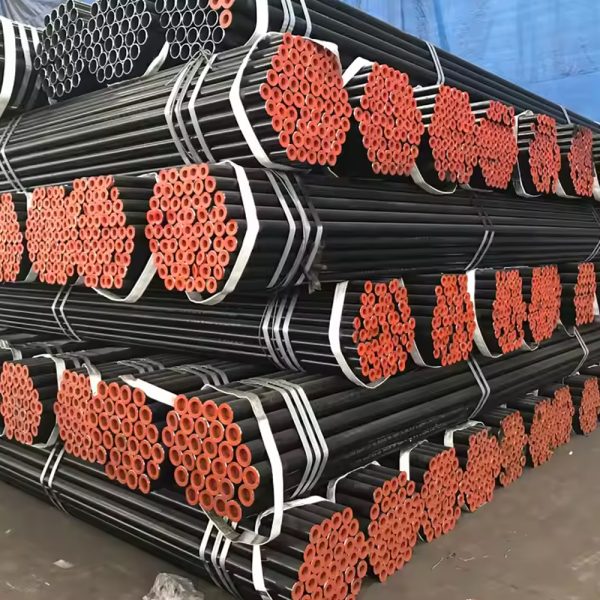




ASTM A106 is suitable for seamless carbon steel pipe for high-temperature environments. ASTM A106 pipe is manufactured according to grades A, B, and C. A106-A is equivalent to the domestic 10# steel material, A106-B is equivalent to the domestic 20# material, which is a relatively common use of a steel pipe material at home and abroad. A106 seamless steel pipe is mainly used in construction, mechanical processing, electrical, petrochemical, and other industries.
ASTM A106 Grade B Pipe (also known as ASME SA106 GR.B pipes) is used in power plants, boilers, petrochemical plants, oil and gas refineries, and ships where the piping must transport hot or cold liquids and gases under high pressures and temperatures. A106 GR. Carbon Steel Seamless Pipes, A106 Gr. B Sch. 40 pipe, and ASTM A106 Grade B Pipe Suppliers are available in various weights, sizes, and black and galvanized grades, both seamless and electric-welded. ASTM A106 Grade B Pipe sizes, less than 2″ are normally delivered as a cold-drawn product. 2″ and up are usually hot finished.
| Product | A106 Grade B Steel Pipe | |
| Standard | EN/DIN/JIS/ASTM/BS/ASME/AISI etc. | |
| Outer Diameter | Seamless: 1/4″-36″ | Welding: 21.3mm-3620mm |
| Round Tube: 1/2″-10″ | Square Tube/Rectangular Tube: 15x15mm-400x600mm | |
| Wall Thickness | Seamless: 1.25mm-50mm | Welding: 1.65mm-65mm |
| Length | 3-12 meters, Support customization | |
| Surface Process | Bright, Polished, Black | |
| Other Services | Machining(cnc), Centerless Grinding(cg), Heat Treatment, Annealing, Pickling, Polishing, Rolling, Forging, Cutting, Bending, Small Machining, etc. | |
About ASTM A106 Grade B:
ASTM A106 Grade B Pipe (also known as ASME SA106 GR.B pipes) is used in power plants, boilers, petrochemical plants, oil and gas refineries, and ships where the piping must transport hot or cold liquids and gases under high pressures and temperatures. A106 GR. Carbon Steel Seamless Pipes, A106 Gr. B Sch. 40 pipe, and ASTM A106 Grade B Pipe Suppliers are available in various weights, sizes, and black and galvanized grades, both seamless and electric-welded. ASTM A106 Grade B Pipe sizes, less than 2″ are normally delivered as a cold-drawn product. 2″ and up are usually hot finished.
About ASTM A106 Grade C:
ASTM A106 Grade C Pipe (also known as ASME SA106 GR.C pipes) is a carbon-manganese steel pipe for high-temperature, large-diameter boilers and superheaters. Its chemical composition is simple and similar to 20G carbon steel, but its carbon and manganese content is higher, so its yield strength is about 12% higher than that of 20G, and its plasticity and toughness are not bad. The steel has a simple production process and good cold and hot workability. Using it to replace 20G headers (economizer, water wall, low-temperature superheater, and reheater header) can reduce the wall thickness by about 10%, which can save material costs, reduce welding workload, and improve the headers’ stress difference at start-up.
| ASTM A106 | Grade A | Grade B | Grade C |
| Tensile Strength (MPa) | ≥330 | ≥415 | ≥485 |
| Yield Strength (MPa) | ≥205 | ≥240 | ≥275 |
| Elongation (%) | ≥35 | ≥30 | ≥30 |
Key differences:
Grade C has the highest strength (yield strength ≥ 275MPa) and is suitable for extremely high-pressure environments, such as supercritical boiler pipes.
Grade B is the most commonly used (yield strength ≥ 240MPa), suitable for medium and high-pressure scenarios such as refineries and power plants.
Grade A has the lowest strength and is suitable for general industrial uses such as low-pressure steam and water transportation.
| Element | Grade A | Grade B | Grade C |
| Carbon max. % | 0.25 | 0.30 | 0.35 |
| Manganese % | 0.27 – 0.93 | 0.29 – 1.06 | 0.29 – 1.06 |
| Phosphorus max % | 0.035 | 0.035 | 0.035 |
| Sulfur max % | 0.035 | 0.035 | 0.035 |
| Silicon, min% % | 0.10 | 0.10 | 0.10 |
A106 GR.A: Commonly used in low-pressure fluid transportation and building structure fields, such as general industrial pipelines and low-pressure steam systems.
A106 GR.B: Commonly used in petrochemical, electric power, and boiler fields, such as refinery pipelines, power plant steam pipes, and high-pressure boiler pipes.
A106 GR.C: Commonly used in ultra-high pressure and high temperature systems and nuclear power fields, such as supercritical power plants, deep-sea oil and gas extraction, and auxiliary pipelines of nuclear power plants.
Grade B is the most widely used, covering more than 90% of high-temperature and high-pressure pipeline needs, such as cracking units in refineries.
Grade C is used in more severe environments, such as supercritical pressure boilers (greater than 22.1 MPa).
Grade A has a lower cost and is suitable for non-critical, low-pressure systems.
Temperature ≤450°C, pressure ≤5MPa → Grade A (economical)
Temperature ≤650°C, pressure ≤15MPa → Grade B (most commonly used)
Temperature ≤700°C, ultra-high pressure conditions → Grade C (special needs)
ASTM A53: low-pressure general-purpose pipeline, weldable, low strength, not suitable for high temperatures.
API 5L: long-distance oil and gas pipelines, focusing on pressure resistance & corrosion resistance, not emphasizing high temperature performance.
ASTM A335: Alloy steel high temperature pipe, containing Cr-Mo alloy, temperature resistance >700°C.


An professional agent will help you find factories, get best quotes, All free!!!
WhatsApp us