
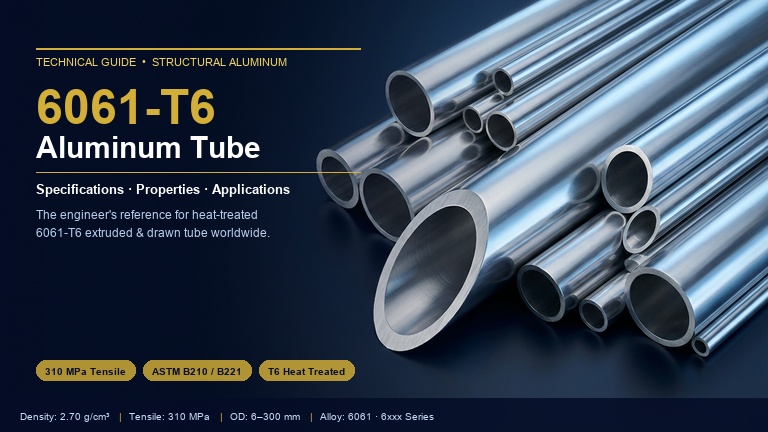
Among the hundreds of aluminum alloys available to engineers and procurement professionals worldwide, 6061-T6 stands apart. It is the most widely specified heat-treatable aluminum alloy in global industrial use — and for good reason. The combination of high tensile strength, excellent corrosion resistance, superior machinability, and broad fabrication compatibility makes 6061-T6 aluminum tube a first-choice structural material across aerospace, construction, automotive, marine, and mechanical engineering sectors.
This technical guide is intended for design engineers, structural specifiers, and purchasing managers evaluating 6061-T6 aluminum tube for specific applications. It covers alloy composition, the T6 heat treatment process, mechanical and physical properties, dimensional standards, key industries of use, and the criteria for selecting a qualified global supplier.
Understanding 6061 Aluminum Alloy
6061 is a precipitation-hardened aluminum alloy belonging to the 6xxx series, in which magnesium (Mg) and silicon (Si) are the primary alloying elements. It was first developed in 1935 and has since become one of the most versatile and commercially significant aluminum alloys in production.
Chemical Composition
| Element | Content (% by weight) |
|---|---|
| Aluminum (Al) | Balance (~97%) |
| Magnesium (Mg) | 0.80 – 1.20 |
| Silicon (Si) | 0.40 – 0.80 |
| Copper (Cu) | 0.15 – 0.40 |
| Chromium (Cr) | 0.04 – 0.35 |
| Iron (Fe) | ≤ 0.70 |
| Zinc (Zn) | ≤ 0.25 |
| Titanium (Ti) | ≤ 0.15 |
| Manganese (Mn) | ≤ 0.15 |
The magnesium-silicon combination forms the intermetallic compound Mg₂Si during heat treatment, which is responsible for the alloy’s age-hardening response and resulting strength. Copper enhances tensile strength and wear resistance, while chromium improves corrosion resistance and suppresses recrystallization.
What Does “T6” Mean? The Heat Treatment Explained
The designation T6 is a temper code defined by the Aluminum Association that specifies the thermal processing history of the alloy. Understanding the temper is essential, as it directly determines the mechanical performance of the finished tube.
T6 Heat Treatment Process
Step 1 — Solution Heat Treatment The aluminum is heated to approximately 515–535°C (960–995°F) and held until the alloying elements dissolve into solid solution. This must be kept below the solidus temperature to avoid partial melting.
Step 2 — Quenching The material is rapidly cooled (quenched) in water to freeze the dissolved elements in supersaturated solid solution, locking in the conditions necessary for subsequent strengthening.
Step 3 — Artificial Aging (Precipitation Hardening) The quenched material is heated to approximately 160–177°C (320–350°F) for 8–12 hours. Fine precipitates of Mg₂Si form throughout the matrix, creating obstacles to dislocation movement — producing the high strength characteristic of T6.
T6 vs. Other Tempers
| Temper | Condition | Tensile Strength (MPa) | Yield Strength (MPa) | Typical Use |
|---|---|---|---|---|
| O | Annealed (fully soft) | 125 | 55 | Forming, bending |
| T4 | Solution treated + naturally aged | 241 | 145 | Where forming follows |
| T6 | Solution treated + artificially aged | 310 | 276 | Structural applications |
| T651 | T6 + stress relieved by stretching | 310 | 276 | Plate and bar (reduced residual stress) |
Mechanical and Physical Properties
Mechanical Properties
| Property | Value |
|---|---|
| Ultimate Tensile Strength | 310 MPa (45,000 psi) |
| Tensile Yield Strength | 276 MPa (40,000 psi) |
| Elongation at Break (50 mm) | 8 – 12% |
| Shear Strength | 207 MPa |
| Shear Modulus | 26 GPa |
| Hardness (Brinell) | 95 HB |
| Fatigue Strength | 96 MPa |
| Modulus of Elasticity | 68.9 GPa |
Physical Properties
| Property | Value |
|---|---|
| Density | 2.70 g/cm³ |
| Melting Range | 582 – 652°C |
| Thermal Conductivity | 167 W/m·K |
| Specific Heat Capacity | 0.896 J/g·°C |
| Electrical Conductivity | 43% IACS |
| Coefficient of Thermal Expansion | 23.6 µm/m·°C |
Manufacturing Methods: Extruded vs. Drawn Tube
Extruded Tube (ASTM B221 / EN 755-2)
A heated billet is forced through a shaped die to produce a continuous hollow profile. Best for larger cross-sections, complex profiles, and moderate tolerances. Standard for structural framing, handrails, and construction applications.
Drawn Tube (ASTM B210)
Cold drawing through a die improves dimensional accuracy, surface finish, and mechanical properties. Preferred for precision applications in aerospace, hydraulics, instrumentation, and medical equipment.
Standard Dimensional Specifications
| Parameter | Round Tube | Square / Rectangular Tube |
|---|---|---|
| Outer Diameter / Width | 6 mm – 300 mm | 10 mm – 200 mm |
| Wall Thickness | 0.5 mm – 20 mm | 1.0 mm – 15 mm |
| Standard Length | 1,000 – 6,000 mm | 1,000 – 6,000 mm |
| OD Tolerance (extruded) | ±0.5% | ±0.5% |
| Wall Thickness Tolerance | ±10% (standard) | ±10% (standard) |
| Straightness | ≤ 1.5 mm/m | ≤ 1.5 mm/m |
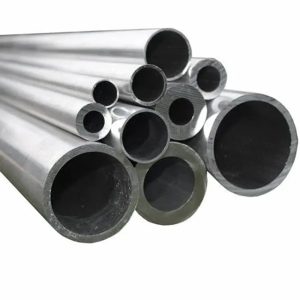
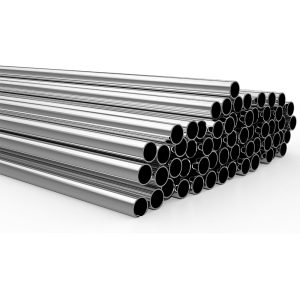
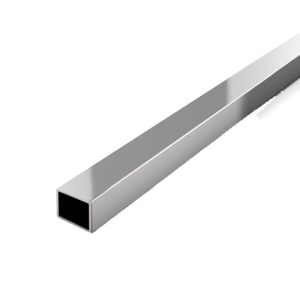
Available profiles: Round · Square · Rectangular · Oval / Elliptical · Custom (per drawing)
Applicable International Standards
| Standard | Issuing Body | Scope |
|---|---|---|
| ASTM B210 | ASTM International | Drawn seamless aluminum tube |
| ASTM B221 | ASTM International | Extruded aluminum profile and tube |
| ASTM B241 | ASTM International | Seamless pipe and extruded tube |
| EN 755-2 | European Standards | Extruded tube mechanical properties |
| EN 573-3 | European Standards | Chemical composition |
| GB/T 6893 | Chinese Standards | Drawn aluminum tube |
| GB/T 4437.1 | Chinese Standards | Extruded aluminum tube |
| AMS 2770 | SAE Aerospace | Heat treatment of wrought aluminum |
| ISO 6361 | ISO | Wrought aluminum sheet, strip, and plate |
Comparison with Related Alloys
| Property | 6061-T6 | 6063-T5 | 7075-T6 | 2024-T3 |
|---|---|---|---|---|
| Tensile Strength (MPa) | 310 | 186 | 572 | 483 |
| Yield Strength (MPa) | 276 | 145 | 503 | 345 |
| Corrosion Resistance | Good | Excellent | Fair | Poor |
| Machinability | Good | Fair | Good | Excellent |
| Weldability | Good | Excellent | Poor | Poor |
| Anodizing Quality | Good | Excellent | Fair | Fair |
| Relative Cost | Moderate | Low | High | High |
| Primary Use | Structural | Architectural | High-stress aerospace | Fatigue aerospace |
Selection guidance: Choose 6061-T6 for the best all-round balance of strength, machinability, weldability, and cost. It is the default structural choice when no extreme requirement pushes toward a more specialized alloy.


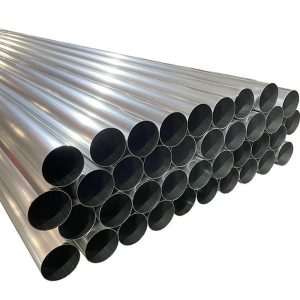
Contact GengFei Steel
GengFei Steel supplies high-quality 6061-T6 aluminum tubes to manufacturers, engineering firms, distributors, and construction companies worldwide. Our product range covers round, square, and rectangular profiles in standard and custom dimensions, with full compliance documentation and competitive export pricing.
We offer:
- Factory-direct pricing with flexible MOQ
- Full MTC and third-party inspection support
- Export packaging conforming to international freight standards
- Technical consultation for alloy and dimension selection
- Global shipping to the Middle East, Southeast Asia, Europe, Africa, and the Americas
Our technical sales team responds within one business day. Sample orders, material certifications, and custom quotations are available upon request.

Get Your Next Project Done!
China Steel Supplier & Manufacturer
THE LARGEST METALS MANUFACTURING
GengFei Steel is a professional “Steel Supplier” located in China, we provide supply service of stainless steel, carbon steel, aluminum and other metal materials.
As an industry-leading company, we are committed to providing our customers with the highest quality raw materials backed by first-class customer service and support. Our wide range of supply includes all kinds of stainless steel plate, tube, wire rod and carbon steel plate, tube, bar and so on. Our team of experienced professionals can help you choose the material that best suits your project needs and ensure your order is delivered on time. Our clients range from small businesses to large manufacturers, and we can provide professional service and support no matter the size of your needs.