
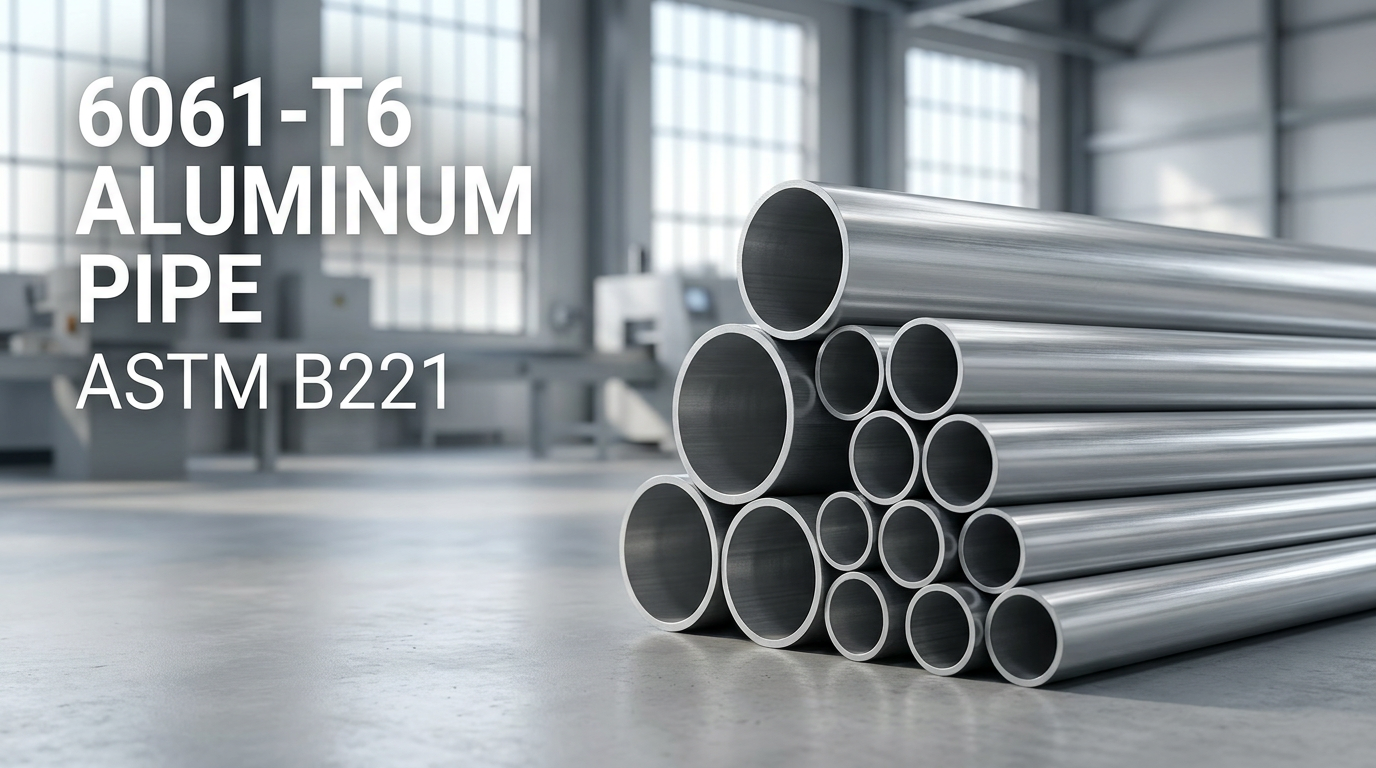
Introduction: The Standard of Structural Aluminum Tubing
In modern industrial engineering, weight reduction and structural integrity are two paramount but often conflicting goals. The Aluminum pipe 6061-T6 ASTM B221 resolves this challenge, serving as one of the most versatile and widely specified extruded aluminum products globally.
Combining the medium-to-high strength of the 6000-series (Al-Mg-Si) alloys with the highly stable T6 temper, and manufactured under the rigorous quality controls of the ASTM B221 standard, this pipe offers an optimal balance of mechanical performance, corrosion resistance, and fabricability.
At GF Steel, we supply precision-engineered 6061-T6 aluminum pipes to structural engineers, aerospace manufacturers, and marine fabricators worldwide. This technical guide outlines the metallurgical properties, mechanical standards, and engineering benefits of this high-performance alloy.
Understanding the Standard: What Is ASTM B221?
ASTM B221 is the Standard Specification for Aluminum and Aluminum-Alloy Extruded Bars, Rods, Wire, Profiles, and Tubes.
Unlike drawn tubing (which is cold-drawn through a die for ultra-precise tolerances, governed by ASTM B210), extruded pipe under ASTM B221 is produced by pushing a heated aluminum billet through an extrusion press. This method is highly cost-effective and structurally robust, making it the premier choice for:
- Structural framing and trusses
- Fluids and gas transport lines
- Marine handrails and offshore platforms
- Heavy machinery chassis
Metallurgical Profile and Chemical Composition
The performance of 6061 aluminum is driven by its alloyed elements—primarily Magnesium (Mg) and Silicon (Si)—which combine to form magnesium silicide (Mg2SiMg2Si). This intermetallic compound renders the alloy heat-treatable and significantly increases its mechanical strength through precipitation hardening.
Table 1: Chemical Composition Limits (% by Weight) for 6061 Alloy (per ASTM B221)
| Element | Minimum (%) | Maximum (%) | Role in Alloy |
|---|---|---|---|
| Aluminum (Al) | Remainder | Remainder | Base metal |
| Magnesium (Mg) | 0.80 | 1.20 | Increases strength, enables heat treatment |
| Silicon (Si) | 0.40 | 0.80 | Combines with Mg to form precipitation phases |
| Copper (Cu) | 0.15 | 0.40 | Enhances mechanical strength |
| Chromium (Cr) | 0.04 | 0.35 | Controls grain growth, improves corrosion resistance |
| Iron (Fe) | – | 0.70 | Impurity limit |
| Zinc (Zn) | – | 0.25 | Impurity limit |
| Manganese (Mn) | – | 0.15 | Controls grain structure |
| Titanium (Ti) | – | 0.15 | Grain refiner |
| Others (Each) | – | 0.05 | – |
| Others (Total) | – | 0.15 | – |
The Heat Treatment Process: The “T6” Temper Explained
The “T6” suffix denotes a specific thermal-mechanical state achieved through a precise two-stage thermal processing cycle:
- Solution Heat Treatment: The extruded pipe is heated to approximately 530°C (990∘F990∘F) to dissolve all alloying elements (specifically Magnesium and Silicon) into a solid solution. It is then rapidly quenched in water or air to lock the dissolved atoms into a supersaturated state at room temperature.
- Artificial Aging (Precipitation Hardening): The quenched material is reheated and held at a lower temperature—around 160°C to 177°C (320∘F320∘F to 350∘F350∘F) for 8 to 18 hours. This allows sub-microscopic particles of Mg2SiMg2Si to precipitate uniformly throughout the aluminum matrix, greatly hindering dislocation movement and increasing the yield and tensile strength of the pipe.
Mechanical and Physical Performance Data
Engineers specify 6061-T6 because of its predictable structural limits under load. The mechanical minimums defined by ASTM B221 ensure structural reliability.
Table 2: Mechanical Properties of Extruded 6061-T6 Aluminum Pipe (per ASTM B221)
| Property | Metric Value | Imperial/US Value |
|---|---|---|
| Tensile Strength (Ultimate, UTS) | ≥262 MPa≥262 MPa | ≥38,000 psi≥38,000 psi |
| Yield Strength (Offset 0.2%) | ≥241 MPa≥241 MPa | ≥35,000 psi≥35,000 psi |
| Elongation (in 50mm / 2 inches) | ≥8%−10%≥8%−10% | ≥8%−10%≥8%−10% |
| Brinell Hardness (500 kg load, 10mm ball) | ~95 HB | ~95 HB |
| Shear Strength | 205 MPa | 30,000 psi |
| Fatigue Limit | 96 MPa | 14,000 psi |
Table 3: Physical Properties of 6061-T6 Aluminum Alloy
| Property | Value |
|---|---|
| Density | 2.70 g/cm3 (0.0975 lb/in3)2.70 g/cm3 (0.0975 lb/in3) |
| Melting Range | 582∘C−652∘C (1080∘F−1205∘F)582∘C−652∘C (1080∘F−1205∘F) |
| Thermal Conductivity (at 25°C) | 167 W/m⋅K167 W/m⋅K |
| Electrical Conductivity (at 20°C) | 40% to 43% IACS40% to 43% IACS |
| Modulus of Elasticity (Tension) | 68.9 GPa (10.0×10⁶ psi)68.9 GPa (10.0×10⁶ psi) |

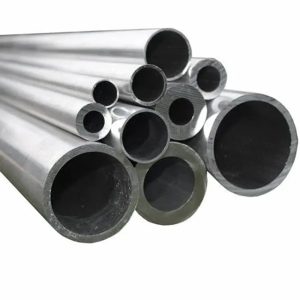

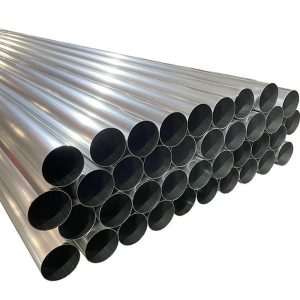
Key Advantages of Aluminum Pipe 6061-T6 ASTM B221
1 Outstanding Corrosion Resistance
Unlike carbon steel, 6061-T6 aluminum pipes naturally form a highly stable oxide film (Al2O3Al2O3) upon exposure to air. This microscopic layer isolates the underlying metal from moisture, aggressive chemical vapors, and industrial atmospheres, eliminating the need for costly primers or anti-corrosion coatings in most applications.
2 Superior Strength-to-Weight Ratio
With a density roughly one-third that of steel, 6061-T6 aluminum provides significant weight savings while maintaining structural integrity. This makes it crucial for transportation industries, reducing fuel consumption and enabling higher payloads.
3 Excellent Weldability and Machinability
The chemical composition of 6061 allows it to be welded using standard processes like TIG (GTAW) and MIG (GMAW). Furthermore, it possesses superior machining characteristics in the T6 temper, producing crisp, clean chips and smooth surface threads.
Major Global Industry Applications
- Marine Engineering: Boat masts, structural deck components, marine handrails, and offshore equipment towers.
- Structural Construction: Architectural structures, frame supports, lighting towers, overhead highway sign bridges, and bridge railings.
- Automotive and Transportation: Fluid distribution lines, structural chassis members, drive shafts, and bicycle frames.
- Aerospace: Aircraft fuselages, wing structures, and aerospace structural tubing where high strength and low density are vital.
Quality Assurance & Tolerance Controls
At GF Steel, we enforce strict quality control measures to ensure that our 6061-T6 aluminum pipes comply perfectly with the dimensional tolerances outlined in ASTM B221. These include tolerances on:
- Wall Thickness and Outside Diameter (OD): Inspected with precise ultrasonic calipers.
- Straightness and Ovality: Checked along the entire length to ensure ease of installation.
- Mechanical Testing: Destructive tensile and bend tests performed in certified laboratories.
Contact GF Steel: Your Global Aluminum & Steel Procurement Partner
GF Steel is a leading global supplier of industrial metal products. Our metallurgy specialists are ready to provide technical support, custom cutting services, and competitive pricing schedules.
Email Address:[email protected]
WhatsApp / Phone Number:+8619138164778
Precision Engineering. Global Delivery. Certified Quality.

Get Your Next Project Done!
China Steel Supplier & Manufacturer
THE LARGEST METALS MANUFACTURING
GengFei Steel is a professional “Steel Supplier” located in China, we provide supply service of stainless steel, carbon steel, aluminum and other metal materials.
As an industry-leading company, we are committed to providing our customers with the highest quality raw materials backed by first-class customer service and support. Our wide range of supply includes all kinds of stainless steel plate, tube, wire rod and carbon steel plate, tube, bar and so on. Our team of experienced professionals can help you choose the material that best suits your project needs and ensure your order is delivered on time. Our clients range from small businesses to large manufacturers, and we can provide professional service and support no matter the size of your needs.