

6061 and 3003 are two of the most common aluminum alloys used for tread plate, diamond plate and checker plate, but they are designed for very different priorities.
6061-T6 aluminum tread plate is generally the better starting point when strength, rigidity, machining and structural load matter. 3003 tread plate is generally preferred when formability, easy fabrication, bright appearance and general corrosion resistance are more important.
For example, an industrial loading ramp, machinery platform or heavily loaded truck floor may benefit from the higher strength of 6061-T6. A toolbox, trailer trim, food-truck interior or decorative wall panel may be easier and more economical to manufacture from 3003.
The alloy, however, is only one part of the decision. Temper, plate thickness, support spacing, tread pattern, surface finish, fabrication method and operating environment can all change which material is appropriate.
6061 vs 3003 Aluminum Tread Plate at a Glance
The quickest way to understand the difference is to compare what each alloy is designed to do.
| Property | 6061-T6 Tread Plate | 3003 Tread Plate |
|---|---|---|
| Alloy Family | Al-Mg-Si | Al-Mn |
| Heat Treatable | Yes | No |
| Typical Tread Temper | T6 | H-series, depending on product/specification |
| Strength | High | Moderate |
| Rigidity | Higher | Lower |
| Formability | Fair to Moderate in T6 | Very Good to Excellent |
| Tight Bending | More difficult | Easier |
| Machinability | Excellent | Fair to Good |
| Weldability | Good | Very Good |
| Post-Weld Strength | HAZ strength reduction must be considered | Less dependent on heat-treatment strengthening |
| Corrosion Resistance | Very Good | Excellent general atmospheric resistance |
| Surface Appearance | Usually mill / industrial finish | Commonly available in bright decorative finish |
| Heat Treatment Strengthening | Solution treatment + aging | Strain hardening |
| Structural Applications | Excellent | Usually light- to medium-duty |
| Decorative Applications | Possible | Excellent |
| Typical Uses | Ramps, platforms, stairs, truck floors | Toolboxes, trim, wall protection, interiors |
| Relative Material/Processing Cost | Usually higher | Usually lower |
| Best Reason to Choose | Strength | Formability |
These are selection guidelines rather than universal design limits. Mechanical properties vary with temper, thickness, production specification and supplier.

What Is Aluminum Tread Plate?
Aluminum tread plate is rolled aluminum sheet or plate with a raised pattern on one surface.
Depending on region and industry, the same general product may be called:
- aluminum tread plate
- aluminum checker plate
- aluminum checkered plate
- aluminum chequer plate
- aluminum diamond plate
- aluminum floor plate
The raised pattern improves surface traction and can also provide a distinctive industrial or decorative appearance.
Steel1Stop supplies aluminum checkered plate in multiple alloy series, tempers, thicknesses and patterns for transportation, industrial flooring, construction and fabricated products.
A common mistake is assuming that all aluminum diamond plates perform similarly because their surfaces look almost identical.
They do not.
Two plates can use the same raised diamond pattern but have very different:
strength, bendability, hardness, machining behavior and load-bearing capability.
Those differences come primarily from the underlying alloy and temper.
What Is 6061-T6 Aluminum Tread Plate?
6061 belongs to the 6000-series aluminum alloys.
Its principal strengthening additions are magnesium and silicon. Together they allow 6061 to be strengthened through heat treatment, which is the reason the alloy is widely used in structural and engineering applications.
6061-T6 is one of its most common high-strength conditions.
The T6 temper means the alloy has been solution heat treated and artificially aged.
That process develops significantly more strength than annealed or non-heat-treated aluminum.
For tread plate applications, this makes 6061-T6 attractive where the plate must do more than simply provide a patterned surface.
It can contribute to the structural performance of:
industrial platforms, truck flooring, loading ramps, access systems and equipment decks.
Key Advantages of 6061-T6 Tread Plate
6061-T6 combines several useful engineering properties.
It offers a high strength-to-weight ratio compared with many general-purpose aluminum alloys while retaining good corrosion resistance.
It machines well, so drilling, milling, tapping and machining mounting features are generally easier than with softer, gummier aluminum alloys.
It is also weldable, although designers need to account for strength changes in the heat-affected zone.
For applications where the tread plate is part of a fabricated structure rather than just a decorative skin, these characteristics can be important.
Steel1Stop has a dedicated guide to 6061 aluminum checkered plate covering its grades, patterns, sizes and industrial applications.
What Is 3003 Aluminum Tread Plate?
3003 belongs to the 3000-series Al-Mn alloy family.
Manganese is its main alloying addition.
Unlike 6061, 3003 cannot be significantly strengthened through solution heat treatment and artificial aging. Instead, its strength is controlled primarily through cold working and subsequent temper processing.
This produces a material that is generally softer and easier to form than 6061-T6.
That characteristic is extremely useful.
A tread plate used for a toolbox may need multiple bends.
A protective panel may require folded edges.
An architectural panel may need to wrap around corners.
A food-truck interior may require numerous fabricated sections.
In applications like these, extreme structural strength may be less important than manufacturing flexibility.
Why 3003 Is Common in Bright Diamond Plate
3003 is frequently associated with bright aluminum tread plate because it combines:
good formability, good corrosion resistance, relatively low weight and an attractive reflective surface.
This is why bright diamond plate is so common in:
trailers, utility boxes, wall protection, vehicle interiors and decorative applications.
However, bright finish is not an inherent requirement of 3003, nor does every 3003 tread plate have the same appearance.
Finish must still be specified when ordering.
6061-T6 vs 3003 Temper: Why T6 and H Tempers Matter
Comparing only “6061 vs 3003” does not tell the complete story.
Temper matters.

What Does 6061-T6 Mean?
6061-T6 receives a heat-treatment sequence broadly involving:
solution heat treatment → quenching → artificial aging.
During solution heat treatment, alloying elements are brought into solid solution.
Rapid cooling retains a supersaturated structure.
Artificial aging then promotes controlled precipitation that increases strength and hardness.
That is why 6061-T6 behaves very differently from soft 6061-O.
What Does an H Temper Mean for 3003?
The H designation indicates strain-hardened material.
Unlike T6, the strengthening mechanism comes primarily from mechanical cold working rather than precipitation heat treatment.
Different 3003 tread plate products can be supplied in different H temper designations depending on the manufacturing standard and market.
This is important when purchasing.
Do not assume every commercial product marketed as “3003 diamond plate” has identical mechanical properties simply because the alloy number is the same.
For engineering orders, specify both:
alloy + temper
and verify the corresponding material certificate.
Chemical Composition: Why 6061 and 3003 Behave Differently
The mechanical difference begins with chemistry.
A simplified comparison is:
| Element | 6061 | 3003 |
|---|---|---|
| Aluminum | Balance | Balance |
| Magnesium | 0.8–1.2% typical specification range | Minor |
| Silicon | 0.4–0.8% typical specification range | Limited |
| Manganese | Limited | Approximately 1.0–1.5% |
| Copper | Controlled addition | Small controlled addition |
| Chromium | Controlled addition | — |
| Zinc | Limited | Limited |
6061 relies mainly on magnesium and silicon for its heat-treatable strengthening system.
3003 uses manganese to improve strength over commercially pure aluminum without sacrificing the high formability expected from a general-purpose sheet alloy.
The practical result is:
6061 → strength-oriented
3003 → forming-oriented
Which Is Stronger: 6061 or 3003 Aluminum Tread Plate?
6061-T6 is substantially stronger than typical 3003 tread plate.
That is one of the most important differences between the two.
For standard 6061-T6 tread plate covered by ASTM tread-plate specifications, minimum mechanical-property requirements are considerably higher than those for 3003 tread-plate tempers.
For practical purchasing, it is better to compare the certified values on the material specification or MTC than to rely on one universal internet number for 3003.
Why?
Because the strength of 3003 changes significantly with strain-hardening condition.
A typical material comparison still looks roughly like this:
| Property | 6061-T6 | 3003 Tread Plate |
|---|---|---|
| Tensile Strength | High, around the 290 MPa+ class under common tread-plate specifications | Moderate; depends strongly on H temper |
| Yield Strength | High, around the 240 MPa+ class under common tread-plate specifications | Significantly lower |
| Hardness | Higher | Lower |
| Structural Rigidity | Better | Lower |
| Forming Ductility | Lower in T6 | Better |
The exact values used in engineering design should come from the purchased material specification.
Yield Strength Matters More Than Many Buyers Realize
When buyers compare tread plate, they often look only at tensile strength.
For a floor, ramp or platform, yield strength can be more relevant.
Yielding means the plate has undergone permanent deformation.
Imagine a tread plate spanning between two supports.
Before the plate actually breaks, it may:
bend, sag or permanently deform.
That may already make the structure unusable.
This is why 6061-T6 is commonly preferred when tread plate contributes directly to the load-bearing structure.
Which Tread Plate Is Better for Heavy Loads?
For equivalent geometry and comparable support conditions, 6061-T6 generally provides more structural capacity than 3003 because of its higher yield strength.
That makes it a stronger candidate for:
loading ramps, machinery platforms, heavy truck flooring, dock components and industrial access systems.
However, you should not select a tread plate simply by saying:
“6061 can support X kg.”
Actual load capacity depends on much more than alloy.
It is controlled by:
plate thickness, clear span, support spacing, boundary conditions, concentrated vs distributed load, tread geometry, fastener spacing and allowable deflection.
A 6 mm 3003 plate supported every 300 mm may behave better than a much thinner 6061 plate spanning a large unsupported distance.
So the correct sequence is:
load → span → allowable deflection → alloy → thickness → support design
not simply:
6061 = heavy duty.
3003 vs 6061: Which Is Easier to Bend?
3003 is generally much easier to bend.
This is one of the clearest reasons to choose it.

Why 3003 Is Better for Tight Bends
3003 retains relatively good ductility in common sheet and tread-plate tempers.
This makes it suitable for:
toolboxes, folded covers, wall panels, enclosures and edge returns.
If the fabrication requires several tight bends, this advantage can save considerable manufacturing time.
Why 6061-T6 Needs More Care
6061-T6 is harder and less forgiving during tight-radius bending.
As bend radius becomes too small, tensile strain on the outside surface can cause cracking.
The required minimum radius depends on:
thickness, rolling direction, material condition, bend orientation and fabrication process.
As thickness increases, the required bend radius generally increases as well.
Therefore, do not copy one bend-radius number from a generic chart and apply it to every 6061-T6 tread plate.
The tread pattern itself can also influence forming behavior because raised ribs locally change geometry and strain distribution.
If tight bending is a major manufacturing requirement, 3003 or another more formable alloy may be more practical.
Does Tread Pattern Affect Bending?
Yes.
Although alloy and temper have the largest influence, tread geometry also matters.
The raised pattern locally changes:
section thickness, stiffness and stress concentration.
A bend crossing raised bars may behave differently from a bend positioned between them.
For mass-production fabrication, actual bend trials on the selected tread pattern are advisable before finalizing tooling.
This is especially important for thicker 6061-T6 plates.
3003 vs 6061 Weldability
Both alloys can be welded, but their behavior after welding is different.
Welding 3003
3003 is widely regarded as a fabrication-friendly aluminum alloy.
It can be welded using common aluminum welding processes and does not depend on precipitation heat treatment for its principal strengthening mechanism.
That makes it convenient for many fabricated sheet assemblies.
Welding 6061-T6
6061 is also considered weldable.
The important issue is not whether it can be welded.
The issue is:
what happens to T6 strength near the weld?
The welding heat changes the precipitation-hardened microstructure in the heat-affected zone.
As a result, the local strength around the weld can be substantially lower than the original T6 parent material.
For a decorative cover, this may have little importance.
For a load-bearing ramp or structural platform, it may be a major engineering consideration.
A welded 6061-T6 structure should therefore not be designed by assuming the entire assembly retains the original T6 parent-metal strength.
Which Is Easier to Machine?
6061-T6 is generally the better machining alloy.
It is widely used for CNC components because it offers a useful combination of:
hardness, chip formation, dimensional stability and machinability.
If your tread plate requires substantial:
drilling, countersinking, milling, tapping or machined pockets,
6061 may provide a better machining experience.
3003 is softer and more ductile, which is advantageous during forming but can result in a more gummy machining behavior.
For simple cutting, shearing and bending, this may not matter.
For extensive machining, it can.
Which Has Better Corrosion Resistance?
Both alloys have good general corrosion resistance, which is one reason aluminum tread plate is popular outdoors.
3003 is particularly well known for excellent resistance to atmospheric environments and moisture.
6061 also provides very good general corrosion resistance and is widely used outdoors.
However, the question:
“Which one is more corrosion resistant?”
can be too simple.
The answer depends on:
environment, surface finish, joints, dissimilar-metal contact, chloride exposure and maintenance.
For highly aggressive marine environments, 5052, 5083 or other 5xxx-series aluminum alloys may be more appropriate than either 3003 or 6061.
That gives us three different selection directions:
| Priority | Typical Starting Choice |
|---|---|
| Formability / Bright Finish | 3003 |
| High Structural Strength | 6061 |
| Marine Corrosion Resistance + Formability | 5052 / 5xxx series |
So if a project involves boat decks, offshore access systems or long-term saltwater exposure, do not automatically choose 6061 simply because it is stronger.
Bright Finish vs Mill Finish
One of the most visible differences in commercial tread plate is surface appearance.
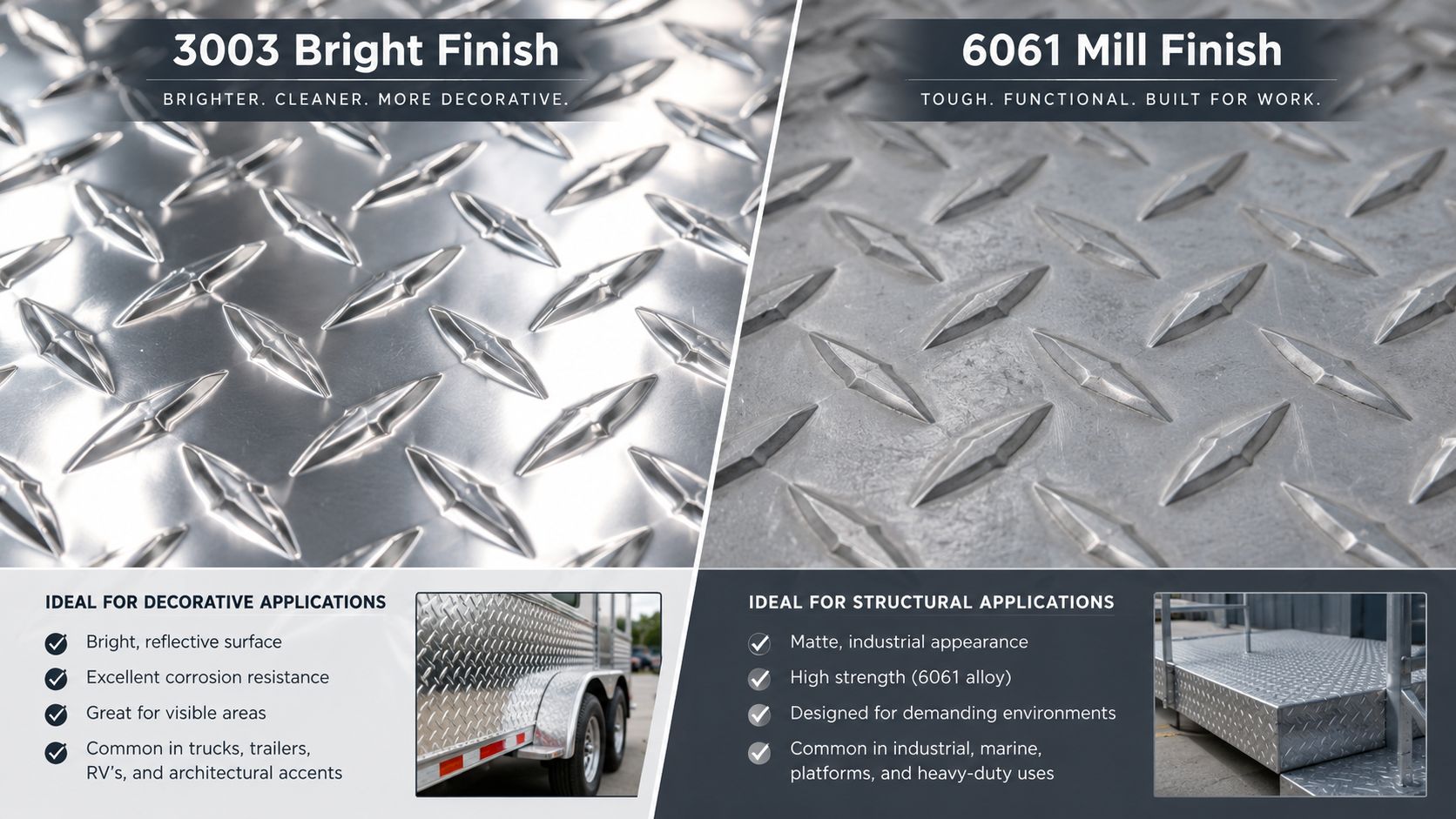
3003 Bright Tread Plate
3003 is frequently sold in a highly reflective tread-brite finish.
It provides the familiar shiny diamond plate appearance associated with:
utility trailers, toolboxes, truck accessories and decorative wall protection.
For visible consumer-facing surfaces, this finish is often part of the reason the material is selected.
6061 Mill Finish
6061 structural tread plate is frequently supplied in a more industrial mill finish.
It may look duller, but this does not mean the material is lower quality.
For an industrial platform, strength and dimensional performance may matter far more than reflectivity.
The key distinction is:
finish is an appearance/process specification; alloy is a material specification.
Do not use surface shine alone to identify alloy.
Is Tread Brite the Same as Aluminum Diamond Plate?
Not exactly.
“Diamond plate” describes the raised surface pattern in general usage.
“Tread Brite” is commonly used commercially for bright, reflective tread plate.
A plate can therefore be:
diamond patterned without being bright finished,
or supplied in a bright finish specifically for decorative appearance.
When requesting a quotation, specify both:
pattern + finish
rather than assuming one automatically implies the other.
Diamond, 5-Bar and Other Tread Patterns
Pattern is another independent selection variable.
Common aluminum checker plate patterns include:
| Pattern | Typical Character |
|---|---|
| Single / Diamond | Classic North American-style tread appearance |
| 2-Bar | Functional traction |
| 3-Bar | Industrial / transportation uses |
| 5-Bar | Common anti-slip flooring pattern |
| Tear Drop | Industrial traction |
| Stucco | Textured decorative/protective surface |
Pattern availability varies by mill, alloy and region.
The correct specification is therefore not just:
6061 diamond plate
but something closer to:
6061-T6 aluminum tread plate, specified thickness, specified size, diamond pattern, mill finish.
Does the Raised Pattern Make a Plate Stronger?
The tread provides local geometric stiffness and surface traction, but it should not be treated as a substitute for proper structural thickness calculation.
When calculating or specifying structural flooring, clarify whether the stated thickness means:
base thickness
or
overall thickness including the raised tread.
This matters because some commercial sellers describe material by nominal total thickness while engineering calculations typically need the thickness of the underlying plate section.
For international purchasing, this should be confirmed before production.
3003 vs 6061 Weight
6061 and 3003 both have densities close to approximately 2.7 g/cm³.
Therefore, if two sheets have essentially the same base dimensions and tread geometry, their weights will be very similar.
6061 is not significantly heavier simply because it is stronger.
The major difference in real projects often comes from required thickness.
A stronger alloy may allow an engineer to meet a design requirement with a different section than would be necessary using a lower-strength alloy.
That decision, however, requires proper structural calculation.
How Thickness Changes Tread Plate Performance
Thickness has a major impact on stiffness.
A small increase in plate thickness can produce a much larger change in resistance to bending.
This means:
alloy selection should never be separated from thickness selection.
Typical commercial tread plate thicknesses may include:
1.5 mm, 2 mm, 3 mm, 4 mm, 5 mm, 6 mm and heavier sizes,
depending on alloy, mill and pattern.
Thin material may work well for:
decorative panels and wall protection.
Medium thicknesses may be suitable for:
vehicle interiors and general flooring.
Heavier plates may be required for:
ramps, industrial platforms and equipment areas.
But actual required thickness must be determined from loading and support conditions.
3003 vs 6061 Applications
The different property combinations naturally push the two alloys toward different applications.

| Application | Recommended Starting Point | Main Reason |
|---|---|---|
| Toolbox | 3003 | Formability and bright finish |
| Trailer Trim | 3003 | Appearance and fabrication |
| Wall Protection | 3003 | Decorative finish and corrosion resistance |
| Food Truck Interior | 3003 | Easy cleaning and appearance |
| Kick Plate | 3003 | Formability |
| Folded Enclosure | 3003 | Easier bending |
| Light-Duty Floor | Depends | Thickness and span determine requirement |
| Loading Ramp | 6061-T6 | High strength |
| Truck Bed | 6061-T6 | Strength and durability |
| Industrial Platform | 6061-T6 | Structural performance |
| Heavy Equipment Flooring | 6061-T6 | Higher yield strength |
| Structural Stair Tread | 6061-T6 | Rigidity and strength |
| Machined Tread Component | 6061-T6 | Machinability |
| Marine Deck | Consider 5052/5xxx | Marine corrosion performance |
These are starting recommendations, not substitutes for engineering design.
Which Is Better for a Truck Bed?
It depends on what part of the truck body the tread plate is performing.
For a structural or heavily loaded bed where resistance to permanent deformation matters, 6061-T6 is generally the stronger option.
For decorative side panels, trim, toolboxes or lighter-duty lining, 3003 may provide adequate performance with easier forming and a brighter appearance.
So the better question is not:
“Which alloy is used on trucks?”
but:
“Is this plate carrying load or primarily providing protection and finish?”
Which Is Better for a Loading Ramp?
6061-T6 is generally the better starting material for a structural loading ramp.
Its higher yield strength allows better resistance to bending and permanent deformation.
However, ramp safety also depends on:
support design, thickness, span, concentrated wheel loads, welding, edge reinforcement and tread geometry.
For vehicle ramps, a structural engineer or qualified fabricator should verify the complete assembly.
Which Is Better for a Toolbox?
3003 is usually more fabrication-friendly.
A toolbox involves multiple:
90° bends, folded edges, corners and formed sections.
3003’s better formability makes these operations easier and reduces the risk of cracking associated with tight bending of a harder T6 alloy.
Its bright finish is also widely used for truck and trailer toolboxes.
Which Is Better for Flooring?
It depends on load.
For decorative or light pedestrian flooring, 3003 may be sufficient when thickness and support spacing are appropriate.
For industrial flooring supporting:
heavy traffic, machinery or structural loads,
6061-T6 is generally a better starting point.
Again, tread plate should be engineered by load and span, not simply by alloy name.
Is 6061 Always Better Because It Is Stronger?
No.
Higher strength is only an advantage when the project needs it.
Using 6061-T6 for a deeply formed decorative cover can actually make manufacturing more difficult.
You may pay more for strength while simultaneously creating bending problems.
Likewise, selecting 3003 purely because it is cheaper can be false economy if a heavily loaded floor permanently deforms.
The best alloy is the one whose properties match the actual function.
What About 5052 Aluminum Tread Plate?
This is an important question because many comparisons present only 3003 and 6061.
5052 fills an important middle ground.
It generally offers:
better strength than 3003, very good formability, excellent corrosion resistance and especially good performance in marine-related environments.
This means the real selection often looks like:
3003 → decorative/formable
5052 → marine/formable/moderate strength
6061 → structural/high strength
Steel1Stop’s general aluminum checkered plate range includes multiple aluminum alloy families so the material can be matched to the project rather than forcing every application into 3003 or 6061.
What Standard Applies to Aluminum Tread Plate?
For ASTM procurement, an important distinction is often missed online.
ASTM B632/B632M
ASTM B632/B632M is specifically titled:
Standard Specification for Aluminum-Alloy Rolled Tread Plate
It is therefore the more direct ASTM reference when ordering qualifying rolled aluminum tread plate.
It covers requirements related to:
alloy and temper, dimensions, chemical composition, tensile properties, heat treatment and testing.
What About ASTM B209?
ASTM B209/B209M is widely used for aluminum and aluminum-alloy sheet and plate.
You will often see it on commercial aluminum plate documentation and supplier catalogs.
However, tread plate has its own dedicated ASTM specification in B632/B632M.
When a project is specification-controlled, the purchase order should clearly state the required standard rather than assuming “ASTM aluminum plate” is sufficient.
Other markets may use:
EN, JIS, GB/T or customer-specific standards.
Steel1Stop can supply aluminum products according to specified international requirements where applicable.
ASTM B632 and 3003 Temper Designation
Another detail worth noting is that standard specifications may list specific tread-plate temper designations that differ from the simplified commercial language used by distributors.
For example, commercial pages frequently advertise 3003-H22, while ASTM tread-plate tables may reference specific registered tread-plate tempers such as 3003-H231.
This is one reason buyers should not copy a mechanical-property value from a generic online article and assume it automatically applies to the ordered product.
For controlled projects, the correct sequence is:
alloy → temper → standard → thickness → required properties → MTC
Should You Specify ASTM B632 or EN 485?
That depends on the project and destination market.
ASTM B632 is highly relevant for ASTM-controlled rolled tread plate.
European projects may instead use EN material standards and product requirements.
The key is consistency.
Avoid combining:
one alloy designation system, another region’s temper assumption and unrelated tolerance values
unless the procurement specification has intentionally reconciled them.
How to Specify Aluminum Tread Plate for a Quote
A clear request allows us to quote the correct material faster.

A complete inquiry should ideally define:
| Item | Example |
|---|---|
| Product | Aluminum Tread Plate |
| Alloy | 6061 / 3003 / 5052 |
| Temper | T6 / specified H temper |
| Standard | ASTM B632/B632M or required standard |
| Base Thickness | 3.0 mm |
| Width | 1220 mm |
| Length | 2440 mm |
| Pattern | Diamond / 5-Bar |
| Finish | Mill / Bright / Other |
| Quantity | Sheets / pieces / tons |
| Cutting | Full sheet / cut-to-size |
| Certificate | MTC if required |
| Packing | Export seaworthy packing |
| Destination | Port / country |
For fabrication work, also provide drawings when the plate requires:
custom cutting, holes, slots, notches or special shapes.
Base Thickness vs Overall Thickness: Confirm This Before Ordering
Tread plate has two heights:
the underlying flat plate and the raised pattern.
That can create confusion when comparing offers.
Suppose two quotations both say:
3 mm aluminum diamond plate.
One supplier may mean approximately 3 mm base metal plus tread height.
Another may be using a nominal overall description.
The products may not actually contain the same amount of metal.
For applications where:
weight, stiffness or structural capacity
matters, always confirm base thickness.
This also makes supplier quotations easier to compare fairly.
Pattern Height Also Matters
Raised pattern geometry influences:
traction, cleanability, appearance and overall thickness.
A more aggressive raised pattern may improve mechanical grip in some situations but can also affect:
cleaning, wheeled traffic and fabrication.
For food-processing, interiors or decorative applications, surface cleaning can matter just as much as aggressive tread height.
For outdoor industrial floors, water drainage and contamination may also influence pattern selection.
Aluminum Tread Plate vs Steel Tread Plate
Another question buyers commonly face is whether to use aluminum at all.
Compared with carbon steel tread plate, aluminum offers major advantages in weight and corrosion resistance.
Its density is roughly one-third that of steel.
That can reduce:
vehicle weight, installation effort and supporting-structure load.
Steel, however, can provide substantially higher stiffness and strength at lower material cost in some heavy industrial installations.
Therefore aluminum is particularly attractive where:
light weight + corrosion resistance + adequate structural performance
matter together.
6061 vs 3003 Cost
3003 is generally the more economical material when only moderate strength is required.
6061-T6 normally involves:
a more highly alloyed material and additional heat-treatment processing.
However, purchase price per kilogram is not the full cost.
A complete project cost can include:
forming, machining, welding, rejected parts, required thickness, maintenance and service life.
For example, buying 6061-T6 for a box with numerous tight bends could raise fabrication costs.
Buying low-strength 3003 for a highly loaded platform could require additional thickness or reinforcement.
So compare:
total fabricated cost
rather than alloy price alone.
How to Choose Between 6061 and 3003
A practical selection process starts with the function of the plate.
Choose 6061-T6 when the priority is:
higher strength, rigidity, structural loading, machining, heavy-duty flooring or industrial performance.
Choose 3003 when the priority is:
forming, folded fabrication, decorative appearance, bright finish, wall protection or general-purpose corrosion resistance.
Consider 5052 or another 5xxx alloy when the priority is:
marine exposure, strong corrosion resistance and good formability.
If load-bearing capacity is involved, finalize thickness and support design through engineering calculation rather than alloy selection alone.
Frequently Asked Questions
Is 6061 aluminum stronger than 3003?
Yes. 6061-T6 has substantially higher yield and tensile strength than common 3003 tread-plate tempers, making it better suited to many structural and heavy-duty applications.
Is 3003 or 6061 better for aluminum diamond plate?
Neither is universally better. 3003 is generally better for formability and bright decorative applications. 6061-T6 is better when high strength and structural performance are required.
What is the difference between 3003 and 6061 diamond plate?
The main differences are alloy chemistry, strengthening mechanism, strength, formability, machining behavior and typical finish. 3003 is an Al-Mn alloy strengthened mainly by cold work. 6061 is an Al-Mg-Si alloy that can be heat treated to T6 for significantly higher strength.
Is 3003 easier to bend than 6061?
Yes. 3003 is generally much more suitable for tight bends and formed components. 6061-T6 normally requires larger bend radii and more careful fabrication to reduce cracking risk.
Can 6061-T6 tread plate be bent?
Yes, but bend radius, thickness, rolling direction and tread orientation must be considered. Tight-radius bending is more difficult than with 3003 or 5052.
Which alloy is better for a truck bed?
6061-T6 is generally preferable when the plate contributes structurally or carries significant loads. 3003 can be appropriate for trim, lining and lighter-duty areas.
Which alloy is better for a toolbox?
3003 is commonly preferred because it bends easily and is widely available with an attractive bright tread finish.
Is 3003 more corrosion resistant than 6061?
3003 has excellent general atmospheric corrosion resistance. 6061 also performs very well in many environments. In severe marine conditions, 5052 or another suitable 5xxx alloy may be a better starting choice than either.
Is 6061 tread plate weldable?
Yes. However, welding affects the T6 heat-treated condition in the heat-affected zone, so welded structural designs must account for reduced local strength.
Is 3003 tread plate structural?
It can be used in light- and medium-duty systems when properly designed, but it has much lower strength than 6061-T6. For demanding load-bearing applications, 6061 or another structural alloy is normally preferred.
Is 6061 more expensive than 3003?
Usually yes, but pricing changes with aluminum market conditions, temper, thickness, finish, quantity and processing. Total fabrication cost should also be considered.
What is Tread Brite aluminum?
Tread Brite generally refers to aluminum tread plate supplied with a bright, reflective surface. 3003 is frequently used for this type of decorative diamond plate.
Is checker plate the same as diamond plate?
The terms aluminum tread plate, checker plate, checkered plate and diamond plate are often used for the same general product family. Exact pattern geometry varies.
Does aluminum tread plate prevent slipping?
The raised pattern improves traction compared with a smooth sheet, but actual slip resistance depends on pattern, contamination, moisture, footwear, surface finish and installation conditions. It should not automatically be treated as certified slip-resistant flooring without appropriate testing.
What thickness aluminum tread plate do I need?
It depends on span, support spacing, load type, allowable deflection and alloy. A structural floor cannot be selected safely from thickness alone.
Does tread height count as plate thickness?
Not always. Buyers should confirm whether the quoted thickness refers to base thickness or overall thickness including the raised pattern.
What ASTM standard applies to aluminum tread plate?
ASTM B632/B632M is the dedicated ASTM specification for aluminum-alloy rolled tread plate. General aluminum sheet and plate may also be referenced under other standards depending on the product and project.
Final Comparison: 6061 or 3003?
The choice becomes much easier when you identify what the tread plate actually needs to do.
6061-T6 is the strength-oriented option.
It is the better starting choice for structural floors, ramps, industrial platforms, truck beds and applications requiring machining or higher resistance to permanent deformation.
3003 is the fabrication-oriented option.
It is well suited to toolboxes, folded panels, wall protection, vehicle interiors and other applications where formability, corrosion resistance and bright appearance are more important than maximum structural strength.
But alloy alone does not determine whether a tread plate will perform successfully.
For an actual project, evaluate:
alloy + temper + base thickness + support span + pattern + finish + fabrication + environment + standard
as one complete specification.
Steel1Stop supplies aluminum checkered plate in multiple alloy families, patterns, thicknesses and dimensions, including high-strength 6061 aluminum checkered plate for demanding applications.
For projects where a smooth structural plate rather than tread plate is required, see our broader aluminum plate guide covering 3003, 5052, 5083, 6061, 7075 and other common aluminum grades.
