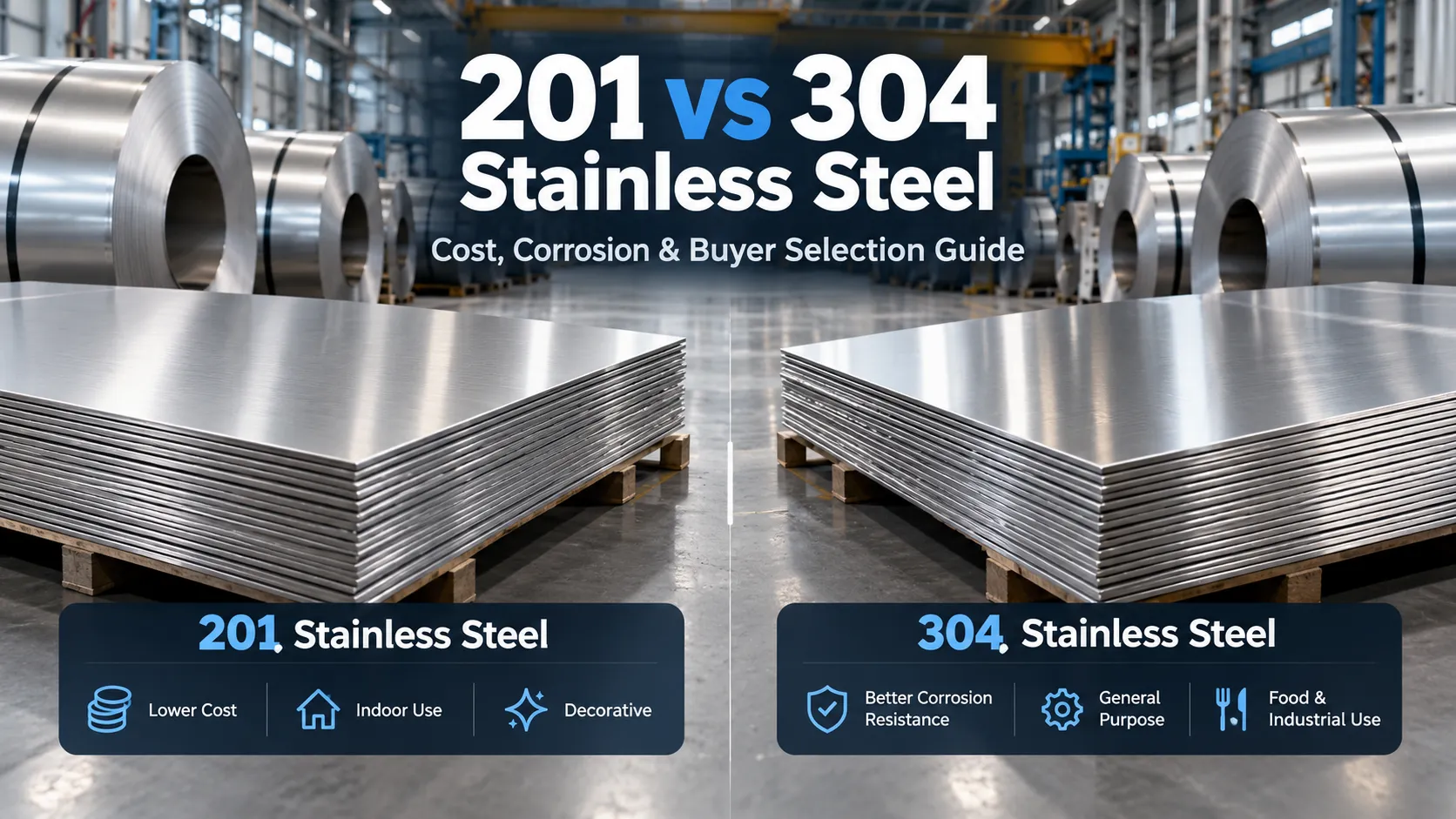
When comparing 201 vs 304 stainless steel, the most important differences are cost, chemical composition, corrosion resistance, formability, and suitability for the intended environment.
201 stainless steel is generally the more economical choice for dry indoor, decorative, and cost-sensitive applications. 304 stainless steel offers better overall corrosion resistance and is usually the more reliable choice for kitchens, equipment exposed to moisture, general outdoor fabrication, and applications where long-term durability matters.
However, 201 is not simply an inferior version of 304. Standard 201 is an austenitic stainless steel with useful strength and work-hardening properties. In certain applications, it can offer a practical balance of material performance and cost.
For international buyers, another important consideration is material verification. Not every product marketed as “201 stainless steel” in the global supply chain necessarily meets the chemical requirements of standardized UNS S20100.
This guide compares 201 and 304 from an engineering and purchasing perspective, including chemical composition, mechanical properties, corrosion performance, cost, fabrication, applications, ASTM specifications, and quality inspection.
201 vs 304 Stainless Steel: Quick Comparison
The following table summarizes the differences between standard 201 and 304 stainless steel.
| Property | 201 Stainless Steel | 304 Stainless Steel |
|---|---|---|
| UNS Designation | S20100 | S30400 |
| Stainless Steel Family | Austenitic, 200 series | Austenitic, 300 series |
| Main Alloying System | Chromium–Manganese–Nickel–Nitrogen | Chromium–Nickel |
| Chromium Content | 16–18% | 18–20% |
| Nickel Content | 3.5–5.5% | 8–10.5% |
| Manganese Content | 5.5–7.5% | Up to 2% |
| Corrosion Resistance | Moderate to good in mild environments | Better general corrosion resistance |
| Chloride Resistance | More limited | Better, but not immune |
| Annealed Strength | Can be higher than 304 | Good general-purpose strength |
| Work Hardening | Relatively rapid | Moderate to high |
| Formability | Good, depending on condition | Generally more versatile |
| Weldability | Weldable with suitable procedures | Generally excellent |
| Magnetic Behavior | Usually weakly magnetic or effectively nonmagnetic when fully austenitic and annealed | Similar; magnetism can increase after cold working |
| Surface Finishes | 2B, BA, No.4, mirror, etc. | 2B, BA, No.4, mirror, etc. |
| Relative Material Cost | Usually lower | Usually higher |
| Dry Indoor Applications | Good choice | Excellent |
| Humid Environments | Requires more careful evaluation | Generally preferable |
| General Outdoor Applications | Limited, environment-dependent | Commonly selected |
| Marine / High-Chloride Conditions | Generally not preferred | May also be inadequate; evaluate 316L or higher |
| Typical Applications | Indoor decorative panels, furniture, trim, light-duty fabrication | Kitchen equipment, sinks, food-processing equipment, industrial components, architectural products |
Quick buying decision: Choose 201 when the environment is relatively mild and controlling initial material cost is important. Choose 304 when corrosion resistance, ease of specification, and broader service suitability justify the higher purchase cost.
Neither grade should be selected solely from this comparison for pressure service, severe chemicals, high-temperature duty, or structural applications with specialized code requirements.
What Is 201 Stainless Steel?
201 stainless steel is an austenitic chromium-manganese-nickel stainless steel belonging to the 200 series.
It was developed as an alternative to higher-nickel austenitic grades, using manganese and nitrogen to replace part of the nickel while maintaining the desired austenitic structure.
Standard 201 stainless steel typically contains:
- 16–18% chromium
- 3.5–5.5% nickel
- 5.5–7.5% manganese
- Controlled nitrogen and carbon additions
Its composition provides useful strength, work-hardening characteristics, corrosion resistance in relatively mild environments, and the ability to receive decorative surface finishes.
Advantages of 201 Stainless Steel
1. Lower alloy cost
The reduced nickel content generally makes 201 less expensive than 304, although market conditions and product specifications affect actual pricing.
2. Good strength
Standard 201 can have higher annealed yield and tensile strength than 304 under comparable product specifications.
3. Strong work-hardening response
Cold working increases the strength and hardness of 201, which can be useful for applications where higher strength after forming is desirable.
4. Attractive surface finish
201 can be polished, brushed, or mirror finished for interior decorative applications.
5. Suitable for cost-sensitive projects
In dry, controlled environments, 201 may provide sufficient performance without the additional corrosion-resistance margin of 304.
Limitations of 201 Stainless Steel
The principal limitation is its reduced corrosion-resistance margin compared with 304 in many service environments.
201 is generally more vulnerable to surface staining, pitting, and corrosion problems where moisture, chlorides, deposits, or aggressive cleaning chemicals are present.
Its high work-hardening rate can also complicate forming operations.
For some applications, higher springback, tooling loads, or reduced formability in cold-worked conditions must be considered.
Steel1Stop supplies 201 stainless steel sheet for decorative and industrial fabrication projects where the selected grade and operating environment are appropriate.
What Is 304 Stainless Steel?
304 stainless steel is one of the most widely specified austenitic stainless steel grades worldwide.
It is commonly described as 18/8 stainless steel because its typical composition contains approximately 18% chromium and 8% nickel.
Standard 304 stainless steel contains:
- 18–20% chromium
- 8–10.5% nickel
- Up to 2% manganese
- Controlled carbon, silicon, phosphorus, sulfur, and nitrogen
This composition provides a well-established combination of corrosion resistance, formability, weldability, toughness, and general-purpose manufacturing performance.
Advantages of 304 Stainless Steel
1. Better general corrosion resistance
304 generally provides more reliable performance than 201 in humid environments, outdoor exposure, and many industrial applications.
2. Excellent fabrication versatility
304 can be cut, bent, stamped, welded, and polished using widely established manufacturing methods.
3. Broad international acceptance
304 is familiar to engineers, OEM manufacturers, equipment builders, and international procurement teams.
4. Wide product availability
It is supplied in sheets, plates, coils, strips, bars, pipes, tubes, and many fabricated components.
5. Suitable for many hygiene-sensitive applications
304 is widely used in food-processing and kitchen equipment because its corrosion resistance and cleanability make it suitable for many intended service conditions.
Limitations of 304 Stainless Steel
304 generally costs more than 201 because of its greater nickel content.
It is also not completely corrosion-proof.
Chloride-rich conditions can cause pitting and crevice corrosion, even in 304.
Highly aggressive marine, chemical, and elevated-temperature chloride applications may require 316L, duplex stainless steel, or other corrosion-resistant alloys.
For general-purpose stainless procurement, see Steel1Stop’s 304 stainless steel sheet and our 304 stainless steel guide.
Chemical Composition: 201 vs 304 Stainless Steel
The largest fundamental difference between the two grades is chemical composition.
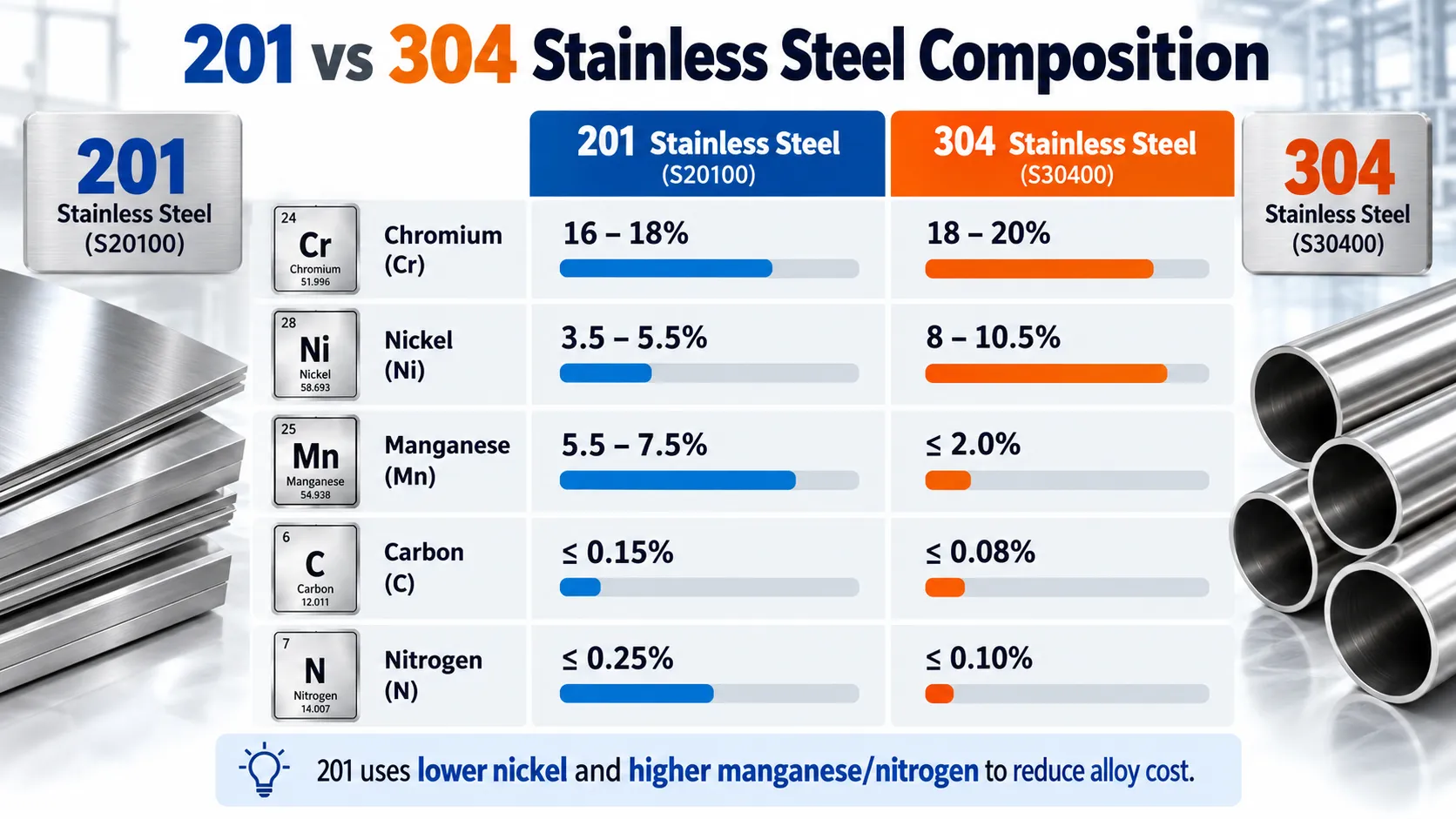
Chemical Composition Table
| Element | 201 (UNS S20100) | 304 (UNS S30400) |
|---|---|---|
| Chromium (Cr) | 16.0–18.0% | 18.0–20.0% |
| Nickel (Ni) | 3.5–5.5% | 8.0–10.5% |
| Manganese (Mn) | 5.5–7.5% | ≤2.0% |
| Carbon (C) | ≤0.15% | ≤0.08% |
| Nitrogen (N) | ≤0.25% | ≤0.10% |
| Silicon (Si) | ≤1.00% | ≤1.00% |
| Phosphorus (P) | ≤0.060% | ≤0.045% |
| Sulfur (S) | ≤0.030% | ≤0.030% |
| Iron (Fe) | Balance | Balance |
These values represent commonly specified standardized grade limits. Final compliance must be checked against the edition of the governing product standard. Commercially named low-nickel 201 variants may have very different chemistry.
Why Does 201 Contain Less Nickel?
Nickel helps stabilize the austenitic crystal structure in stainless steel.
It also influences material behavior during fabrication and contributes to the overall properties of the alloy system.
Because nickel is a relatively expensive alloying element, reducing nickel content can lower the raw-material cost.
In 201, increased manganese and nitrogen help stabilize the austenitic structure while maintaining useful mechanical properties.
This is the main economic reason 201 is often cheaper than 304.
Why Does Chromium Matter?
Chromium is essential to stainless steel corrosion resistance.
It forms a thin, protective, chromium-rich oxide film on the surface.
This passive film helps protect the underlying metal against corrosion.
304 has a higher specified chromium range than 201 and usually offers a greater corrosion-resistance margin under many practical conditions.
However, corrosion performance cannot be predicted from chromium alone.
Nickel, nitrogen, other alloying elements, surface condition, temperature, chloride concentration, and fabrication quality also affect performance.
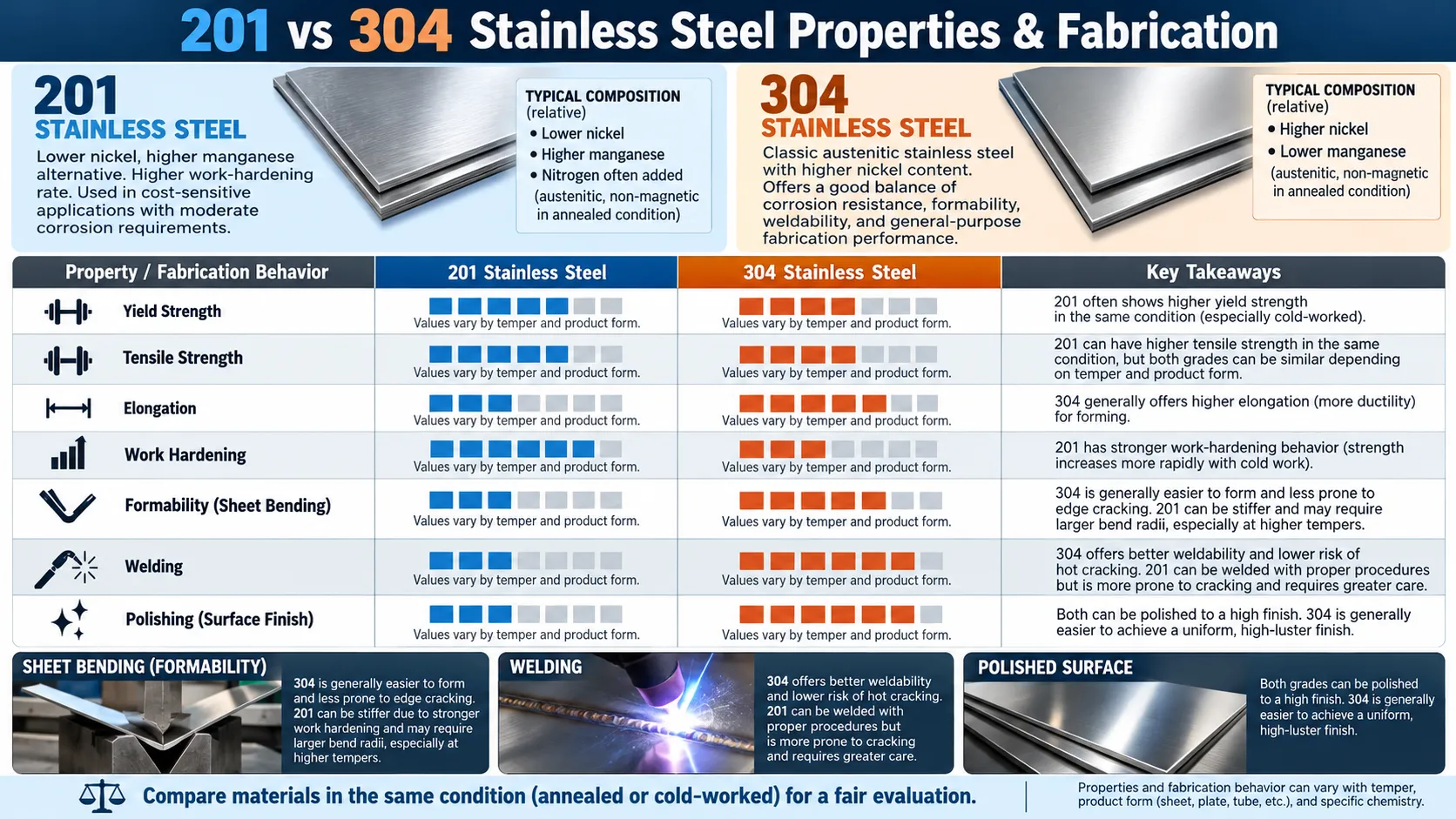
Mechanical Properties: Is 201 Stronger Than 304?
A common misconception is that 304 must be stronger because it is usually more expensive.
In fact, standard 201 can have higher minimum yield and tensile strength than 304 in the annealed condition.
The distinction between strength and corrosion resistance is important.
A material can have higher mechanical strength while being less resistant to a particular corrosive environment.
Mechanical Property Comparison
The following table shows representative published minimum requirements for annealed flat products under commonly referenced ASTM A240 data.
| Mechanical Property | 201 / S20100 | 304 / S30400 |
|---|---|---|
| Tensile Strength, Minimum | 655 MPa | 515 MPa |
| 0.2% Yield Strength, Minimum | 310 MPa | 205 MPa |
| Elongation, Minimum | 40% | 40% |
| Elastic Modulus | Approximately 200 GPa | Approximately 193–200 GPa |
| Work-Hardening Behavior | Relatively high | Lower than 201 in many comparable conditions |
These are representative published values, not universal guaranteed values for every product sold as 201 or 304. ASTM requirements may include different material types or conditions. Confirm mechanical requirements in the current applicable standard, purchase order, and mill test certificate.
Tensile Strength
Tensile strength describes the maximum tensile stress a material can withstand before fracture.
201 can offer high tensile strength due to its alloying system and work-hardening behavior.
304 also provides good tensile strength and is widely used for general-purpose fabricated components.
Yield Strength
Yield strength is the stress at which permanent plastic deformation begins.
For structural brackets, formed parts, supports, and other mechanical components, yield strength may be more important than ultimate tensile strength.
Although standard 201 may offer higher yield strength, that does not automatically make it the better choice for every load-bearing application.
Corrosion, welding, fatigue, temperature, geometry, and applicable design codes must also be considered.
Work Hardening
201 generally work-hardens more rapidly than 304.
During rolling, forming, or other plastic deformation, its strength and hardness increase.
This can provide useful strengthening but may also result in:
- Higher forming loads
- Greater springback
- Increased tool wear
- More demanding deep-drawing operations
- Lower remaining ductility in heavily cold-worked conditions
304 is often preferred for manufacturing operations where balanced formability, established processing procedures, and corrosion resistance are important.
Corrosion Resistance: Does 201 Rust More Easily Than 304?
In many common environments, 201 has a higher risk of corrosion than 304.
This difference becomes especially important when stainless steel is exposed to moisture, chloride-containing water, salt deposits, or aggressive cleaning chemicals.
Both grades rely on their chromium-rich passive surface film.
When the environment damages this protective film faster than it can recover, localized corrosion may begin.
Why Stainless Steel Can Rust
Stainless steel is corrosion-resistant, not completely rust-proof.
Common causes of corrosion include:
- Chloride contamination
- Saltwater exposure
- Persistent moisture
- Deposits and crevices
- Aggressive cleaning chemicals
- Surface contamination from carbon steel
- Inadequate weld cleaning
- Poor drainage
- Incorrect grade selection
For a more detailed explanation, see our article on metals that do not rust.
201 vs 304 in Different Environments
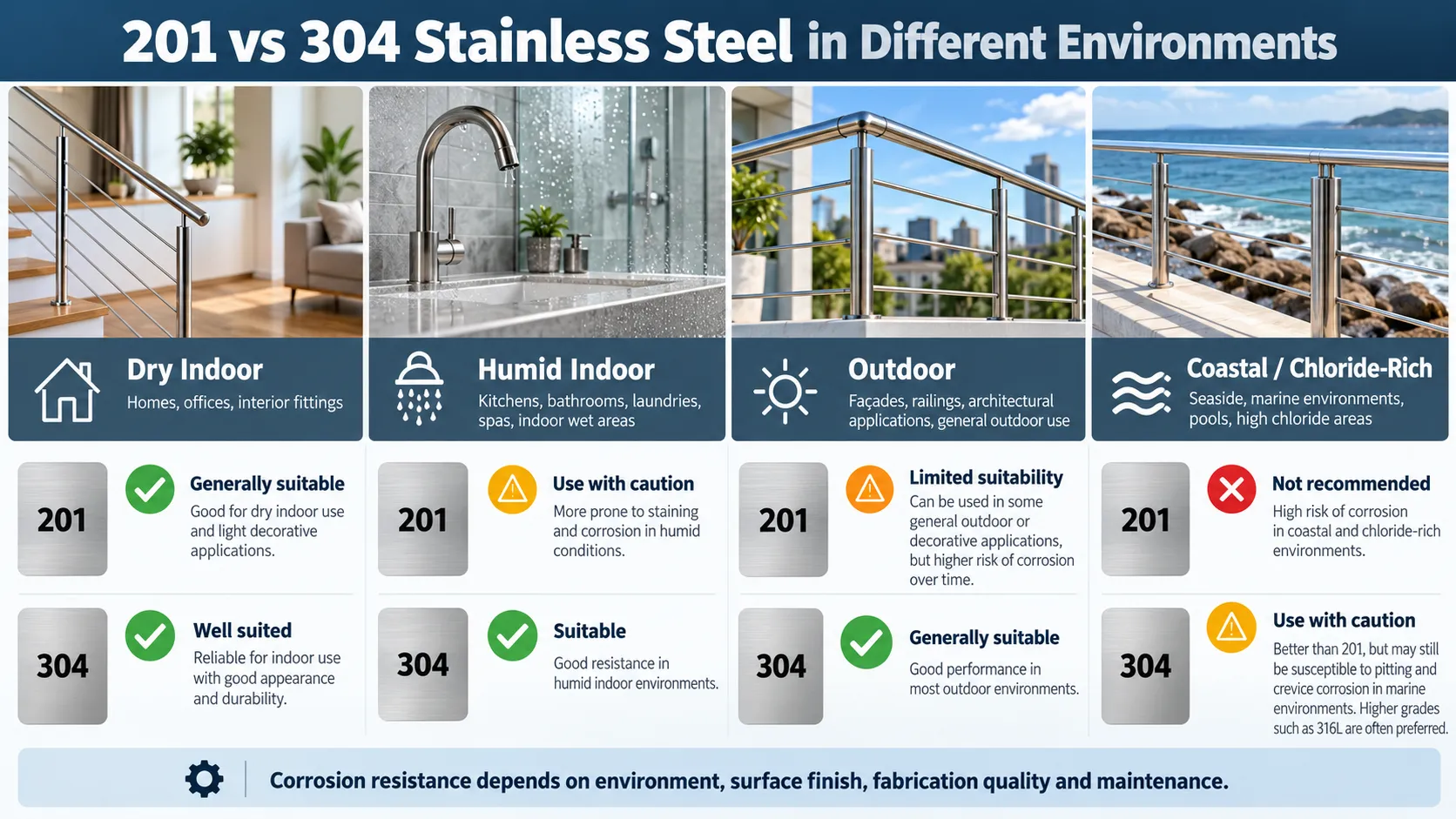
| Service Environment | 201 Stainless Steel | 304 Stainless Steel |
|---|---|---|
| Dry indoor offices | Generally suitable | Excellent |
| Indoor decorative wall panels | Generally suitable | Excellent |
| Indoor furniture | Often suitable | Excellent |
| Humid bathrooms | Evaluate carefully | Usually preferable |
| Commercial kitchens | Application-dependent | Commonly preferred |
| General inland outdoor exposure | Limited; careful assessment required | Often suitable |
| Outdoor railings | Higher corrosion risk | Common starting point |
| Swimming pool environments | Generally not preferred | May still be inadequate |
| Coastal atmosphere | Generally not preferred | Requires careful assessment |
| Direct seawater exposure | Not recommended as a general choice | Often inadequate; select by engineering requirements |
| Strong chemical environments | Application-specific | Application-specific; may require higher alloys |
The table is a preliminary selection guide rather than a guarantee of corrosion performance.
Dry Indoor Environments
201 often performs satisfactorily in clean, dry indoor locations.
Examples include:
interior decorative panels, office furniture, elevator interiors, and architectural trim.
In these conditions, the extra corrosion margin of 304 may not always justify its additional material cost.
Humid Environments
Humidity changes the selection decision.
When moisture remains on the surface, corrosion risk increases.
Bathrooms, commercial kitchens, laundries, and facilities with frequent washing may expose the metal to water, cleaning chemicals, and deposits.
304 is generally the safer starting choice for many of these conditions.
Outdoor Environments
Outdoor stainless steel is exposed to rain, pollution, changing temperatures, and deposited contaminants.
304 generally performs better than 201 in ordinary atmospheric environments.
However, the actual suitability of 304 depends on the exposure severity and maintenance conditions.
Coastal and Chloride-Rich Environments
Chlorides can cause pitting and crevice corrosion.
304 is more resistant than 201 in many chloride-containing conditions, but it is not immune.
For coastal railings, marine equipment, and other chloride-exposed applications, 316L is often a better starting point.
In severe seawater service, even 316L may be insufficient.
The material must be selected according to chloride level, temperature, crevice conditions, and the relevant engineering requirements.
201 vs 304 Stainless Steel Price: Which Is Cheaper?
201 stainless steel generally has a lower initial material cost than 304.
The main reason is its reduced nickel content.
However, buyers should distinguish between:
lower material price and lower total project cost.
The cheapest grade to purchase is not always the most economical material over the product’s full service life.
What Affects Stainless Steel Prices?
The delivered price of stainless steel can depend on:
| Cost Factor | Why It Matters |
|---|---|
| Nickel Price | Especially important for 304 alloy cost |
| Chromium and Manganese | Influence alloy production cost |
| Steel Mill | Different production routes and specifications |
| Grade | 201, 304, 304L, 316L, etc. |
| Product Form | Sheet, coil, plate, strip, tube |
| Thickness | Affects rolling and processing cost |
| Surface Finish | 2B, BA, No.4, mirror, decorative treatments |
| Quantity | Order scale and production efficiency |
| Cutting / Processing | Additional fabrication requirements |
| Packing | Export preparation |
| Freight | Transport route and destination |
| Certification | Documentation and testing requirements |
The price difference between 201 and 304 changes over time.
A fixed statement such as “201 is always 30% cheaper” should not be used as a procurement assumption without a current quotation.
Initial Cost vs. Total Cost of Ownership
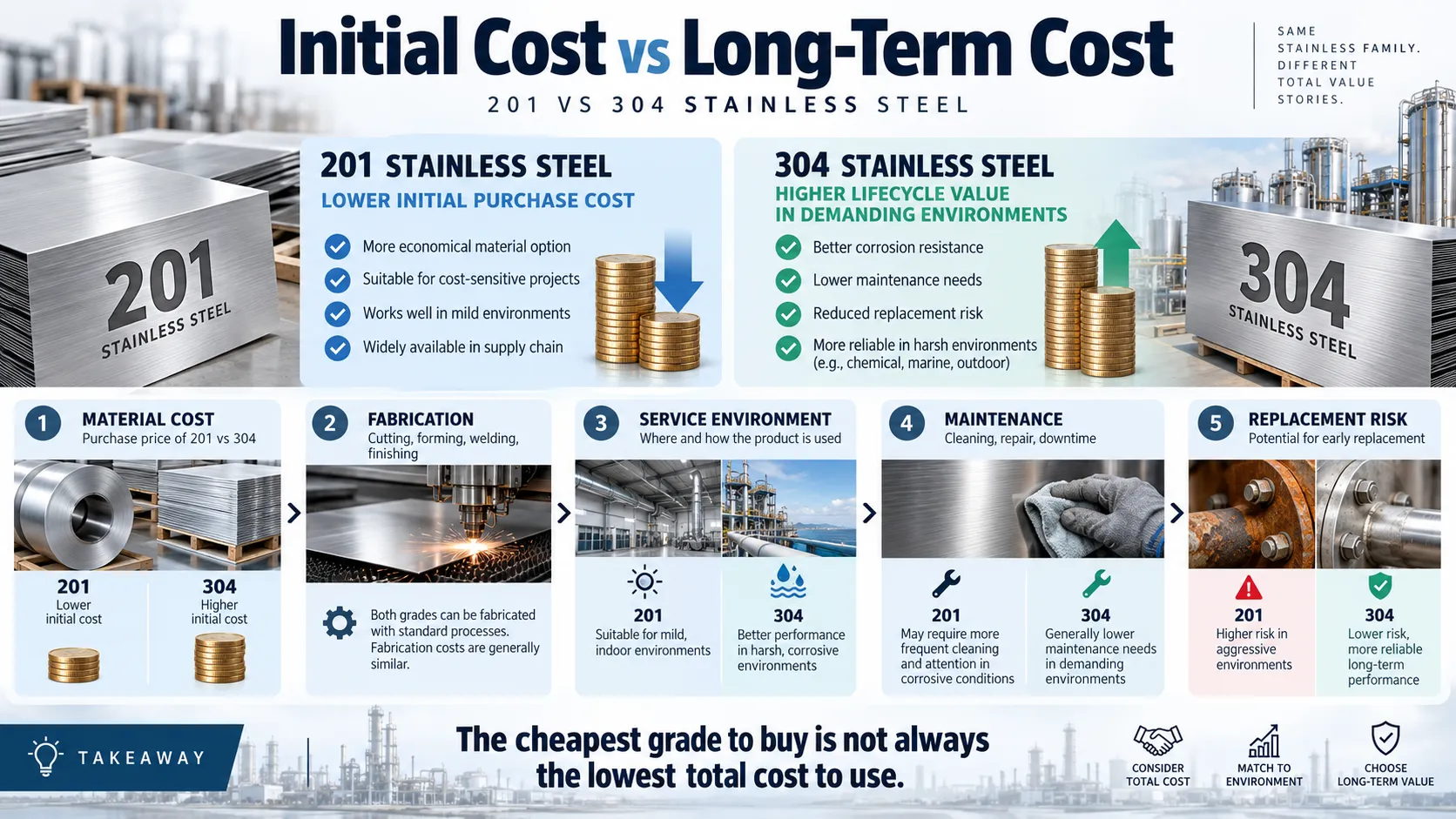
A practical comparison should include:
Total Cost = Material + Fabrication + Installation + Maintenance + Downtime + Replacement
Consider two illustrative scenarios.
Scenario A: Indoor Decorative Panels
A commercial building requires stainless decorative sheets for a dry interior.
The material is not regularly exposed to water, chlorides, or aggressive cleaners.
If standard 201 meets the design requirements, it may reduce procurement cost without creating significant additional maintenance risk.
Scenario B: Frequently Washed Industrial Equipment
An OEM manufacturer requires stainless steel for equipment exposed to moisture and repeated cleaning.
Using lower-cost 201 may create additional corrosion or staining risk.
If the component needs repair or replacement, the initial material savings can disappear.
In this case, 304 may provide better total value.
The correct decision depends on the actual operating environment, maintenance schedule, product life expectations, and commercial requirements.
Welding, Bending, Cutting and Polishing: 201 vs 304
Material selection also affects fabrication.
Both 201 and 304 can be processed using common stainless steel manufacturing methods, but differences in work hardening, composition, and corrosion performance matter.
Bending and Forming
304 is widely used for bending, stamping, and deep drawing.
Its balanced ductility and established processing behavior make it a common material for complex sheet-metal components.
201 can also be formed, but its rapid work hardening can increase forming loads and springback.
For deep drawing or complex bends, the exact material condition becomes particularly important.
A heavily cold-worked 201 sheet may behave very differently from an annealed sheet of the same nominal grade.
Welding
Both 201 and 304 can be welded using suitable procedures.
304 is widely used for welded fabrication because of its established welding characteristics and broad availability.
For welded assemblies requiring good corrosion resistance, 304L is frequently considered because its lower carbon content reduces sensitization risk.
201 can also be welded, but filler selection, heat input, weld design, and post-weld surface condition should be evaluated.
The actual carbon level and specification of the supplied material must be known.
Laser Cutting
Both grades can be laser cut using suitable equipment.
Cutting quality depends on:
- Material thickness
- Laser power
- Assist gas
- Cutting speed
- Surface condition
- Equipment settings
The general alloy designation alone does not determine cutting quality.
Surface Polishing
Both 201 and 304 can achieve attractive polished or mirror finishes.
Common stainless steel finishes include:
| Finish | Description | Common Use |
|---|---|---|
| No.1 | Hot-rolled, annealed and pickled | Industrial plate |
| 2B | Cold-rolled, annealed, pickled, skin-passed | General-purpose sheet |
| BA | Bright annealed | Reflective sheet and decorative products |
| No.4 | Mechanically polished satin finish | Kitchens, panels, equipment |
| Hairline | Directional brushed appearance | Architecture and interiors |
| No.8 / Mirror | Highly reflective polished finish | Decorative applications |
Neither appearance nor polish level proves whether the material is 201 or 304.
For decorative applications, Steel1Stop also supplies colored stainless steel sheet in multiple grades and surface finishes.
Is 201 Stainless Steel Magnetic? What About 304?
A common online claim is:
“201 is magnetic, while 304 is non-magnetic.”
This is unreliable.
Both standard 201 and 304 are austenitic stainless steels. In a fully austenitic, annealed condition, both usually show little or no attraction to an ordinary magnet.
However, cold working can cause some austenite to transform into magnetic martensite.
This means that a stainless steel sheet may become more magnetic after:
- Rolling
- Bending
- Deep drawing
- Mechanical deformation
- Certain fabrication operations
Magnetic response also depends on exact chemical composition and microstructure.
Therefore, a magnet cannot reliably determine whether a material is 201 or 304.
If alloy identity matters, use appropriate material documentation and chemical analysis rather than magnetic testing alone.
Is 201 Stainless Steel Food Grade?
This question requires more care than a simple yes-or-no answer.
A stainless steel grade number by itself does not automatically establish that a finished product is suitable or compliant for every food-contact application.
Food-contact suitability depends on:
- Material composition
- Food chemistry
- Contact time
- Temperature
- Cleaning procedures
- Sanitizing chemicals
- Corrosion resistance
- Surface condition
- Equipment design
- Applicable local regulations
304 is widely used for commercial kitchen and food-processing equipment because it provides a well-established combination of corrosion resistance, cleanability, and fabrication performance.
201 may be suitable for certain food-related applications under appropriate conditions, but its corrosion limitations should be assessed.
For equipment exposed to aggressive foods, frequent sanitation, or chloride-containing cleaning agents, choosing a more corrosion-resistant grade may be important.
In the United States, food-processing equipment must meet applicable requirements for sanitary design, corrosion-resistant food-contact surfaces, and appropriate materials for the intended environment.
Similarly, describing a material as “FDA-approved stainless steel” solely because it is 304 is misleading.
Product compliance depends on the applicable regulatory and product requirements, not just the alloy designation.
China 201 Stainless Steel: J1, J2, J3 and J4 Explained
For international buyers sourcing stainless steel from China, this is one of the most important distinctions in the entire comparison.
In global specifications, 201 stainless steel normally refers to a standardized grade such as UNS S20100.
However, in parts of the Chinese stainless steel market, the term “201” is also used commercially for lower-nickel chromium-manganese stainless products.
Some of these materials are identified using labels such as:
201 J1, J2, J3, J4, or J5.
These are commercial designations, not universally harmonized replacements for UNS S20100.
Why Do Different 201 Variants Exist?
Different commercial grades are produced to balance:
- Nickel cost
- Chromium content
- Manganese content
- Copper additions
- Hardness
- Ductility
- Formability
- Surface appearance
- Intended applications
For example, a manufacturer making simple decorative tubes may prioritize low cost and hardness.
A manufacturer producing deep-drawn components may need better ductility.
These different requirements can lead to significantly different alloy recipes.
Are J1, J2, J3 and J4 Standard ASTM Grades?
No. They should not automatically be treated as standardized ASTM grades.
Their commercial meanings and chemistry may differ between mills and suppliers.
A commonly encountered market distinction is:
| Commercial Label | Typical Market Positioning | Buyer Should Verify |
|---|---|---|
| J1 | General fabrication and forming | Chemistry, elongation, hardness |
| J2 | Cost-sensitive or relatively hard material | Formability, carbon, nickel, chromium |
| J3 | General decorative fabrication | Actual composition and forming performance |
| J4 | Often promoted for improved forming | Copper content, elongation, actual chemistry |
| Other “201” variants | Supplier-specific products | Complete mill specification |
These descriptions are not official chemical specifications.
There is no universal chemical table that should be applied to every producer’s J1, J2, J3, or J4 designation.
Why This Matters to Buyers
Suppose an overseas buyer issues an inquiry simply stating:
“201 stainless steel sheet, 1.0 mm, 2B finish.”
Different suppliers may interpret the request differently.
One may quote standard UNS S20100.
Another may quote a commercially designated low-nickel stainless product.
Both might be described in informal sales language as “201 stainless steel,” even though their actual chemical compositions differ.
This can create differences in:
- Corrosion performance
- Fabrication behavior
- Material certification
- Price
- Contract compliance
How to Avoid Grade Confusion
When buying standardized 201, state the complete designation:
201 / UNS S20100
Then specify:
- Applicable material standard
- Required chemical limits
- Product form and dimensions
- Mechanical-property requirements
- Surface finish
- Required mill test certificate
- Inspection or PMI requirements
If a commercially designated J-grade is acceptable, identify the approved chemistry and performance requirements explicitly.
Do not purchase solely based on the commercial label “201” when the application depends on a particular standardized composition.
How to Identify 201 vs 304 Stainless Steel
201 and 304 can look nearly identical.
Color, polish, surface texture, and ordinary visual inspection are not reliable methods for identifying the grade.
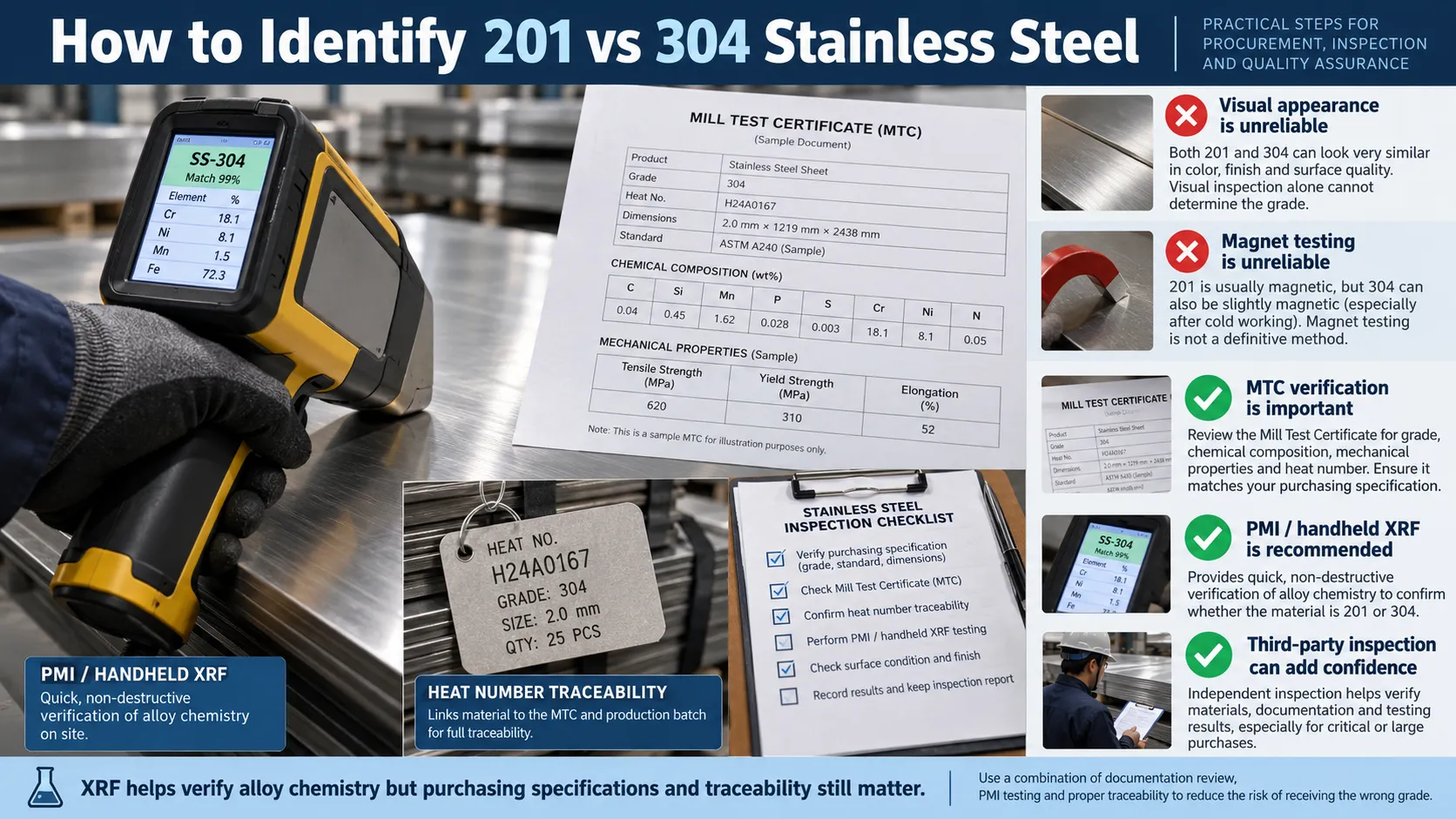
Material identification should combine documentation, traceability, and appropriate analysis. Magnet response alone is not a reliable test for either grade.
1. Check the Mill Test Certificate
A Mill Test Certificate (MTC), sometimes called a Mill Test Report (MTR), records material information such as:
- Manufacturer or mill
- Grade
- Heat number
- Product dimensions
- Chemical composition
- Mechanical properties
- Referenced standards
- Inspection results
For international purchasing, request the certificate type required by the purchase order.
For example, EN 10204 Type 3.1 is widely used for specified inspection documentation.
2. Verify the Heat Number
The heat number helps connect material to its production batch and certificate.
Check that the identification on the material, package, or traceability documentation corresponds to the certificate.
The certificate should match the material supplied.
3. Use Handheld XRF / PMI
Handheld X-ray fluorescence (XRF) analysis is a common method for Positive Material Identification (PMI).
It can help verify major alloying elements such as:
- Chromium
- Nickel
- Manganese
- Molybdenum
This is particularly useful when separating standard 201 from 304 because their nickel and manganese contents differ considerably.
However, handheld XRF has limitations.
Standard handheld XRF cannot reliably measure carbon or nitrogen.
It is therefore not sufficient by itself to verify every chemical requirement or distinguish certain grades where light-element content is critical.
4. Use Laboratory Chemical Analysis When Necessary
For projects requiring full chemical verification, methods such as optical emission spectroscopy (OES) or suitable laboratory analysis may be required.
This is especially relevant when carbon and nitrogen limits affect material acceptance.
5. Consider Third-Party Inspection
For large orders or critical projects, independent inspection can help verify:
- Material identity
- Chemical composition
- Dimensional tolerance
- Surface quality
- Quantity
- Packing
- Documentation
Inspection requirements should be agreed before production or shipment.
201 vs 304 Stainless Steel: Which Is Better for Your Application?
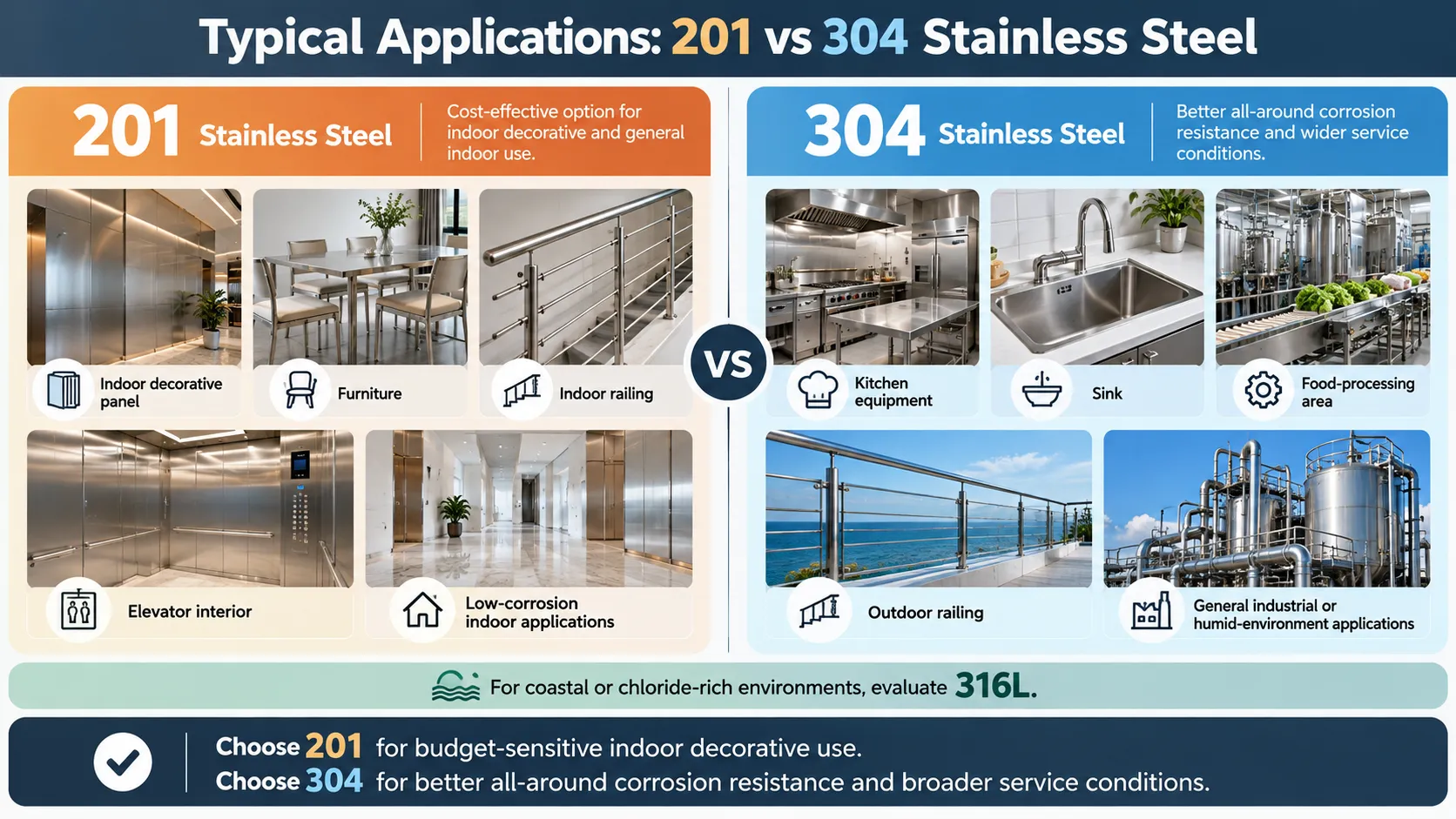
Choosing the appropriate grade should begin with the intended service environment.
| Application | Recommended Starting Point | Main Consideration |
|---|---|---|
| Elevator Interior | 201 / 304 | Dry indoor exposure and appearance |
| Decorative Wall Panel | 201 | Cost and finish |
| Indoor Furniture | 201 / 304 | Budget and cleaning |
| Indoor Stair Railing | 201 / 304 | Humidity and maintenance |
| Outdoor Handrail | 304 | Atmospheric corrosion |
| Coastal Railing | 316L or higher | Chloride exposure |
| Commercial Kitchen Table | 304 | Cleaning and corrosion resistance |
| Kitchen Sink | 304 | Water, detergents and forming |
| Food-Processing Equipment | 304 / 316L | Food chemistry and sanitation |
| Decorative Stainless Tube | 201 / 304 | Indoor vs outdoor environment |
| General Industrial Enclosure | 304 | Corrosion requirements |
| Storage Tank | Application-specific | Stored liquid, temperature, pressure |
| Architectural Cladding | 201 / 304 / 316L | Exposure severity |
| Pharmaceutical Equipment | Application-specific | Cleaning, process chemistry, regulatory requirements |
| Chemical Process Equipment | Application-specific | Exact chemical compatibility |
| Swimming Pool Components | Often higher alloys | Chloride exposure and corrosion risk |
201 vs 304 for Indoor Decoration
201 is often a practical option for dry indoor decorative applications.
Its polished appearance can be comparable to 304 while offering a lower initial material cost.
Typical uses include:
- Elevator interior panels
- Office decoration
- Furniture components
- Wall cladding
- Interior trim
However, if the environment involves frequent washing, chlorides, or aggressive cleaning products, 304 may be preferable.
201 vs 304 for Outdoor Railings
304 is usually the better starting point for general outdoor railings.
Outdoor exposure introduces rain, atmospheric contamination, and repeated wet-dry cycles.
201 may be vulnerable to staining and localized corrosion under these conditions.
For coastal railings, 316L or a higher-alloy material may be necessary.
201 vs 304 for Kitchen Equipment
304 is generally preferred for many commercial kitchen applications.
It offers good resistance to common cleaning conditions and is widely used for sinks, worktables, and kitchen equipment.
However, the food chemistry, detergents, temperature, surface finish, and cleaning frequency still need consideration.
201 vs 304 for Stainless Steel Pipes
The choice depends on whether the pipe is decorative or performs a process function.
For dry indoor decorative tubing, 201 may provide adequate performance.
For industrial piping, fluid handling, or more corrosive service, the choice must consider:
- Medium being conveyed
- Pressure and temperature
- Applicable piping standard
- Welding
- Corrosion requirements
- Mechanical properties
A decorative tube and a pressure-rated process pipe are not interchangeable simply because they have the same outside diameter.
When Should You Choose 304L, 316L or 430 Instead?
Sometimes neither 201 nor standard 304 is the best option.
304L Stainless Steel
304L is a low-carbon version of 304.
It is often selected for welded fabrication where reducing susceptibility to sensitization and intergranular corrosion is important.
The lower carbon content is especially relevant in thicker welded sections and applications exposed to susceptible service conditions.
316L Stainless Steel
316L contains molybdenum and generally offers improved resistance to chloride-related localized corrosion compared with 304.
It is frequently considered for:
- Coastal installations
- Marine-related structures
- Certain chemical equipment
- Process systems exposed to chlorides
However, 316L must still be evaluated against the specific service conditions.
430 Stainless Steel
430 is a ferritic stainless steel with little or no intentional nickel addition.
It may be a cost-effective alternative for certain appliance, decorative, and moderately corrosive applications.
Unlike 201 and 304, 430 is generally magnetic.
Its forming, welding, and corrosion characteristics are also different.
The best stainless steel grade is the one that matches the complete application—not simply the most expensive grade or the lowest-priced material.
ASTM Standards for 201 and 304 Stainless Steel
For industrial procurement, the applicable product standard is essential.
A stainless steel grade designation is not a complete purchase specification.
Different product forms can require different standards.
| Standard | General Application |
|---|---|
| ASTM A240/A240M | Stainless steel plate, sheet and strip for applicable general and pressure-vessel uses |
| ASTM A480/A480M | General requirements for flat-rolled stainless and heat-resisting steel products |
| ASTM A554 | Welded stainless steel mechanical tubing |
| ASTM A269/A269M | Seamless and welded austenitic stainless steel tubing for specified general service |
| ASTM A312/A312M | Seamless, welded, and heavily cold-worked austenitic stainless steel pipe |
| ASTM A666 | Annealed or cold-worked austenitic stainless steel sheet, strip, plate and flat bar under its scope |
| EN 10088 | European stainless steel designation and product-related specification series |
| EN 10204 | Metallic product inspection-document types |
Not every listed standard covers every stainless steel grade or product form.
Before purchasing, confirm that the required grade, form, condition, dimensions, and service application fall within the chosen specification.
ASTM A240/A240M for Stainless Steel Sheet and Plate
ASTM A240/A240M covers applicable stainless steel plate, sheet, and strip.
It includes requirements for chemical composition and mechanical properties.
For a purchase of 304 stainless steel sheet, the material could be ordered using a specification such as:
ASTM A240/A240M, UNS S30400, annealed, 2B finish, specified dimensions and tolerances.
For 201, use the appropriate standard grade and defined material type or condition.
ASTM A480/A480M for Dimensional Requirements
ASTM A480/A480M provides general requirements for applicable flat-rolled stainless products.
For buyers, this is important because a quotation must consider more than nominal sheet thickness.
Confirm:
- Thickness tolerances
- Width and length requirements
- Flatness
- Surface condition
- Edge requirements
- Inspection
- Documentation
Mechanical Tubing vs. Process Piping
If the order is for decorative or mechanical tubing, a standard such as ASTM A554 may be relevant.
If the material is intended for process piping or pressure applications, the applicable piping standard and design code must be identified separately.
A supplier should never assume that all stainless tubes are governed by the same standard.
Stainless Steel Procurement Checklist for International Buyers
A complete request for quotation makes it easier to compare suppliers and avoid material substitution.
| Specification Item | Example / Requirement |
|---|---|
| Product | Stainless Steel Sheet |
| Grade | 201 / S20100 or 304 / S30400 |
| Standard | ASTM A240/A240M |
| Material Condition | Annealed / specified cold-worked condition |
| Thickness | 1.0 mm |
| Width | 1219 mm |
| Length | 2438 mm |
| Surface Finish | 2B / No.4 / BA / Mirror |
| Quantity | Sheets / metric tons |
| Chemical Requirements | Per specified grade and standard |
| Mechanical Requirements | Per standard / approved drawing |
| MTC | Required certificate type |
| PMI | If required |
| Edge / Cutting | Mill edge / slit edge / cut to size |
| Packaging | Export packing requirements |
| Delivery Terms | EXW / FOB / CFR / CIF as agreed |
| Destination | Country and port |
| Additional Inspection | Third-party or customer requirements |
Example RFQ for 304 Stainless Steel Sheet
A purchasing specification might read:
Product: 304 Stainless Steel Sheet
Grade: UNS S30400
Standard: ASTM A240/A240M
Thickness: 1.0 mm
Size: 1219 × 2438 mm
Finish: 2B
Quantity: 10 metric tons
Documentation: MTC with heat traceability
Additional Requirements: Export seaworthy packing
Destination: To be advised
This is substantially clearer than requesting only:
“Stainless steel 304, best price.”
What to Verify Before Shipment
For significant orders, verify the following:
- The grade on the purchase order matches the MTC.
- The chemical composition meets the specified limits.
- Mechanical-property documentation is consistent with the standard and product condition.
- Dimensions and tolerances meet the contract.
- Surface finish matches the approved specification.
- Heat identification is traceable.
- Quantity and packaging are correct.
- Required inspection records are available.
These checks are especially important when sourcing stainless steel from multiple mills or purchasing commercially designated low-nickel materials.
Frequently Asked Questions
Is 201 stainless steel cheaper than 304?
Generally, yes. Standard 201 contains less nickel, which often reduces its raw-material cost. The actual price difference depends on alloy markets, mill, product form, thickness, finish, order quantity, and processing requirements.
Does 201 stainless steel rust?
201 is corrosion-resistant but can develop staining, pitting, or other corrosion in unfavorable conditions. It is generally less resistant than 304 in many wet or chloride-containing environments.
Does 304 stainless steel rust?
Yes, 304 can corrode under sufficiently aggressive conditions. Chlorides, persistent deposits, crevices, contamination, and unsuitable cleaning chemicals can cause corrosion despite its generally good performance.
Is 201 stronger than 304?
Standard 201 can have higher minimum yield and tensile strength than 304 in the annealed condition. However, strength depends on the exact product standard, material condition, and manufacturing process.
Which stainless steel is better for outdoor use?
304 is generally preferable to 201 for ordinary outdoor exposure. For coastal or chloride-rich environments, 316L or higher-alloy materials may be required.
Is 201 stainless steel food grade?
Food-contact suitability cannot be established by grade number alone. The material must meet applicable requirements for its intended food, temperature, cleaning conditions, and equipment design. 304 is more widely selected for many commercial food-contact applications.
Can 201 stainless steel replace 304?
In some dry indoor decorative applications, yes, if the material meets the project’s performance and specification requirements. Substitution should not be made automatically for outdoor, hygienic, corrosive, or code-controlled applications.
How can I tell 201 from 304 stainless steel?
Use a mill test certificate, heat-number traceability, and appropriate chemical analysis such as handheld XRF/PMI. Visual appearance and magnet testing are not reliable grade-identification methods.
Is 201 stainless steel magnetic?
Annealed, fully austenitic standard 201 generally has low magnetic permeability. Cold working can increase its magnetic response. A magnet cannot reliably distinguish 201 from 304.
What is the main chemical difference between 201 and 304?
201 contains substantially less nickel and more manganese and nitrogen. 304 contains more chromium and nickel and generally provides better overall corrosion resistance.
Which grade is better for a kitchen sink?
304 is a widely used and generally preferable starting choice because of its corrosion resistance and formability. Exact suitability also depends on water chemistry, cleaning chemicals, and intended service conditions.
Can 201 stainless steel be welded?
Yes. Appropriate welding procedures and filler materials are required. The grade’s chemistry, material condition, service environment, and required post-weld corrosion resistance must be considered.
Is 304 stainless steel worth the extra cost?
Often yes when the environment exposes the material to moisture, repeated cleaning, or other corrosion risks. For dry decorative applications, 201 may be more economical if it meets the project requirements.
What is the difference between standard 201 and 201 J1/J2/J3/J4?
Standard UNS S20100 is a defined stainless steel grade. J1, J2, J3, and J4 are commercial market designations that may represent different lower-nickel material recipes. Their chemical compositions must be verified rather than assumed.
Which is better: 201, 304 or 316L?
Choose based on the environment. 201 can be suitable for mild indoor applications. 304 offers broader general corrosion resistance. 316L is often preferred where chloride exposure is more demanding, although some environments require even higher-alloy materials.
Final Verdict: 201 or 304 Stainless Steel?
The difference between 201 and 304 stainless steel is not simply that one is cheap and the other is expensive.
They are different austenitic alloy systems designed around different combinations of composition, strength, cost, corrosion performance, and manufacturing behavior.
Choose 201 stainless steel when:
- The application is mainly indoors.
- Corrosion exposure is relatively mild.
- Material cost is a major consideration.
- The required forming and mechanical properties can be met.
- Standardized chemistry or an approved commercial composition has been verified.
Choose 304 stainless steel when:
- Better general corrosion resistance is important.
- The product may be exposed to moisture or ordinary outdoor environments.
- The application involves frequent cleaning.
- The buyer requires a widely standardized general-purpose grade.
- Long-term maintenance and replacement risks matter.
For coastal, severe chloride, and chemical environments, do not assume 304 is always sufficient. Evaluate 316L or other appropriate alloys according to the service conditions.
Most importantly, buyers should specify the exact grade, product standard, dimensions, material condition, surface finish, and inspection requirements.
When sourcing stainless steel internationally, a clear purchasing specification and reliable material verification are just as important as obtaining a competitive price.
At Steel1Stop, we support international buyers sourcing carbon steel, stainless steel, and aluminum materials for manufacturing, construction, fabrication, and industrial applications.
For current specifications and purchasing options, explore our 201 stainless steel sheet and 304 stainless steel sheet product pages. Buyers requiring narrower flat products can also refer to our stainless steel strip guide.
Selecting the correct grade at the purchasing stage helps control cost, avoid material substitution, and improve product performance throughout its intended service life.