
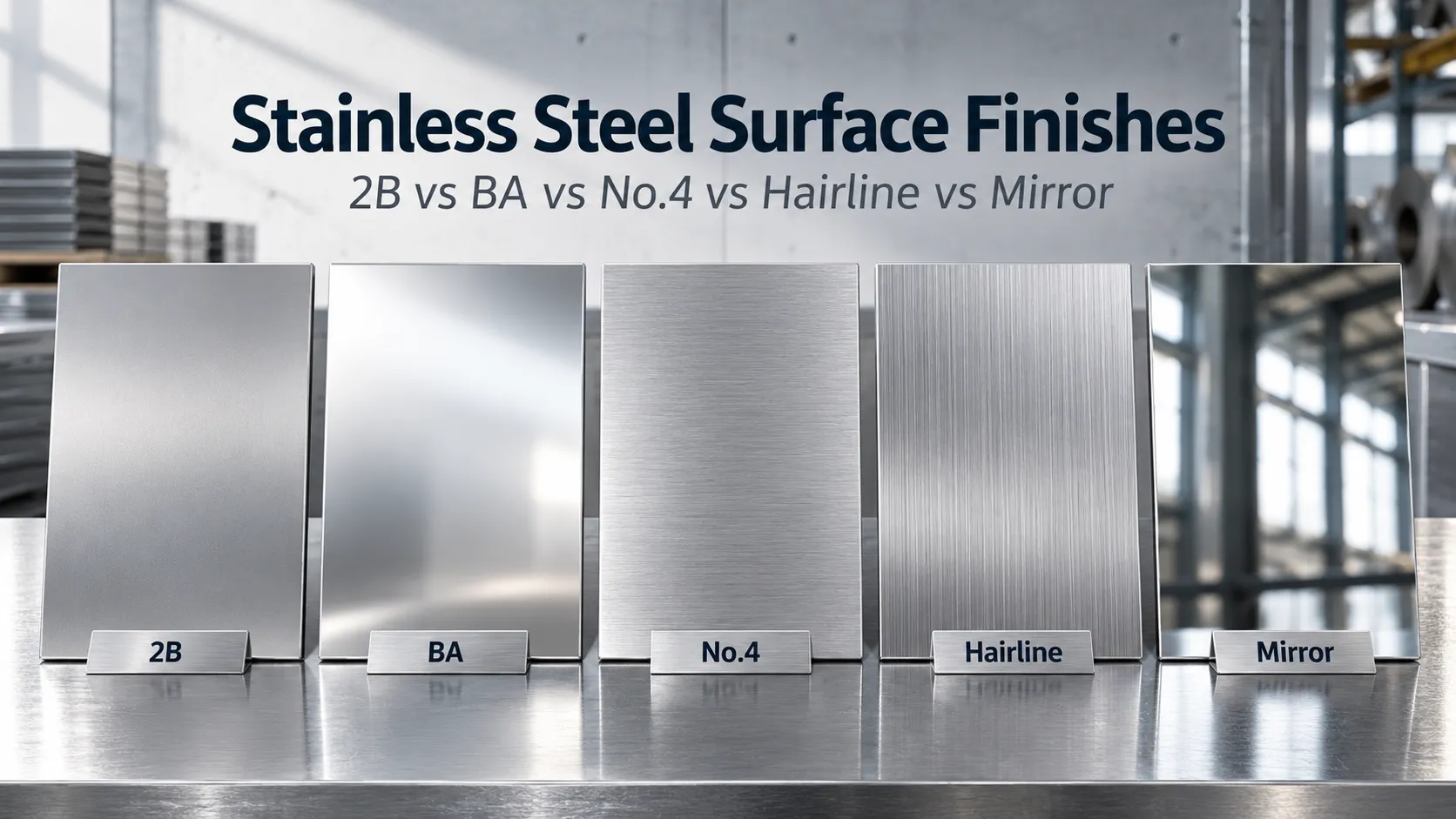
Choosing the right stainless steel surface finish is just as important as selecting the correct stainless steel grade. Two sheets made from the same 304 stainless steel can have completely different appearances, manufacturing requirements, surface roughness, maintenance needs, and prices.
The five most commonly discussed stainless steel finishes are 2B, BA (Bright Annealed), No.4, Hairline (HL), and Mirror (No.8 or commercially 8K).
Each serves a different purpose:
- 2B: A smooth, low-gloss mill finish commonly used for general fabrication and industrial products.
- BA: A bright, reflective mill finish produced through bright annealing.
- No.4: A directional satin finish popular for kitchen equipment, worktops, and interior panels.
- Hairline (HL): A fine, continuous linear brushed finish commonly used in architectural and decorative applications.
- Mirror / No.8: A highly reflective mechanically polished finish used for decorative panels and architectural features.
For buyers sourcing stainless steel sheet or coil, the correct specification goes beyond the finish name. Surface roughness, brushing direction, protective film, finished side, material grade, and an approved reference sample may all be necessary.
This guide compares the five finishes, explains how they are produced, and shows how to specify and inspect them for international purchasing.
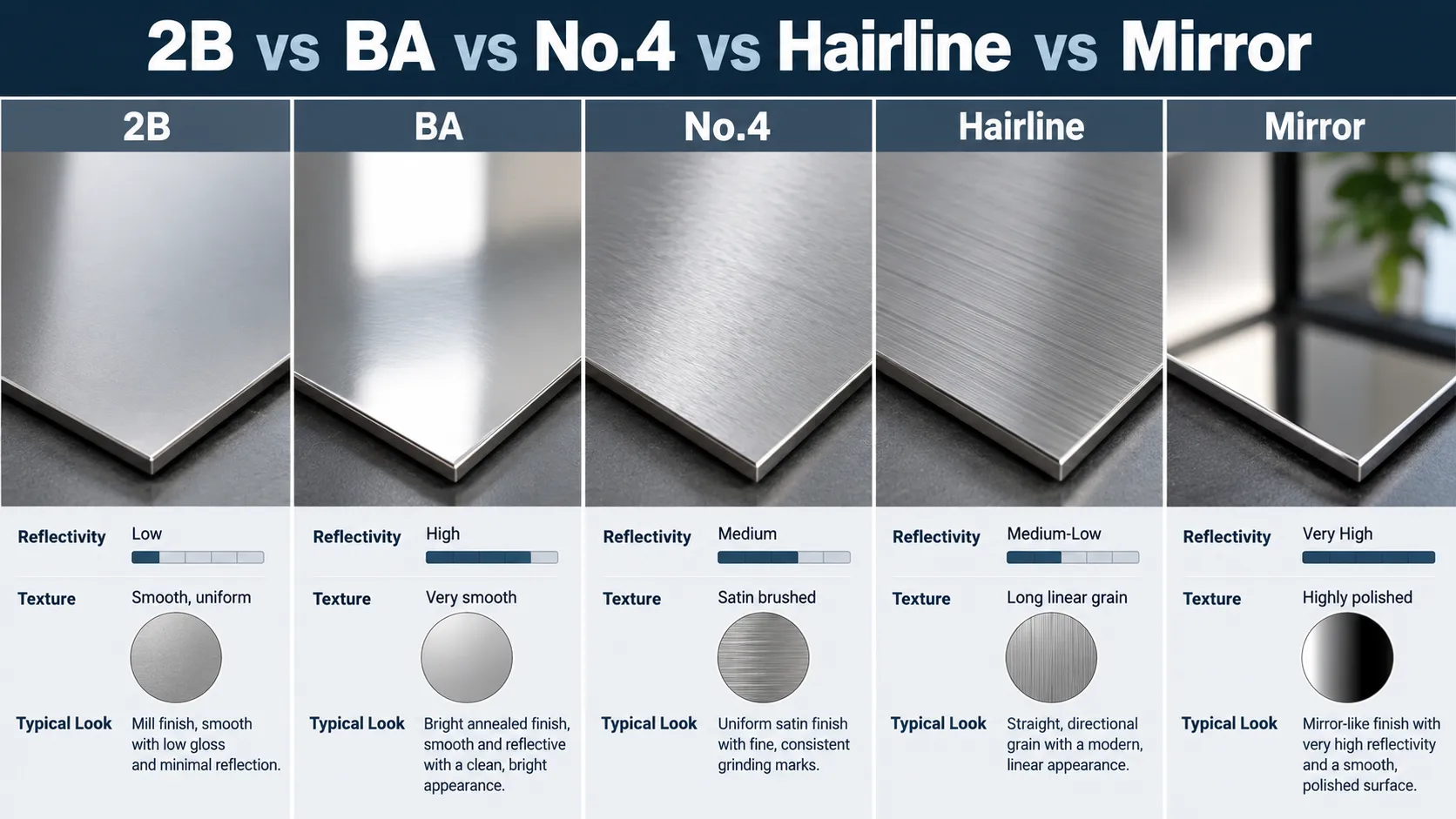
Stainless Steel Surface Finishes at a Glance
The following comparison provides a quick reference for selecting stainless steel finishes.
| Finish | Manufacturing Method | Appearance | Reflectivity | Typical Applications |
|---|---|---|---|---|
| 2B | Cold rolling, annealing, descaling and skin passing | Smooth, low-gloss | Low to moderate | General fabrication, equipment, sheet metal |
| BA / 2R | Cold rolling and bright annealing | Smooth, bright and reflective | High | Appliances, decorative sheet, precision components |
| No.4 | Mechanical grinding and polishing | Directional satin grain | Moderate | Kitchens, worktops, equipment, interiors |
| Hairline / HL | Controlled directional brushing or polishing | Fine, long linear grain | Variable, usually moderate | Elevators, wall panels, decorative cladding |
| Mirror / No.8 | Progressive fine polishing and buffing | Highly reflective, mirror-like | Very high | Decorative panels, architectural features |
These descriptions represent typical commercial appearances.
The final finish can vary depending on the steel grade, rolling conditions, abrasive material, polishing process, and supplier.
Important: 2B and BA are established mill-finish designations. No.4 and No.8 are recognized finish terms in ASTM specifications, while Hairline is widely used as a commercial description and often requires additional agreement on the exact appearance.
What Is a Stainless Steel Surface Finish?
A stainless steel surface finish describes the condition of the metal surface after rolling, annealing, descaling, grinding, brushing, polishing, or other finishing operations.
It influences the appearance and certain functional characteristics of the final product.
These can include:
- Surface roughness
- Reflectivity
- Visual texture
- Cleanability
- Appearance after scratching
- Suitability for subsequent processing
- Corrosion performance under particular conditions
Surface finish should not be confused with stainless steel grade.
For example, 304 stainless steel describes a chemical composition and associated material requirements.
A 2B finish describes a particular surface production route.
The same stainless steel grade can be supplied with several different finishes.
Stainless Steel Grade vs. Surface Finish
| Specification | What It Determines | Example |
|---|---|---|
| Grade | Chemical composition and material properties | 304 / S30400 |
| Product Form | Physical product supplied | Sheet / Coil / Plate / Strip |
| Surface Finish | Surface processing and appearance | 2B / BA / No.4 |
| Surface Roughness | Measured surface profile | Ra ≤ 0.5 μm, if specified |
| Dimensions | Thickness, width, length | 1.0 × 1219 × 2438 mm |
| Surface Protection | Protection during transport and fabrication | PE protective film |
For international procurement, these should be treated as separate specification items.
A request for “304 stainless steel sheet” alone does not fully define the surface condition of the material being purchased.
What Is 2B Stainless Steel Finish?
2B is one of the most common cold-rolled stainless steel mill finishes.
It is widely used as a general-purpose finish and as a starting surface for additional fabrication or polishing.
How Is 2B Finish Produced?
A typical production route includes:
- Cold rolling
- Annealing
- Descaling, commonly by pickling
- Light final rolling, also called skin passing
Skin passing improves the surface condition and helps control flatness.
The result is a relatively smooth, uniform surface with a soft metallic appearance.
2B is commonly identified as 2B under EN 10088-2 and ASTM A480.
What Does 2B Stainless Steel Look Like?
A typical 2B sheet has:
- A uniform silvery-gray appearance
- Low to moderate reflectivity
- A smooth surface without deliberate decorative brushing
- A relatively consistent mill finish
It is not normally intended to produce clear mirror-like reflections.
However, the actual brightness can differ between mills, steel grades, and rolling processes.
Advantages of 2B Finish
2B offers a practical combination of surface quality, availability, and processing flexibility.
It is commonly selected when the stainless steel will be:
- Cut or formed
- Welded into components
- Used as industrial sheet metal
- Further polished or brushed
- Used where a decorative surface is not essential
Because it is a standard mill finish, 2B may reduce unnecessary finishing costs in applications that do not require a special visual appearance.
Typical 2B Applications
2B stainless steel is frequently used in:
- Industrial enclosures
- Sheet metal fabrication
- General equipment manufacturing
- Tanks and fabricated assemblies
- Commercial appliance components
- Further processing into polished sheet products
For common material grades and available surface options, see our 304 stainless steel sheet product page.
When Should You Choose 2B?
Choose 2B when surface uniformity, general fabrication performance, and cost efficiency are more important than decorative reflectivity.
It is often the most practical starting point for a component that will undergo additional manufacturing operations.
What Is BA (Bright Annealed) Stainless Steel Finish?
BA stands for Bright Annealed.
It is a smooth, highly reflective mill finish produced by controlling the annealing atmosphere to minimize surface oxidation.
Under EN 10088-2, bright-annealed cold-rolled stainless steel is commonly designated 2R.
How Is BA Stainless Steel Produced?
In bright annealing, stainless steel is heated under a controlled protective atmosphere.
The goal is to avoid the oxidation that would otherwise occur during conventional annealing in air.
This allows the material to retain a clean, bright surface without requiring the same post-annealing descaling route typically used for 2B.
The final appearance is influenced by the original cold-rolled surface and production conditions.
BA and 2B should therefore be understood as different finishing routes rather than BA being merely a polished version of 2B.
What Does BA Finish Look Like?
BA stainless steel generally has:
- A smooth, bright surface
- Stronger reflection than typical 2B
- Little or no intentional abrasive grain
- A clean metallic appearance
- High visual uniformity when properly manufactured
Some BA products can have a very reflective, mirror-like appearance.
However, a BA designation does not automatically guarantee the same image clarity as a mechanically polished No.8 mirror finish.
Advantages of BA Finish
BA is useful where brightness and smoothness are important but extensive mechanical polishing may not be necessary.
Common advantages include:
- High reflectivity
- Smooth surface appearance
- Good suitability for certain forming operations
- Attractive appearance for visible components
- Availability in sheet and coil products
Typical BA Applications
BA stainless steel may be used for:
- Household appliances
- Decorative panels
- Precision sheet metal parts
- Certain kitchen components
- Electrical and industrial enclosures
- Products requiring a bright metallic appearance
BA vs. 2B Stainless Steel
| Property | 2B | BA / 2R |
|---|---|---|
| Annealing Route | Annealed and descaled | Bright annealed in controlled atmosphere |
| Appearance | Smooth, low-gloss | Bright and reflective |
| Typical Reflectivity | Lower | Higher |
| Deliberate Brushing | No | No |
| Further Polishing | Possible | Possible |
| Common Use | General manufacturing | Appliances and bright sheet products |
| Relative Cost | Often economical | Depends on grade, mill and availability |
Choose BA when a bright mill surface is required. Choose 2B when a conventional general-purpose surface is sufficient.
How Are Stainless Steel Surface Finishes Manufactured?
Stainless steel finishing is not one single production process.
Different finishes are created through different manufacturing routes.
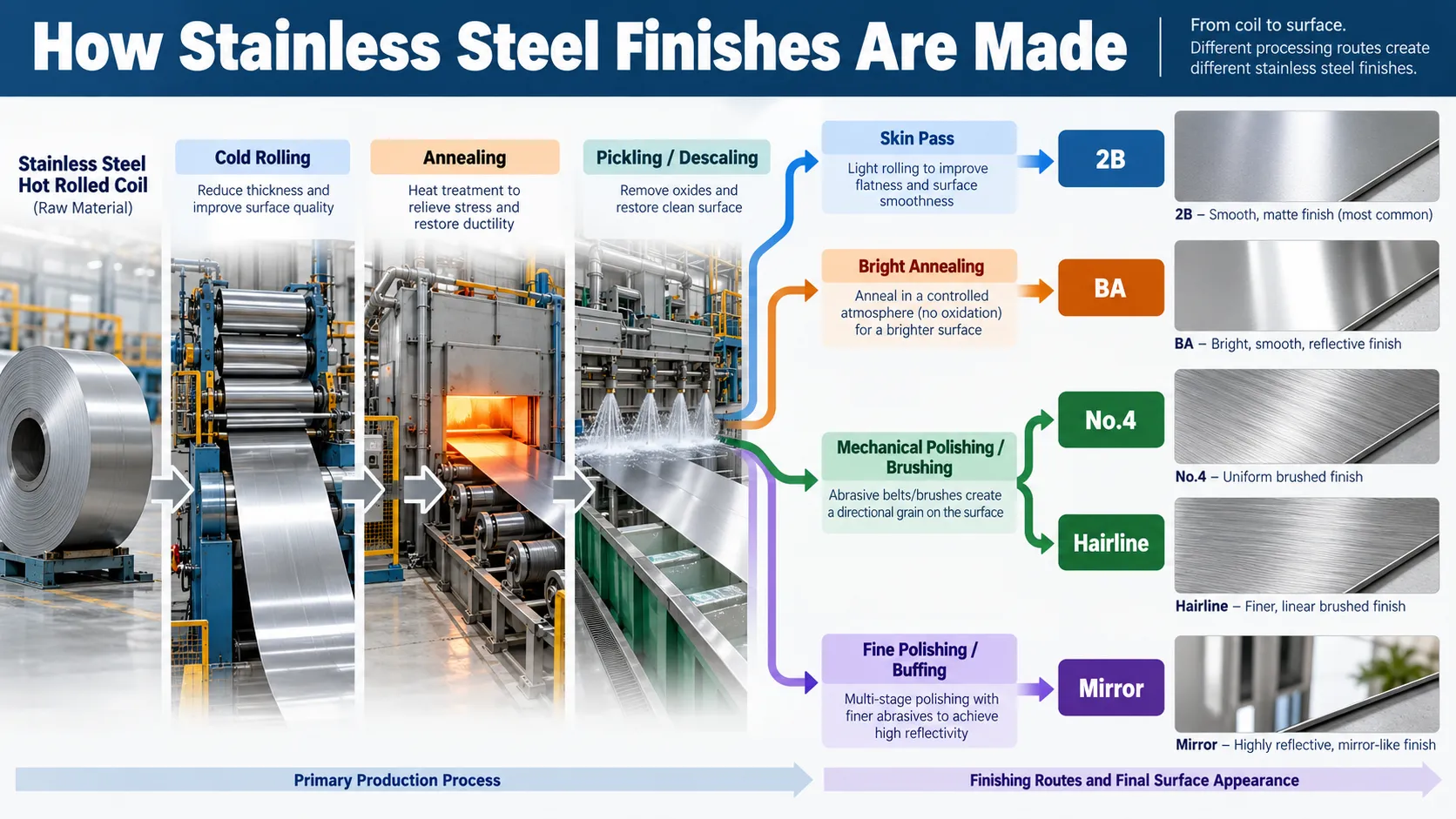
Simplified manufacturing illustration. BA production uses a controlled bright-annealing route rather than necessarily following the conventional pickling route used for 2B. Mechanical finishes may begin with suitable mill-finished material.
Mill Finishing
Mill finishes are produced as part of the stainless steel rolling and heat-treatment process.
Examples include:
- No.1 / 1D
- 2D
- 2B
- BA / 2R
The finish is closely associated with the manufacturing route.
Mechanical Finishing
Mechanical finishing uses abrasive processes to create a required surface appearance.
Examples include:
- Grinding
- Brushing
- Satin polishing
- Fine polishing
- Buffing
These processes can be applied to suitable mill-finished sheet, coil, or fabricated components.
Decorative Surface Processing
Additional decorative treatments may include:
- Hairline finishing
- Mirror polishing
- Embossing
- Pattern rolling
- Etching
- Coloring
- Decorative surface coating
For example, brushed or mirror-polished stainless steel may be used as the base material for certain colored architectural products.
Our colored stainless steel sheet range includes decorative stainless surfaces for architectural and interior applications.
What Is No.4 Stainless Steel Finish?
No.4 is a mechanically finished stainless steel surface with a directional satin appearance.
It is one of the most familiar finishes in commercial kitchens, equipment manufacturing, and architectural interiors.
How Is No.4 Finish Produced?
A suitable stainless steel surface is mechanically finished using abrasive belts or other appropriate polishing equipment.
The process creates fine directional marks.
The appearance depends on:
- Abrasive grade
- Equipment configuration
- Belt condition
- Processing pressure
- Feed speed
- Number of polishing passes
- Final finishing method
A No.4 finish is often described as brushed or satin stainless steel.
However, terms such as “satin” and “brushed” do not completely define the final appearance.
What Does No.4 Stainless Steel Look Like?
Typical characteristics include:
- Fine directional polishing marks
- A relatively uniform satin appearance
- Moderate reflectivity
- Less obvious reflections than BA or Mirror
- Visible texture when viewed closely
No.4 can range from relatively fine and subtle to more visibly brushed, depending on the finishing process.
Advantages of No.4 Finish
No.4 is a popular compromise between decorative appearance and practical maintenance.
It can make certain minor surface marks less visually noticeable than on a highly reflective mirror surface.
It is also familiar to fabricators and finishers, making local restoration or blending possible in some circumstances.
However, the repaired area must be matched carefully to the original grain and appearance.
Typical No.4 Applications
No.4 is commonly selected for:
- Commercial kitchen worktops
- Stainless steel sinks
- Food-service equipment
- Equipment cabinets
- Architectural trim
- Interior wall protection
- Elevator components
- General decorative fabrication
Is No.4 Stainless Steel Food Grade?
No.4 is a surface-finish designation, not a food-contact certification.
Whether a stainless steel product is suitable for food processing depends on the material grade, measured surface condition, fabrication quality, cleanability, equipment design, and applicable hygiene requirements.
A No.4 surface may be suitable for many applications, but critical hygienic equipment may require a specifically defined surface roughness and finishing procedure.
What Is Hairline (HL) Stainless Steel Finish?
Hairline, commonly abbreviated HL, is a decorative stainless steel finish characterized by fine, continuous, directional linear marks.
It is particularly popular in architectural and interior design.
How Is Hairline Finish Produced?
Hairline finishing typically uses controlled brushing or abrasive finishing to produce a consistent linear grain.
The exact process varies between suppliers.
Some products have very fine, subtle lines.
Others have more pronounced directional patterns.
Unlike a universally quantified material property, the commercial term “Hairline” does not define one fixed surface texture or Ra value.
For decorative projects, buyers should approve an actual surface sample.
What Does Hairline Stainless Steel Look Like?
Typical characteristics include:
- Long and continuous directional grain
- Fine linear texture
- Satin or softly reflective appearance
- A consistent architectural effect
- A clearly identifiable polishing direction
The direction of the pattern becomes important when several panels are installed together.
Typical Hairline Applications
Hairline stainless steel is commonly used for:
- Elevator wall panels
- Lift doors
- Interior wall cladding
- Building entrance panels
- Decorative columns
- Retail interiors
- Architectural partitions
- Furniture and decorative trim
Why Does Hairline Direction Matter?
Imagine several Hairline stainless steel panels installed side by side.
If the grain direction is vertical on most panels but horizontal on one, the difference can become visually obvious under lighting.
Even when the panels use the same steel grade, inconsistent finishing direction can result in an unacceptable appearance.
For large architectural orders, always specify the required grain direction.
Examples include:
- Grain parallel to sheet length
- Grain parallel to sheet width
- Vertical grain after installation
- Horizontal grain after installation
Where multiple panels must visually match, supply an approved reference sample and a panel installation drawing.
No.4 vs. Hairline Stainless Steel: What’s the Difference?
No.4 and Hairline are sometimes confused because both are directional mechanically finished surfaces.
The key difference is usually the intended visual texture.
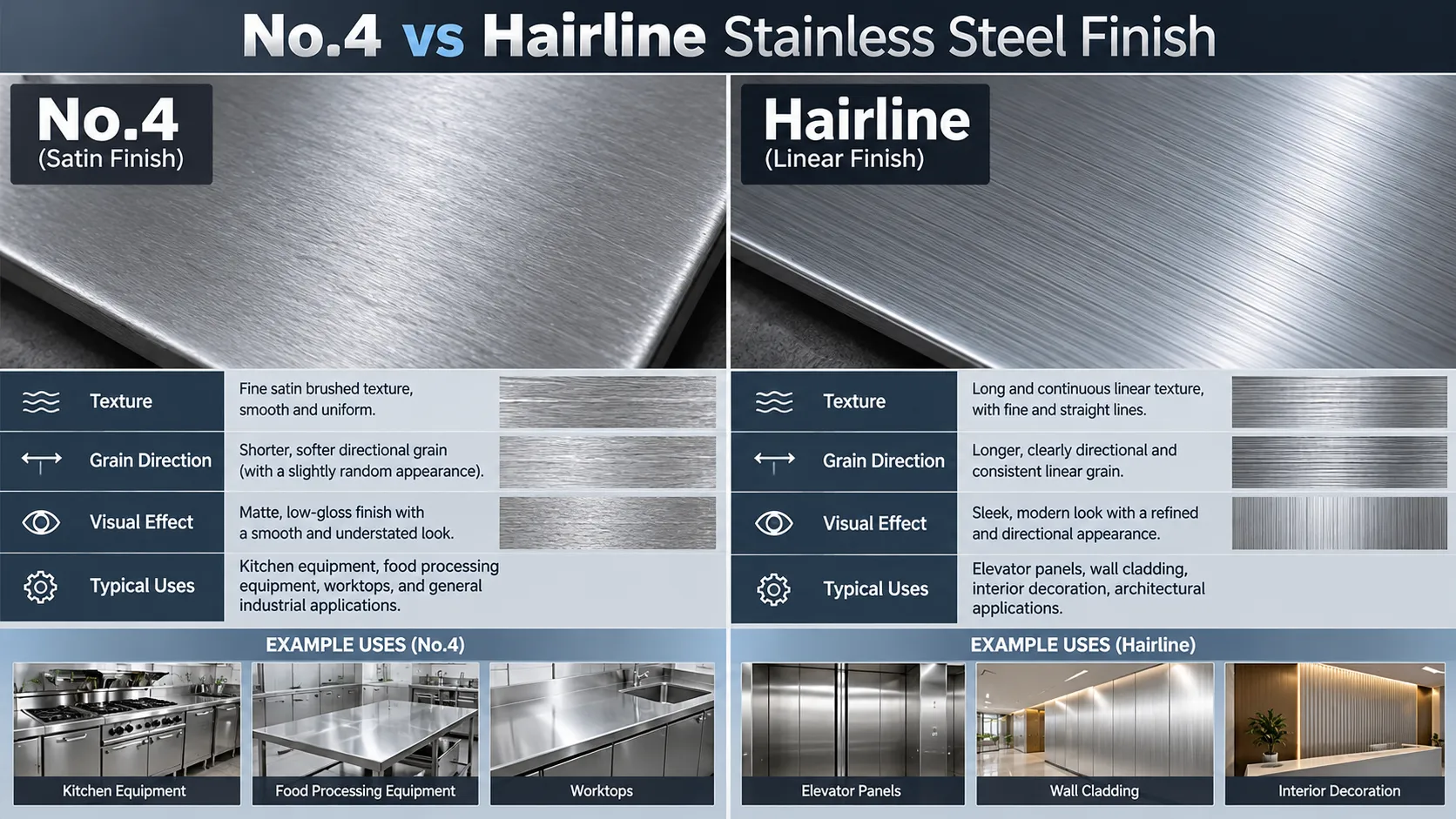
| Feature | No.4 | Hairline |
|---|---|---|
| Typical Appearance | Satin brushed | Fine linear brushed |
| Grain Pattern | Directional polishing marks | Long, visually continuous lines |
| Reflectivity | Moderate | Variable |
| Typical Applications | Kitchens and equipment | Elevators and architectural panels |
| Grain Matching | Important for visible surfaces | Especially important |
| Finish Consistency | Requires processing control | Often requires approved reference sample |
| Main Priority | Practical satin appearance | Decorative linear appearance |
These differences describe common commercial products rather than an absolute technical boundary.
A finely produced No.4 finish and a commercial Hairline finish may look similar.
Which Is Better for Kitchen Equipment?
No.4 is commonly chosen because its satin appearance is familiar and practical for many commercial kitchen applications.
However, measured roughness, cleaning requirements, and food-contact regulations may be more important than appearance.
Which Is Better for Elevator Panels?
Hairline is frequently selected for elevators and architectural interiors because its long linear grain gives a refined, consistent appearance.
No.4 can also be used.
The final choice is often architectural rather than a fundamental material-performance difference.
What Is Mirror Finish Stainless Steel?
Mirror-finished stainless steel is mechanically polished to produce a highly reflective surface with a high degree of image clarity.
It is commonly associated with No.8 in ASTM terminology and 2P bright-polished finishes under EN terminology.
In international commercial quotations, the term 8K is also frequently used.
However, commercial 8K does not necessarily define one globally uniform surface-quality requirement.
How Is Mirror Finish Produced?
Mirror polishing typically involves several stages of progressively finer surface preparation.
Depending on the original surface, these may include:
- Surface preparation
- Grinding or initial polishing
- Fine abrasive polishing
- Buffing
- Cleaning
- Final visual inspection
Each stage reduces visible surface defects and improves reflectivity.
What Does Mirror Stainless Steel Look Like?
A high-quality mirror surface should produce clear reflections with minimal visible distortion.
However, actual image quality depends on:
- Base material quality
- Flatness
- Surface defects
- Polishing process
- Residual waviness
- Cleaning
- Handling and packaging
Even a highly polished surface can show distortion if the underlying sheet is not sufficiently flat.
No.8 vs. 8K Stainless Steel
No.8 is a recognized mirror-polished finish description in ASTM terminology.
8K is a widely used commercial label.
When an order requires a particular reflection quality, it is advisable to specify:
- Mirror finish designation
- Reference sample
- Reflectivity or image clarity requirements, if relevant
- Permitted surface defects
- Protective film
- Inspection conditions
BA vs. Mirror Stainless Steel
These finishes can appear similar at first glance.
However, they are produced differently.
| Property | BA / 2R | Mirror / No.8 |
|---|---|---|
| Main Production Route | Bright annealing | Fine mechanical polishing |
| Reflectivity | High | Very high |
| Image Clarity | Can be high | Intended to be very high |
| Abrasive Polishing Required | Not inherent to BA | Yes |
| Surface Quality | Mill-controlled | Polishing- and substrate-dependent |
| Common Use | Appliances and bright sheet | Decorative and architectural panels |
If the final design depends on clear reflections, a conventional BA designation should not automatically be substituted for an approved mirror-polished product.
Typical Mirror Finish Applications
Mirror stainless steel is widely used in:
- Luxury interior panels
- Decorative ceilings
- Architectural feature walls
- Elevator interiors
- Retail displays
- Decorative columns
- High-reflectivity design features
Stainless Steel Surface Roughness (Ra) Explained
Surface roughness is one of the most important technical considerations when specifying stainless steel finishes.
Ra means arithmetic mean roughness.
It describes the average absolute deviation of a measured surface profile from its mean line over the evaluated length.
Ra is commonly expressed in micrometers (μm).
For example:
Ra ≤ 0.5 μm
means the measured roughness must not exceed the specified limit when evaluated according to the agreed measurement method and conditions.
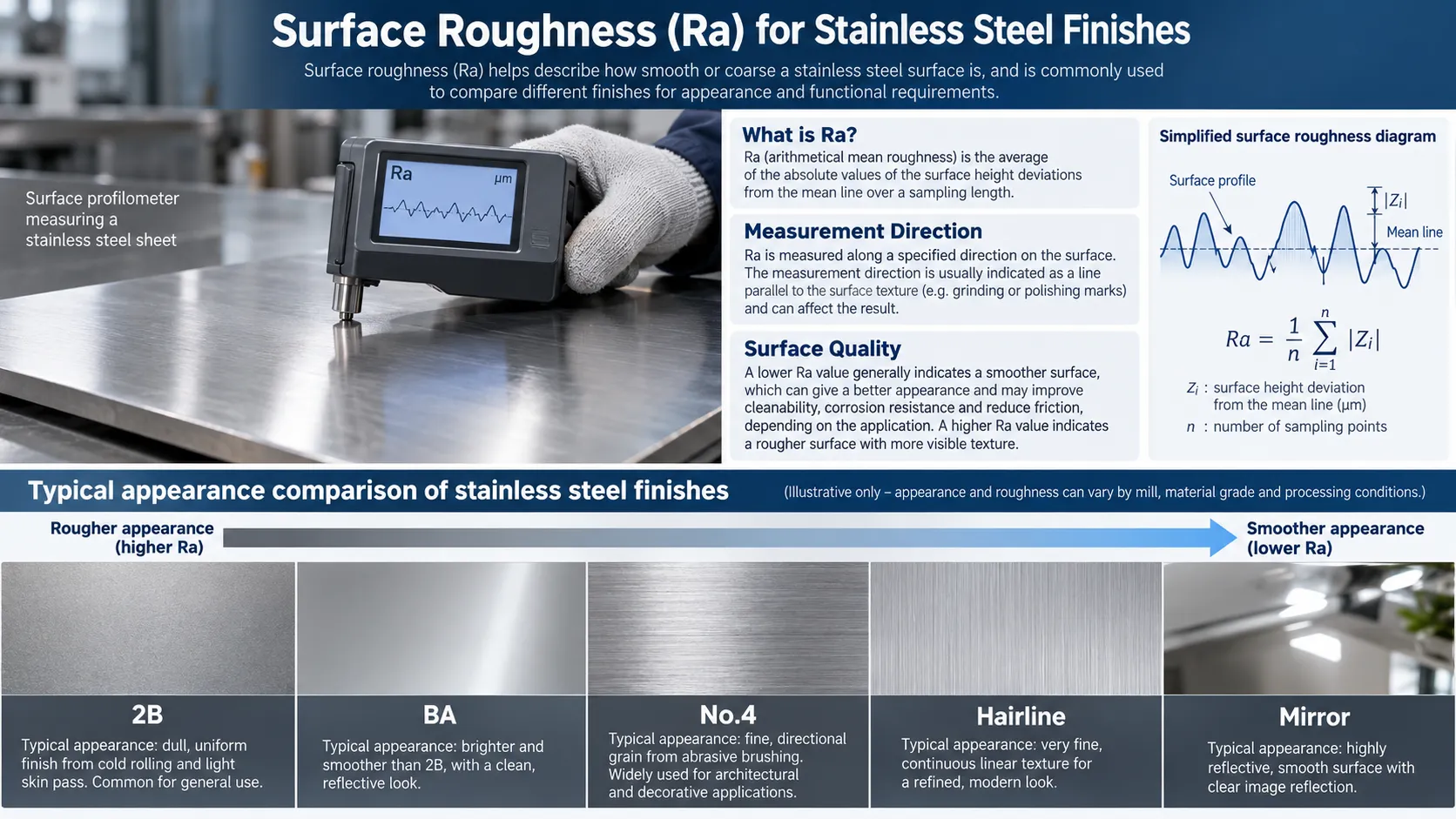
The image illustrates surface measurement concepts. It does not provide certified roughness results or establish a universal ranking of every finish. Measurement direction, method, and actual process conditions affect Ra.
Typical Ra Values for Stainless Steel Finishes
Published industry reference data provide the following indicative ranges.
| Finish / EN Designation | Indicative Ra | Notes |
|---|---|---|
| 2B | 0.1–0.5 μm | Typical cold-rolled mill finish |
| BA / 2R | 0.05–0.1 μm | Typical bright-annealed surface |
| Brushed / 2J | 0.2–1.5 μm | Broad range depending on polishing |
| Satin Polished / 2K | Below 0.5 μm | Specified transverse roughness requirement |
| Bright Polished / 2P | Typically below 0.1 μm | High-reflectivity polished finish |
These values are based on representative industry data and standard-finish descriptions.
They are not guaranteed values for every sheet, mill, or finish sold under these names.
Hairline does not have one universal Ra range. Commercial No.4 may vary within the wider category of mechanically brushed or polished finishes.
Why Ra Alone Is Not Enough
Two stainless steel surfaces can have similar Ra values but look completely different.
For example:
- One may have long directional grain.
- Another may have fine, non-directional polishing marks.
- One may reflect light uniformly.
- Another may appear cloudy.
- One may contain isolated scratches.
- Another may have a visually consistent pattern.
Ra is useful, but it does not fully describe:
- Visual appearance
- Grain direction
- Reflection clarity
- Isolated defects
- Surface waviness
- Color or tone consistency
For decorative architectural products, an approved physical sample is often essential.
How Is Ra Measured?
Surface roughness may be measured using a suitable contact profilometer or other validated instrument.
The inspection procedure should define:
- Measurement method
- Evaluation length
- Profile filtering settings
- Measuring direction
- Number of measurements
- Measurement locations
- Acceptance limit
For a strongly directional surface, measurements are commonly taken transverse to the lay when this is appropriate to the applicable surface-texture specification.
Measurements along and across the grain can produce different results.
Therefore, a purchase order that specifies only “Ra ≤ 0.5 μm” may still be incomplete if the measurement method and direction are important.
Surface Roughness vs. Abrasive Grit
Another common mistake is assuming that polishing grit size automatically determines Ra.
For example:
“No.4 finish using 180 grit” does not guarantee one exact roughness value.
Actual roughness depends on the complete finishing process, including abrasive condition, pressure, feed speed, contact time, and substrate quality.
For demanding projects, specify the required surface performance rather than relying solely on the last abrasive grit number.
Does Stainless Steel Surface Finish Affect Corrosion Resistance?
Yes, surface condition can influence corrosion performance.
However, stainless steel grade and service environment remain fundamental.
A stainless steel surface is protected by a thin chromium-rich passive oxide film.
Damage, contamination, deposits, and unsuitable surface processing can increase the risk of localized corrosion.
Surface Roughness and Contamination
A coarse surface may have more places where moisture or deposits can remain.
Under certain conditions, these areas can contribute to localized corrosion.
A suitably smooth and clean surface can be easier to maintain.
However, surface roughness alone does not fully predict corrosion resistance.
Mechanical Polishing and Surface Contamination
Mechanical finishing should use suitable equipment and clean abrasives.
Tools previously used on carbon steel can transfer iron contamination to stainless steel.
This may cause surface rust staining even when the stainless steel grade itself is appropriate.
For important architectural or hygienic products, finishing procedures and cleaning requirements should be agreed in advance.
Welding and Surface Restoration
Welding can produce heat tint and surface changes.
Depending on the application, suitable cleaning, pickling, passivation, or mechanical restoration may be necessary.
A visually attractive brushed finish does not automatically indicate that weld-affected areas have received adequate corrosion-related treatment.
Is Mirror Finish More Corrosion Resistant Than 2B?
A smooth, clean mirror-polished surface can provide corrosion-performance benefits in some environments because of its surface condition.
However, it is not correct to claim that mirror-polished 304 automatically outperforms every 2B stainless product in every corrosive environment.
Material composition, surface cleanliness, exposure severity, crevices, welding, and maintenance still determine performance.
In chloride-rich environments, choosing an appropriate grade such as 316L may be more important than choosing a more reflective finish on an unsuitable grade.
Which Finish Is Better for Scratches, Fingerprints and Cleaning?
Different surfaces behave differently during daily use.
| Finish | Scratch Visibility | Fingerprint Visibility | Cleaning Considerations |
|---|---|---|---|
| 2B | Depends on lighting and damage | Moderate | Generally straightforward |
| BA | Fine scratches may be visible | Can show fingerprints | Smooth surface |
| No.4 | Grain can visually disguise some marks | Depends on surface and lighting | Clean along grain |
| Hairline | Grain can disguise certain directional marks | Variable | Grain matching matters |
| Mirror | Fine scratches can be conspicuous | Often conspicuous | Requires careful handling |
These are general appearance tendencies, not laboratory performance rankings.
Is No.4 More Scratch Resistant Than Mirror?
Not necessarily.
The underlying hardness and mechanical properties of the steel are not automatically changed simply because the finish has a different appearance.
A No.4 surface may make small scratches less visually obvious.
A mirror surface can make similar scratches easier to notice.
Scratch visibility is not the same as scratch resistance.
Which Finish Is Easiest to Clean?
Cleaning performance depends on actual surface texture, contamination, design, and cleaning procedures.
A smooth surface may be easier to clean in many applications.
However, appropriate cleaning chemicals and techniques remain important.
Avoid using carbon-steel brushes or unsuitable abrasive cleaning tools on stainless steel.
For directional finishes such as No.4 and HL, cleaning and minor blending are generally performed in the direction of the visible grain.
How Surface Finish Affects Cutting, Bending and Welding
The finish should be considered before the fabrication process begins.
A polished stainless steel sheet may require additional protection during manufacturing.
Laser Cutting
For laser-cut stainless steel sheet, buyers should consider whether a protective film is required.
The film must be compatible with the actual cutting process and machine requirements.
Not every protective film is suitable for laser processing.
Film type, adhesive, thickness, and removal conditions should be confirmed with the material supplier and fabricator.
Bending
Bending can change how light reflects from a finished surface.
For brushed and Hairline sheet, the relationship between the bend line and grain direction can influence the final appearance.
In some applications, the grain direction may also interact with material anisotropy and forming behavior.
For visually critical fabricated panels, production samples may be necessary.
Welding
Welding can damage a prefinished decorative surface around the weld.
Restoring a uniform No.4 or Hairline appearance may require additional polishing or brushing.
Mirror-finished assemblies can be particularly demanding because polished surfaces may reveal distortion, unevenness, or local repair marks.
Should Stainless Steel Be Polished Before or After Fabrication?
There is no universal answer.
For simple cut panels, purchasing prefinished sheet may be more efficient.
For welded assemblies requiring continuous surface appearance, some finishing operations may be more appropriate after fabrication.
Consider:
- Final geometry
- Weld locations
- Surface accessibility
- Required appearance
- Equipment availability
- Risk of handling damage
- Total processing cost
ASTM A480 vs. EN 10088-2 Surface Finish Standards
International buyers frequently encounter different finish designations in quotations.
The two commonly referenced systems for stainless steel flat products include:
- ASTM finish descriptions, associated with ASTM A480/A480M
- European finish codes, specified through EN 10088-2
These systems overlap, but their terminology and definitions are not always interchangeable in every detail.
ASTM and EN Surface Finish Comparison
| Common Description | ASTM Terminology | EN 10088-2 | Notes |
|---|---|---|---|
| Hot-Rolled, Annealed and Pickled | No.1 | 1D | Common hot-rolled finish |
| Cold-Rolled, Annealed and Pickled | 2D | 2D | Duller than typical 2B |
| Cold-Rolled, Skin-Passed | 2B | 2B | Common mill finish |
| Bright Annealed | BA | 2R | Bright mill finish |
| Ground | No.3 | 2G | Approximate comparison |
| Brushed / Dull Polished | No.4 | 2J | Approximate comparison |
| Fine Satin Polished | No.6 | 2K | Not interchangeable without checking requirements |
| Bright Polished / Mirror | No.8 | 2P | Highly reflective polished surface |
| Hairline | HL, commercial | Project-defined; often within directional special finishes | Sample approval recommended |
The table is intended as a practical comparison.
A buyer should not assume the resulting surface appearance is identical merely because two designation systems have similar descriptions.
What About No.1 Stainless Steel?
No.1 is a common hot-rolled finish.
It generally appears rougher and less reflective than cold-rolled 2B.
It is widely used for heavier industrial plate where decorative appearance is not the main priority.
What About No.3, No.6 and No.7?
These are additional mechanically finished surface categories.
No.3 is generally a relatively coarse ground or polished finish.
No.6 refers to a fine satin-type finish.
No.7 refers to a highly reflective buffed finish that is not necessarily equivalent to the full image clarity expected from No.8 mirror polishing.
For procurement, refer to the relevant standard and confirm the actual finish requirements.
Why Approved Samples Matter
A surface designation may control a general production category without specifying every aspect of visual appearance.
Where an architectural project uses large panels from different production batches, even small differences in brushing pattern or reflectivity may be noticeable.
An approved sample establishes a clearer visual acceptance basis.
Which Stainless Steel Finish Should You Choose?
The correct finish depends on the application.
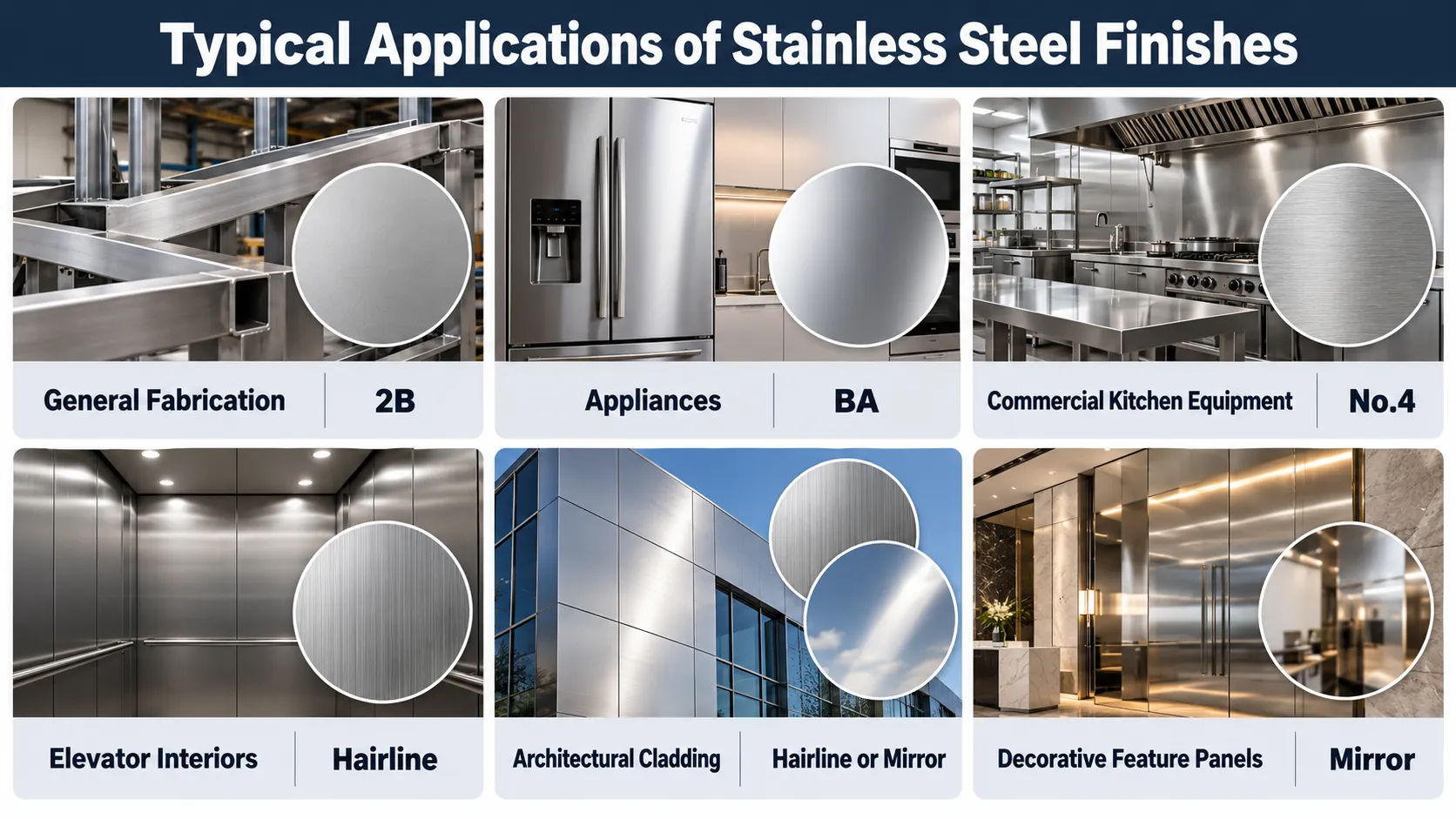
Application Selection Table
| Application | Common Starting Finish | Reason |
|---|---|---|
| General Industrial Fabrication | 2B | Economical, common base material |
| Sheet Metal Enclosures | 2B / BA | Manufacturing and appearance requirements |
| Household Appliance Panels | BA / Brushed | Appearance and cleanability |
| Commercial Kitchen Equipment | No.4 / Specified Smooth Finish | Practical surface and cleaning |
| Food Processing Equipment | 2B / Specified Polished Finish | Measured cleanability requirements |
| Elevator Interiors | HL / No.4 | Directional decorative texture |
| Architectural Wall Cladding | HL / Mirror | Visual design |
| Decorative Feature Panels | Mirror | High reflectivity |
| Stainless Steel Coil for Further Finishing | 2B / BA | Suitable processing base |
| Colored Decorative Panels | HL / Mirror / Other Approved Base | Decorative processing requirements |
For Commercial Kitchens
No.4 is common for visible kitchen equipment.
However, where hygiene requirements are critical, the actual material, surface roughness, weld quality, and cleaning design must be considered.
For Elevators and Interior Decoration
Hairline is often preferred for its continuous linear appearance.
No.4 may also be suitable where a satin appearance is desired.
For large panel installations, consistency between batches is particularly important.
For Architectural Mirror Panels
Mirror-polished sheet is often selected for visual impact.
Specify the reference sample, protective film, panel flatness, and appearance requirements.
The grade should still be selected based on the actual environment.
For Industrial Manufacturing
2B is usually a practical choice where decorative finishing is unnecessary.
If a bright surface is required directly from the mill, BA may be an alternative.
Stainless Steel Finish Cost Comparison
Surface finishing influences the delivered price of stainless steel.
In general, additional polishing stages increase processing requirements.
However, the relative cost depends on grade, sheet dimensions, mill capability, availability, order quantity, and required quality.
| Finish | General Processing Complexity | Common Cost Consideration |
|---|---|---|
| 2B | Standard mill process | Often economical for general applications |
| BA | Controlled bright-annealing route | Depends on mill and product availability |
| No.4 | Additional mechanical finishing | Abrasives, labor and processing |
| Hairline | Controlled directional finishing | Appearance consistency and grain matching |
| Mirror | Multiple fine polishing stages | Processing, yield and surface protection |
Why Mirror Stainless Steel Can Cost More
Mirror polishing may involve:
- Multiple polishing stages
- Fine abrasive materials
- More demanding visual inspection
- Additional handling protection
- Higher rejection risk for visible defects
- Protective film and careful packaging
Large mirror-finished sheets can be particularly sensitive to cosmetic damage during handling and transportation.
Why Finish Price Cannot Be Compared Alone
Suppose a buyer compares two quotations for 304 stainless steel sheet.
Supplier A offers No.4 with standard commercial appearance.
Supplier B offers No.4 with:
- A controlled reference sample
- Defined surface roughness
- One-face finish requirements
- Special protective film
- Additional inspection
- Strict cosmetic acceptance criteria
These are not necessarily equivalent products.
The lowest-priced quotation is not always the lowest-cost acceptable supply.
How to Specify Stainless Steel Sheet and Coil Finishes
This is one of the most important steps for buyers sourcing stainless steel internationally.
An incomplete finish specification can lead to:
- Incorrect surface appearance
- Wrong brushing direction
- Unexpected roughness
- Different reflectivity between batches
- Protective film problems
- Scratches during handling
- Disagreements over cosmetic acceptance
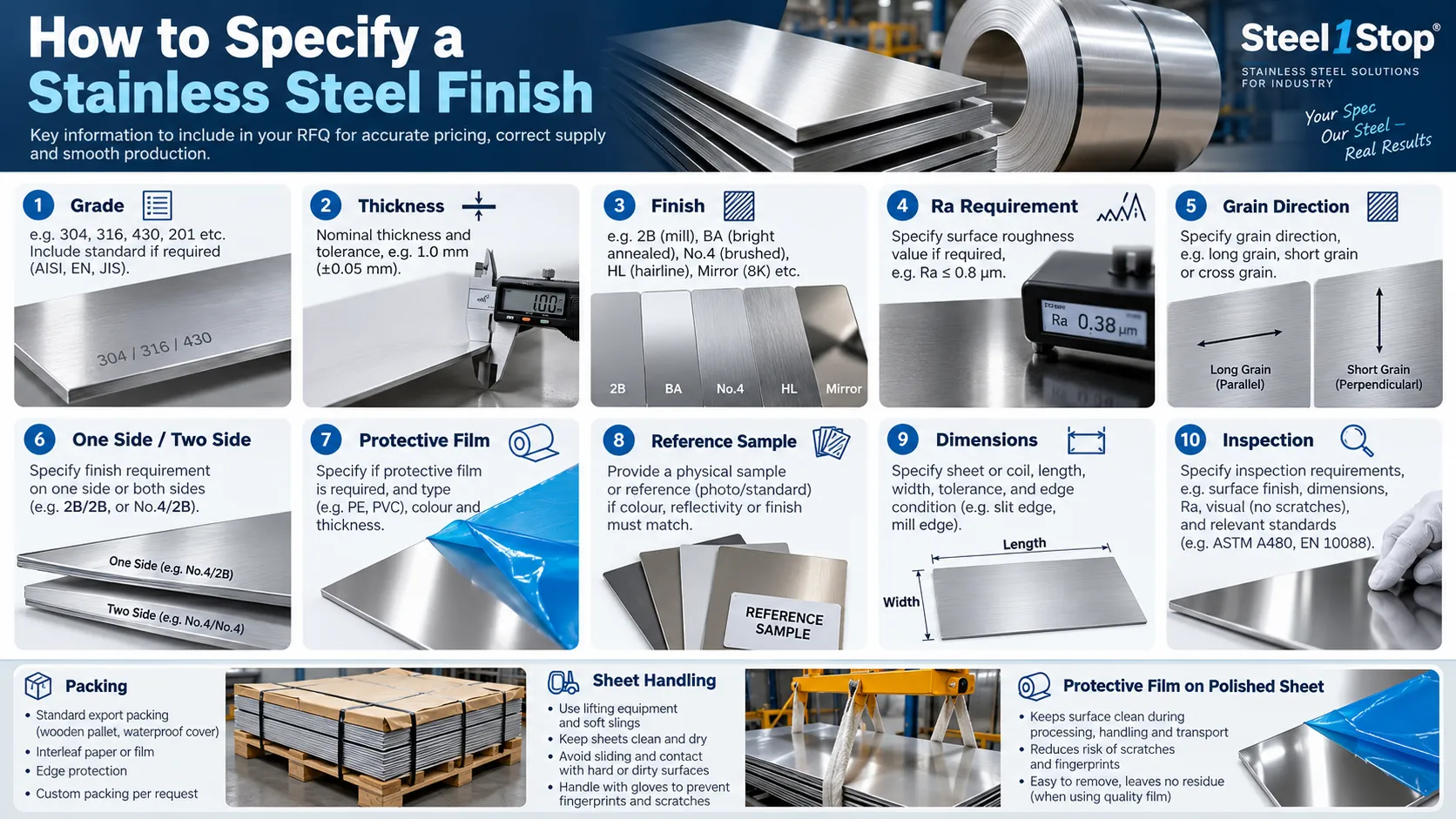
Stainless Steel Finish RFQ Checklist
| Item | What to Specify | Example |
|---|---|---|
| Grade | Stainless steel grade / UNS | 304 / S30400 |
| Standard | Material and finish requirements | ASTM A240/A240M, A480/A480M |
| Product Form | Sheet, coil, plate or strip | Sheet |
| Thickness | Nominal thickness and tolerance | 1.0 mm, applicable standard tolerance |
| Width | Required width | 1219 mm |
| Length | Required sheet length | 2438 mm |
| Finish | Surface designation | No.4 |
| Surface Side | One side or both sides | No.4 front / 2B back |
| Ra | Maximum roughness, if applicable | Ra ≤ 0.8 μm, measured as specified |
| Grain Direction | Orientation relative to dimensions | Parallel to sheet length |
| Appearance | Approved reference | Customer-approved sample |
| Protective Film | Type and coverage | PE film, agreed specification |
| Edge | Mill edge / slit edge | As required |
| Quantity | Pieces, coils or metric tons | 500 sheets |
| MTC | Inspection document requirements | As agreed |
| Packaging | Protection for transport | Export pallet with interleaving |
| Destination | Country and port | Buyer to specify |
The values above illustrate how to prepare a quotation request. They do not represent a standard Steel1Stop stock item or a universal tolerance requirement.
Example RFQ: 304 No.4 Stainless Steel Sheet
A complete purchasing request might read:
Product: Stainless Steel Sheet
Grade: 304 / UNS S30400
Material Standard: ASTM A240/A240M
General Requirements: ASTM A480/A480M
Thickness: 1.0 mm
Width: 1219 mm
Length: 2438 mm
Surface Finish: No.4 on front side, 2B on reverse side
Grain Direction: Parallel to sheet length
Appearance: Match approved reference sample
Protective Film: PE protective film on finished face
Quantity: 500 sheets
Documentation: Mill Test Certificate as agreed
Inspection: Surface appearance, dimensions and finish requirements
Packing: Export packing with surface protection
This gives the supplier considerably more useful information than simply requesting:
“304 stainless steel sheet, brushed finish, best price.”
One-Side vs. Two-Side Finishing
Some buyers require a decorative surface on only one side.
For example:
No.4 / 2B
This can indicate No.4 on the designated face and 2B on the reverse side, subject to confirmation with the supplier.
Other projects may require both sides to receive a specified decorative finish.
Two-sided finishing may increase processing cost and introduce additional handling requirements.
Always identify which surface will remain visible after installation.
Stainless Steel Sheet vs. Coil Finish Requirements
Finished sheet and coil products can introduce different purchasing considerations.
| Requirement | Stainless Steel Sheet | Stainless Steel Coil |
|---|---|---|
| Dimensions | Thickness, width, length | Thickness, width, coil dimensions |
| Finished Side | Front / reverse | Outer / inner face or defined side |
| Grain Direction | Relative to sheet dimensions | Relative to rolling direction |
| Surface Protection | Film / interleaving | Film suitability and winding protection |
| Handling | Stacking and lifting | Coil handling and unwinding |
| Surface Inspection | Individual panels / samples | Sampling across coil length and width |
| Additional Details | Flatness and panel appearance | Coil weight, ID, OD, edge and processing |
For coil orders, clarify whether the coil will be slit, cut to length, stamped, or further polished after delivery.
Why Protective Film Matters
Protective film can reduce surface damage during:
- Transportation
- Cutting
- Bending
- Installation
- Storage
But it must be suitable for the application.
Specify requirements such as:
- PE or other suitable film
- Adhesive characteristics
- Thickness
- Color, if relevant
- Laser-processing compatibility, if required
- Storage and removal conditions
- Residue restrictions
Protective film is not a guarantee against all scratches or handling damage.
How to Inspect Stainless Steel Surface Finish Before Acceptance
For large sheet or coil orders, inspection requirements should be agreed before shipment.
Visual Inspection
Confirm that the surface matches the approved finish specification and reference sample.
Check for:
- Scratches
- Dents
- Discoloration
- Stains
- Surface contamination
- Uneven polishing
- Grain inconsistency
- Unacceptable marks
- Protective film defects
The inspection should use an agreed viewing distance, lighting condition, and acceptance criteria for appearance-critical products.
Grain Direction Inspection
For No.4 and Hairline products, confirm that the polishing direction is correct.
For architectural panels, check visual consistency across the full order.
Roughness Inspection
When Ra is specified, measure it using the agreed method and sampling plan.
Do not treat one measurement taken at an arbitrary location as proof of the entire batch.
Dimensional Inspection
Check thickness, width, length, flatness, and edge condition against the required standard and purchase order.
Documentation Verification
Verify the material grade, heat number, and required test certificate.
A chemical composition certificate does not automatically certify cosmetic surface quality.
Surface acceptance should be assessed separately.
Stainless Steel Surface Finish FAQs
What is the most common stainless steel finish?
2B is one of the most common cold-rolled stainless steel mill finishes. It is widely used for general fabrication, industrial equipment, and products that require further processing.
What is the difference between 2B and BA stainless steel?
2B is produced through cold rolling, annealing, descaling, and skin passing. BA is produced through bright annealing under a controlled atmosphere. BA typically has higher reflectivity.
Is BA the same as mirror finish?
Not necessarily. BA can be highly reflective, but No.8 mirror finish is produced through mechanical fine polishing and is intended to achieve high image clarity.
What is No.4 stainless steel finish?
No.4 is a directional mechanically polished stainless steel finish with a satin appearance. It is common in kitchen equipment, worktops, and decorative industrial applications.
Is No.4 the same as brushed stainless steel?
No.4 is commonly described as brushed stainless steel, but “brushed” is a broad commercial term. The final grain pattern and surface appearance must be verified.
What is Hairline stainless steel finish?
Hairline is a fine, continuous linear brushed finish used in elevator panels, architectural cladding, furniture, and decorative products.
Is Hairline better than No.4?
Neither is universally better. Hairline is often selected for its continuous architectural grain, while No.4 is widely used for satin-finished equipment and worktops.
What is 8K stainless steel?
8K is a commercial description commonly used for highly reflective mirror-polished stainless steel. Buyers should agree on the actual appearance and surface-quality requirements rather than relying only on the term 8K.
What is the difference between No.8 and 8K?
No.8 is a recognized finish term in ASTM terminology. 8K is widely used commercially. They may refer to similar products, but exact cosmetic acceptance should be defined by specification and approved sample.
Which stainless steel finish is easiest to clean?
A sufficiently smooth, clean and properly fabricated surface can facilitate cleaning. However, cleanability depends on the actual roughness, surface defects, equipment design, contaminants, and cleaning procedures rather than the finish name alone.
Does mirror stainless steel scratch easily?
A mirror surface can make fine scratches visually conspicuous. This does not necessarily mean the base metal is mechanically softer than the same grade supplied with another finish.
Which finish is best for stainless steel kitchen equipment?
No.4 is common for visible kitchen equipment, while 2B and other specified smooth surfaces may be used for different components. Hygiene requirements should be evaluated separately.
Which stainless steel finish is best for outdoor use?
The correct finish depends on the stainless steel grade, exposure environment, and maintenance conditions. A suitably smooth, clean finish can be beneficial, but finish selection cannot replace proper corrosion-resistant grade selection.
What does Ra mean for stainless steel?
Ra is the arithmetic mean roughness of a measured surface profile. It is commonly expressed in micrometers and helps quantify surface texture under a defined measurement procedure.
Does 180-grit polishing guarantee a No.4 finish?
No. Abrasive grit is only one processing parameter. The final appearance depends on other manufacturing conditions, including pressure, feed speed, abrasive condition, and finishing sequence.
Can 2B stainless steel be polished into Mirror finish?
Yes. Suitable 2B stainless steel can be further polished to produce a mirror-like finish. The achievable quality depends on material grade, substrate condition, flatness, defects, and polishing procedures.
What is the difference between ASTM and EN stainless steel finishes?
ASTM and EN use different surface designation systems. Some finishes have approximate equivalents, but buyers should confirm that the process, appearance, and acceptance requirements match.
What information should I include when ordering stainless steel finishes?
Specify grade, standard, thickness, dimensions, finish, finished side, grain direction, Ra when required, reference sample, protective film, quantity, inspection, and packing requirements.
Final Selection Guide: Which Stainless Steel Finish Is Best?
There is no single best stainless steel surface finish for every application.
Each serves a different purpose.
Choose 2B for general manufacturing, industrial components, or applications requiring a practical standard mill finish.
Choose BA when a bright, smooth and reflective mill surface is important.
Choose No.4 for a directional satin appearance commonly used in kitchens, worktops and commercial interiors.
Choose Hairline when architectural appearance depends on a fine, continuous linear grain.
Choose Mirror / No.8 when highly reflective decorative appearance and strong visual impact are the main requirements.
For purchasing, the finish designation should be considered together with:
Grade + Product Form + Thickness + Dimensions + Finish + Ra + Grain Direction + Protective Film + Reference Sample + Inspection Requirements
At Steel1Stop, we supply stainless steel products for international manufacturing, architectural, industrial and fabrication projects.
Buyers can explore our stainless steel plate and sheet, 304 stainless steel sheet, 201 stainless steel sheet, 316L stainless steel coil, and colored stainless steel sheet product pages.
When requesting a quotation, provide the required material grade, product dimensions, surface designation, quantity, and any special appearance or inspection requirements.
A clearly defined surface finish helps avoid purchasing misunderstandings, improves production consistency, and supports the successful delivery of stainless steel sheet and coil projects.
