
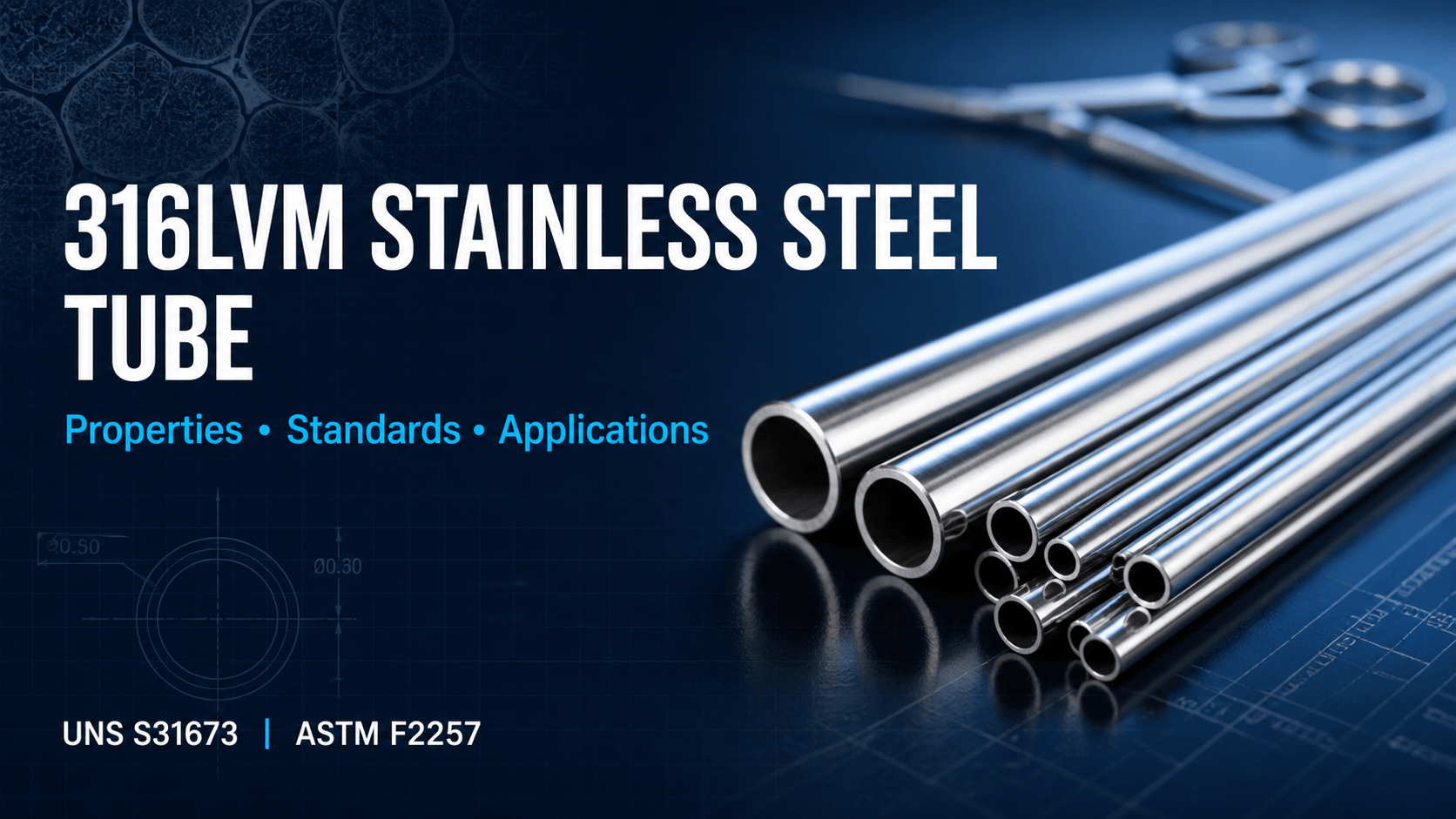
316LVM stainless steel tube is a high-purity, molybdenum-alloyed austenitic stainless steel tubing material produced from vacuum-remelted steel. It is generally associated with UNS S31673 and is widely considered for applications requiring controlled chemistry, structural homogeneity, high surface quality, corrosion resistance, and reliable mechanical performance.
Unlike conventional 316L stainless steel, 316LVM is produced with additional emphasis on material cleanliness and metallurgical consistency. A representative medical-grade 316LVM specification describes the alloy as vacuum-remelted, molybdenum-alloyed austenitic stainless steel characterized by high strength, fatigue strength, microcleanliness, structural homogeneity, and high-quality surface finish. citeturn686245view0
Because of these characteristics, 316LVM stainless steel tubing is especially relevant to precision industries, including medical devices, surgical components, instrumentation, and other demanding engineering applications.
What Does 316LVM Mean?
The designation can be understood as follows:
316 – A chromium-nickel-molybdenum austenitic stainless steel family.
L – Indicates low carbon content.
VM – Commonly refers to vacuum-melted or vacuum-remelted processing used to improve material cleanliness and consistency.
The low carbon content helps reduce the risk of chromium carbide precipitation during thermal processing and welding, while molybdenum contributes to resistance against localized corrosion.
The vacuum-remelting process is one of the most important differences between standard commercial 316L and 316LVM. It is intended to provide a cleaner and more homogeneous material structure, which is particularly important when tubing will be used for precision or critical components.
316LVM Stainless Steel Chemical Composition
316LVM is based on a chromium-nickel-molybdenum alloy system. Exact composition requirements should always be confirmed according to the specified material standard and purchase documentation.
A representative nominal 316LVM medical-grade composition is shown below. citeturn686245view0
| Element | Representative Content |
|---|---|
| Carbon (C) | ≤ 0.025% |
| Silicon (Si) | 0.6% |
| Manganese (Mn) | 1.7% |
| Phosphorus (P) | ≤ 0.025% |
| Sulfur (S) | ≤ 0.003% |
| Chromium (Cr) | 17.5% |
| Nickel (Ni) | 14% |
| Molybdenum (Mo) | 2.8% |
| Copper (Cu) | ≤ 0.10% |
| Nitrogen (N) | ≤ 0.10% |
These values should be regarded as a representative reference rather than a universal purchasing specification. Final requirements depend on the applicable ASTM, ISO, customer, and product specifications.
Key Properties of 316LVM Stainless Steel Tube
1. High Material Cleanliness
One of the primary reasons for selecting 316LVM rather than conventional 316L is its high degree of metallurgical cleanliness.
Vacuum-remelted material is designed to minimize unwanted inclusions and improve consistency throughout the material. This characteristic is particularly important for small-diameter tubes and components that may undergo extensive cold working, forming, machining, or precision finishing.
High microcleanliness is recognized as one of the characteristic features of 316LVM.
2. Good Corrosion Resistance
The chromium-nickel-molybdenum composition provides resistance to many corrosive environments. Molybdenum is particularly important for improving resistance to localized forms of corrosion such as pitting and crevice corrosion.
Medical-grade 316LVM is reported to provide good resistance to general, intergranular, pitting, and crevice corrosion in physiological environments.
However, corrosion performance always depends on factors such as:
Chloride concentration
Temperature
Surface condition
Fabrication process
Cleaning and passivation
Exposure time
Applied stress
Therefore, material suitability should be evaluated according to the actual operating environment.
3. High Strength
316LVM tubing can be supplied in different metallurgical conditions, including annealed and cold-worked conditions.
Cold working can significantly increase tensile and yield strength, allowing manufacturers to produce thin-wall components while maintaining demanding mechanical performance.
Representative technical data for 316LVM tubing shows that mechanical properties vary significantly depending on tube dimensions and whether the material is annealed or cold worked.
4. Good Fatigue Performance
Fatigue resistance is important for components exposed to repeated cyclic loading.
The combination of controlled chemistry, high microcleanliness, homogeneous structure, and suitable mechanical processing makes 316LVM attractive for components in which cyclic mechanical loading is an important design consideration.
5. Excellent Surface Finish Potential
Precision tubing often requires highly controlled internal and external surfaces.
316LVM can be manufactured with bright, polished, or specially finished surfaces depending on the application. For medical and precision-engineering applications, surface roughness and cleanliness may be specified together with dimensional tolerances.
A high-quality 316LVM tube surface can help support subsequent processes such as:
Precision machining
Electropolishing
Passivation
Forming
Laser processing
Cleaning
Component assembly
316LVM Stainless Steel Tube Standards
Material standards are especially important when purchasing 316LVM tubing.
UNS S31673
The recognized UNS designation associated with implant-grade 316LVM stainless steel is:
UNS S31673
ISO documentation identifies the wrought stainless steel covered by ISO 5832-1 as corresponding to UNS S31673 under ASTM F138 and ASTM F139.
ASTM F138
ASTM F138 covers wrought 18Cr-14Ni-2.5Mo stainless steel bar and wire for surgical implant applications under UNS S31673.
It is frequently referenced when discussing the base material chemistry and metallurgical requirements associated with 316LVM.
ASTM F2257
For small-diameter tubing, ASTM F2257 is particularly relevant.
ASTM F2257 covers wrought seamless or welded-and-drawn 18Cr-14Ni-2.5Mo stainless steel small-diameter tubing used for the manufacture of surgical implants. The ASTM specification covers requirements including chemistry, dimensions and mechanical properties.
Under ASTM F2257, the material is required to conform to applicable requirements of ASTM F138 for seamless material or ASTM F139 for welded-and-drawn material.
ISO 5832-1
ISO 5832-1:2024 specifies characteristics and associated test methods for wrought stainless steel intended for the manufacture of surgical implants.
The 2024 edition identifies the alloy as corresponding to UNS S31673 in ASTM F138 and ASTM F139.
For international procurement, buyers should specify the exact standard and edition required rather than simply requesting “316LVM.”
316LVM vs. 316L Stainless Steel Tube
Although the two materials are closely related, 316LVM stainless steel tube and conventional 316L stainless steel tube should not automatically be considered interchangeable.
| Feature | 316L Stainless Steel Tube | 316LVM Stainless Steel Tube |
| Stainless steel family | Austenitic | Austenitic |
| Carbon content | Low | Low |
| Molybdenum alloyed | Yes | Yes |
| Vacuum remelting | Not necessarily | Characteristic feature |
| Material cleanliness | Standard commercial control | Higher cleanliness emphasis |
| Structural homogeneity | Good | More tightly controlled |
| Precision medical applications | Application-dependent | Commonly selected |
| Typical UNS designation | S31603 | S31673 |
| Relevant implant standards | Not normally specified simply as commercial 316L | ASTM F138/F2257 and ISO 5832-1 may apply |
The distinction is particularly important for medical-device, implant, and precision-engineering procurement.
A buyer requiring UNS S31673 tubing should not substitute ordinary UNS S31603 tubing unless the design authority and applicable specification explicitly permit it.
Manufacturing of 316LVM Stainless Steel Tube
Depending on dimensional and application requirements, 316LVM tubing may be manufactured through processes such as:
Seamless Tube Production
Seamless tubing eliminates a longitudinal weld seam and can be processed through multiple cold-drawing and heat-treatment stages to achieve controlled dimensions and mechanical properties.
For critical small-diameter tubing, seamless production may be selected where uniform structure and dimensional precision are required.
Welded and Drawn Tubing
316LVM can also be manufactured through welding followed by drawing operations.
The drawing process reduces dimensions, improves dimensional accuracy, and can modify the mechanical properties and surface characteristics of the tube.
ASTM F2257 specifically addresses both seamless and welded-and-drawn small-diameter tubing used for surgical implant manufacture.
Cold Drawing
Cold drawing is frequently used to produce:
Smaller outside diameters
Thin wall thicknesses
Tight dimensional tolerances
Improved surface quality
Increased mechanical strength
Multiple drawing and annealing operations may be used depending on the final specification.
Heat Treatment
Annealing is used to restore ductility, control microstructure, and achieve required mechanical properties after cold deformation.
Alternatively, certain tubing may be supplied in a cold-worked condition when higher strength is required.
Typical Applications of 316LVM Stainless Steel Tube
Medical Devices
316LVM is strongly associated with medical and surgical-device manufacturing because of its controlled composition, high material cleanliness, mechanical performance, and surface quality.
316LVM materials are used in orthopedic, cardiovascular and surgical applications, while the precise suitability of any specific tube must be evaluated against the applicable device design and regulatory requirements.
Orthopedic Components
Potential applications include components associated with:
Trauma fixation systems
Orthopedic fixation devices
Bone screws and related components
Spinal systems
Surgical fixation assemblies
Cardiovascular Components
Precision stainless steel tubing may also be considered for cardiovascular-device components where small dimensions, surface finish and mechanical consistency are important.
Surgical Instruments
316LVM can be considered for precision components used in surgical instruments and related tools.
Precision Engineering
Outside direct implant applications, the combination of cleanliness, corrosion resistance, surface quality and mechanical consistency may make 316LVM useful in other high-specification applications where ordinary commercial stainless steel does not provide the required level of material control.
Important Specifications When Purchasing 316LVM Stainless Steel Tube
When requesting a quotation, buyers should provide more than just the material grade.
A professional purchasing specification should include:
Material Grade:
316LVM / UNS S31673
Applicable Standard:
ASTM F2257, ASTM F138-related requirements, ISO 5832-1, or another applicable customer specification
Manufacturing Method:
Seamless or welded and drawn
Outside Diameter:
Specified in millimeters or inches
Wall Thickness:
Required nominal wall thickness and tolerance
Length:
Straight length or other specified form
Condition:
Annealed, cold worked, or other required condition
Surface Finish:
Bright annealed, polished, mechanically polished, or other specified finish
Surface Roughness:
Ra requirement where applicable
Dimensional Tolerances:
OD, ID, wall thickness, straightness and length tolerances
Mechanical Properties:
Required tensile strength, yield strength and elongation
Documentation:
Material certificates, chemical analysis, mechanical test data, inspection reports and other documents required by the purchase specification
Clearly defining these parameters can reduce procurement risk and help ensure that the delivered tubing matches the intended manufacturing process.


How to Choose a 316LVM Stainless Steel Tube Supplier
For international buyers, selecting a supplier should involve more than comparing price.
Material Traceability
The supplier should be able to provide clear identification of the material grade, heat or batch information, and applicable material documentation when required.
Dimensional Control
Small-diameter and thin-wall tubing can require extremely precise dimensional control. Buyers should specify acceptable tolerances before production.
Surface Quality
For precision applications, scratches, pits, contamination, and uncontrolled surface roughness may affect downstream manufacturing.
Surface requirements should therefore be included directly in the purchase specification.
Testing Requirements
Depending on the application, buyers may request:
Chemical composition testing
Tensile testing
Dimensional inspection
Surface roughness inspection
Non-destructive testing
Metallurgical examination
Material certification
Standard Compliance
The required ASTM, ISO, customer, or regulatory specification should always be identified on the purchase order.
For medical-device applications in particular, specifying only “316LVM” is not sufficient to establish that a finished product is suitable for a particular medical use. Material, manufacturing process, testing, device design and regulatory requirements must all be considered.
Conclusion
316LVM stainless steel tube is a high-purity, vacuum-remelted austenitic stainless steel tubing material designed for applications requiring excellent material cleanliness, structural consistency, corrosion resistance, mechanical performance and high-quality surface finish.
Its association with UNS S31673, together with standards such as ASTM F2257, ASTM F138 and ISO 5832-1, makes it particularly important for precision medical and engineering applications. citeturn686245view1turn968761view0
When purchasing 316LVM tubing, buyers should clearly specify the required standard, dimensions, manufacturing method, mechanical condition, surface finish, tolerances, testing and documentation requirements.
For international sourcing inquiries or to discuss your required stainless steel tube specifications, contact GF Steel.
GF Steel
Email: [email protected]
WhatsApp: +86 191 3816 4778

Get Your Next Project Done!
China Steel Supplier & Manufacturer
THE LARGEST METALS MANUFACTURING
GengFei Steel is a professional “Steel Supplier” located in China, we provide supply service of stainless steel, carbon steel, aluminum and other metal materials.
As an industry-leading company, we are committed to providing our customers with the highest quality raw materials backed by first-class customer service and support. Our wide range of supply includes all kinds of stainless steel plate, tube, wire rod and carbon steel plate, tube, bar and so on. Our team of experienced professionals can help you choose the material that best suits your project needs and ensure your order is delivered on time. Our clients range from small businesses to large manufacturers, and we can provide professional service and support no matter the size of your needs.