
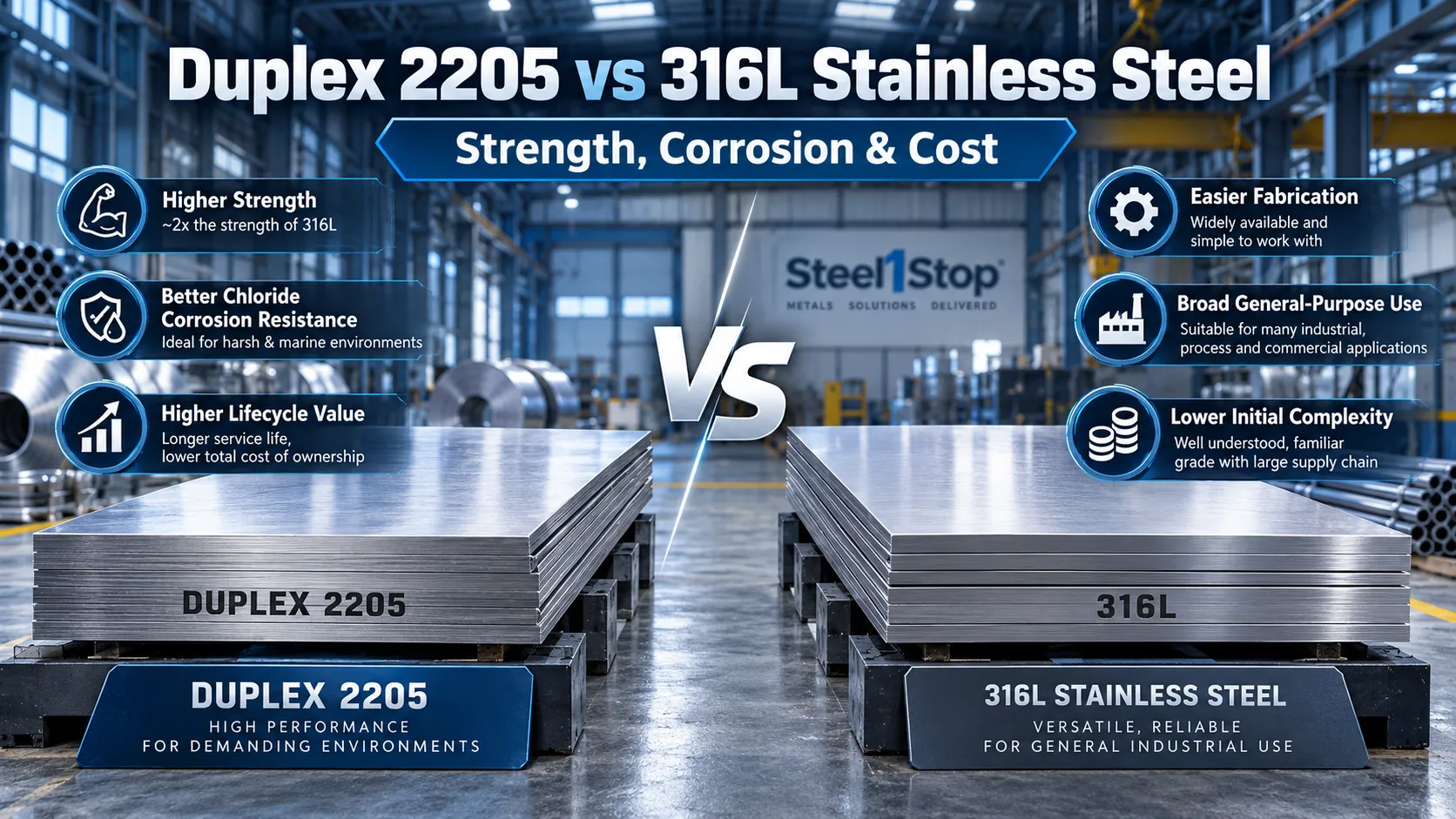
Saat membandingkan Baja tahan karat dupleks 2205 vs 316L, perbedaan terpenting adalah kekuatan mekanik, ketahanan korosi klorida, struktur mikro, persyaratan fabrikasi, dan total biaya proyek.
Duplex 2205 umumnya merupakan titik awal yang lebih baik ketika kekuatan tinggi, ketahanan terhadap lubang yang disebabkan oleh klorida, dan retak korosi tegangan klorida sangat penting. 316L seringkali lebih praktis untuk pemrosesan kimia umum, peralatan higienis, fabrikasi kompleks, dan aplikasi yang ketahanan terhadap korosinya sudah memadai.
Perbedaannya sangat besar. Berdasarkan spesifikasi pelat ASTM A240 yang umum direferensikan, Duplex 2205 (UNS S32205) memiliki kekuatan leleh minimum 450 MPa dibandingkan dengan 170 MPa untuk 316L (UNS S31603).
Namun, ini tidak berarti 2205 secara otomatis merupakan material yang lebih baik untuk setiap proyek. Baja dupleks memerlukan perhatian lebih pada kualifikasi prosedur pengelasan, keseimbangan fasa, batasan suhu, dan verifikasi material.
Untuk pembeli industri yang mencari pelat baja tahan karat, koil, pipa, atau peralatan tekanan, keputusan yang tepat harus dipertimbangkan paparan korosi, suhu pengoperasian, tekanan desain, persyaratan fabrikasi, standar yang berlaku, dan total biaya siklus hidup.
Duplex 2205 vs 316L Stainless Steel: Perbandingan Cepat
Tabel berikut merangkum perbedaan utama antara kedua kelas tersebut.
| Milik | Dupleks 2205 (S32205) | 316L (S31603) |
|---|---|---|
| Keluarga Baja Tahan Karat | Rangkap | Austenitic |
| Struktur mikro | Ferit + Austenit | Kaum Austenit |
| nilai AS | S32205 / S31803 | S31603 |
| Kelas EN Umum | 1.4462 | 1.4404 |
| Kromium | 22–23% | 16–18% |
| Nikel | 4,5–6,5% | 10–14% |
| Molybdenum | 3,0–3,5% | 2,0–3,0% |
| Nitrogen | 00,14–0,20% | ≤0,10% |
| Kekuatan Hasil Minimum | 450 MPa | 170 MPa |
| Kekuatan Tarik Minimum | 655 MPa | 485 MPa |
| Perpanjangan Minimum | 25% | 40% |
| PREN yang khas | 35–37 | 24–26 |
| Ketahanan Korosi Umum | Sangat bagus di banyak lingkungan | Sangat bagus di banyak lingkungan |
| Resistensi Lubang Klorida | Lebih tinggi | Lebih rendah |
| Resistensi Klorida SCC | Jauh lebih tinggi | Lebih rentan |
| Kemampuan las | Baik dengan prosedur yang terkendali | Umumnya lebih mudah |
| Sifat mampu bentuk yang dingin | Lebih menuntut | Lebih baik |
| Kemampuan mesin | Lebih sulit | Umumnya lebih mudah |
| Perilaku Magnetik | Magnet | Biasanya bersifat magnetis lemah saat dianil |
| Suhu Tinggi | Lebih dibatasi | Rentang aplikasi potensial yang lebih luas |
| Aplikasi Kriogenik | Membutuhkan kualifikasi yang cermat | Umumnya disukai |
| Aplikasi khas | Lepas pantai, desalinasi, peralatan kimia, sistem berkekuatan tinggi | Pemrosesan makanan, obat-obatan, perpipaan dan tangki industri umum |
Sifat mekanis adalah nilai minimum yang ditentukan untuk produk pelat anil berdasarkan persyaratan ASTM A240 yang relevan. Sifat pipa, tabung, batangan, tempa, dan produk pengerjaan dingin mungkin berbeda.
Panduan Seleksi Cepat
Memilih Duplex 2205 Kapan:
- Diperlukan kekuatan luluh yang lebih tinggi.
- Lubang klorida dan korosi celah merupakan masalah utama.
- Penerapannya melibatkan potensi retak korosi tegangan klorida.
- Mengurangi bobot struktural dapat bermanfaat setelah verifikasi teknis.
- Proyek ini dapat mengakomodasi prosedur pengelasan dan inspeksi dupleks yang memenuhi syarat.
Memilih 316L Kapan:
- Ketahanan korosinya cukup untuk lingkungan yang diinginkan.
- Pembentukan atau fabrikasi yang rumit itu penting.
- Peralatan tersebut memerlukan prosedur pengelasan austenitik yang telah ditetapkan.
- Ketangguhan suhu rendah merupakan pertimbangan utama.
- Ketersediaan bahan yang lebih banyak dan proses yang mudah merupakan prioritas.
Apa itu Baja Tahan Karat Dupleks 2205?
Duplex 2205 adalah baja tahan karat kromium-nikel-molibdenum-nitrogen yang mengandung ferit dan austenit dalam struktur mikronya.
Istilahnya rangkap mengacu pada struktur dua fase ini.
Tidak seperti baja tahan karat austenitik konvensional, yang sebagian besar terdiri dari austenit setelah anil yang tepat, Duplex 2205 mengandung proporsi kedua fase yang substansial.
Struktur khas larutan anil 2205 memiliki ferit dan austenit yang kira-kira seimbang, meskipun proporsi pastinya bervariasi menurut komposisi dan pemrosesan.
Mengapa Struktur Mikro Dupleks Penting?
Ferit dan austenit menyumbangkan sifat material yang berbeda.
Ferit berkontribusi terhadap kekuatan tinggi dan peningkatan ketahanan terhadap retak korosi tegangan klorida.
Austenit menyumbang keuletan dan ketangguhan.
Ketika fase-fasa tersebut seimbang dengan baik, paduan tersebut menggabungkan karakteristik yang sangat berharga dalam lingkungan industri yang menuntut.
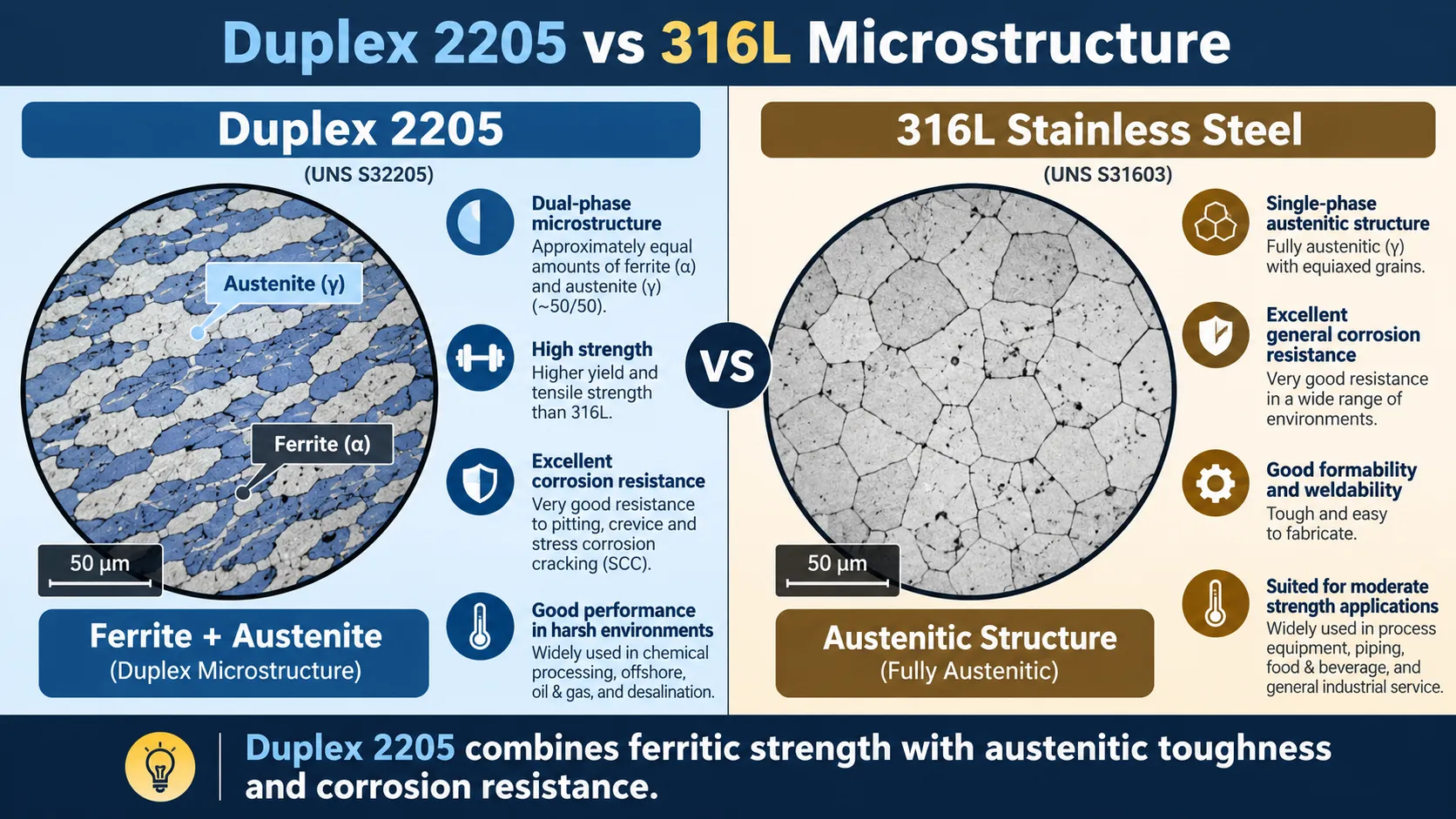
Struktur mikro yang ditampilkan adalah ilustrasi teknik dan bukan pengukuran metalografi bersertifikat.
Keuntungan Utama Dupleks 2205
Kekuatan mekanik yang tinggi
2205 memberikan kekuatan luluh spesifik yang jauh lebih tinggi dibandingkan 316L anil konvensional.
Hal ini dapat memberikan keuntungan pada peralatan bertekanan, struktur fabrikasi, dan komponen yang desainnya dikontrol oleh kekuatan.
Improved chloride corrosion resistance
The combination of chromium, molybdenum, and nitrogen improves resistance to chloride-induced pitting and crevice corrosion.
Better resistance to chloride SCC
Duplex stainless steels are generally more resistant than standard austenitic grades to chloride stress corrosion cracking under comparable conditions.
Potential weight reduction
Higher strength may allow lighter designs when the governing design standards permit it.
Useful performance in demanding industrial systems
2205 is widely considered for chemical processing, pulp and paper equipment, offshore facilities, and selected water-treatment applications.
Limitations of Duplex 2205
Despite these advantages, 2205 requires careful application assessment.
Potential limitations include:
- More demanding welding process control
- Kekuatan pembentuk yang lebih tinggi
- Pemesinan yang lebih sulit
- Layanan suhu tinggi jangka panjang yang terbatas
- Kesesuaian yang lebih rendah untuk aplikasi kriogenik dibandingkan banyak jenis austenitik
- Persyaratan inspeksi tambahan dalam aplikasi kritis
Penawaran Steel1Stop Duplex 2205 Stainless Steel Coil untuk aplikasi industri yang membutuhkan kekuatan dan ketahanan korosi yang lebih tinggi.
Apa itu Baja Tahan Karat 316L?
316L adalah baja tahan karat austenitik rendah karbon yang mengandung kromium, nikel, dan molibdenum.
Sebutan UNS-nya adalah S31603.
Surat itu L menunjukkan kandungan karbon maksimum yang lebih rendah dibandingkan 316 konvensional, membantu mengurangi kerentanan terhadap sensitisasi dan korosi intergranular yang terkait dengan paparan termal dan kondisi pengelasan tertentu.
316L banyak digunakan karena memberikan kombinasi praktis antara ketahanan korosi, keuletan, ketangguhan, dan keserbagunaan manufaktur.
Keuntungan dari Baja Tahan Karat 316L
Ketahanan korosi umum yang baik
Penambahan molibdenum meningkatkan ketahanan terhadap korosi lokal dibandingkan dengan baja tahan karat 304 konvensional.
Karakteristik fabrikasi yang sangat baik
316L dapat dipotong, ditekuk, digulung, dilas, dan dibuat menggunakan teknik manufaktur yang sudah ada.
Ketangguhan suhu rendah yang baik
Struktur austenitiknya membuatnya menarik untuk banyak aplikasi suhu rendah dan kriogenik, tergantung pada spesifikasi material dan desain yang relevan.
Penerimaan industri yang luas
316L umumnya ditentukan dalam pemrosesan kimia, peralatan makanan, sistem farmasi, tangki, dan perpipaan.
Rantai pasokan yang mapan
316L tersedia secara luas dalam berbagai bentuk dan dimensi produk.
Keterbatasan 316L
316L memiliki kekuatan luluh yang jauh lebih rendah dibandingkan 2205.
Hal ini juga lebih rentan terhadap retak korosi tegangan klorida dalam kondisi tertentu.
Meskipun 316L menawarkan ketahanan klorida yang lebih baik daripada 304, 316L tidak cocok untuk semua aplikasi kelautan atau aplikasi klorida tinggi.
Untuk nilai, hasil akhir, dan dimensi yang tersedia, lihat kami Kumparan baja tahan karat 316L halaman produk.
Komposisi Kimia: Dupleks 2205 vs 316L
Komposisi kimia menjelaskan banyak perbedaan kinerja antara kedua paduan ini.
Perbandingan Komposisi Kimia
| Elemen | Dupleks 2205 S32205 | 316L S31603 |
|---|---|---|
| Chromium (CR) | 22,0–23,0% | 16,0–18,0% |
| Nikel (NI) | 4,5–6,5% | 10,0–14,0% |
| Molybdenum (MO) | 3,0–3,5% | 2,0–3,0% |
| Nitrogen (N) | 00,14–0,20% | ≤0,10% |
| Karbon (C) | ≤0,030% | ≤0,030% |
| Mangan (MN) | ≤2,00% | ≤2,00% |
| Silikon (SI) | ≤1,00% | ≤0,75% |
| Besi (Fe) | Keseimbangan | Keseimbangan |
Batasan bahan kimia didasarkan pada spesifikasi produk datar ASTM yang umum direferensikan. Konfirmasikan kandungan kimia sebenarnya terhadap edisi standar yang berlaku dan Sertifikat Uji Pabrik.
Chromium: Perlindungan Film Pasif
Kromium sangat penting untuk pembentukan lapisan pasif pelindung pada baja tahan karat.
2205 mengandung lebih banyak kromium daripada 316L.
Hal ini berkontribusi terhadap ketahanan terhadap korosi, terutama jika dikombinasikan dengan molibdenum dan nitrogen.
Molibdenum: Ketahanan Korosi Lokal
Molibdenum meningkatkan ketahanan terhadap korosi lokal, khususnya korosi lubang dan celah di lingkungan yang mengandung klorida.
2205 umumnya mengandung lebih banyak molibdenum daripada 316L.
Namun, molibdenum saja tidak menentukan apakah suatu paduan tertentu cocok untuk lingkungan kimia yang agresif.
Nitrogen: Kekuatan dan Ketahanan Korosi
Nitrogen sangat penting dalam baja tahan karat dupleks modern.
Ini berkontribusi pada:
- Stabilisasi austenit
- Kekuatan mekanik yang lebih tinggi
- Peningkatan ketahanan terhadap korosi pitting
- Appropriate phase balance
The higher specified nitrogen content of S32205 is one reason its chemistry must be distinguished from the broader S31803 specification.
Why Does 2205 Contain Less Nickel?
Nickel stabilizes austenite.
Because 2205 is designed to contain both ferrite and austenite, its composition does not require the same nickel content as fully austenitic 316L.
This difference can influence alloy cost, although actual market prices depend on the total alloy composition, production route, and commercial conditions.
Mechanical Properties: How Much Stronger Is Duplex 2205?
One of the strongest reasons to consider 2205 is its high yield strength.
Under representative ASTM A240 plate requirements, 2205 S32205 has more than twice the minimum yield strength of 316L.
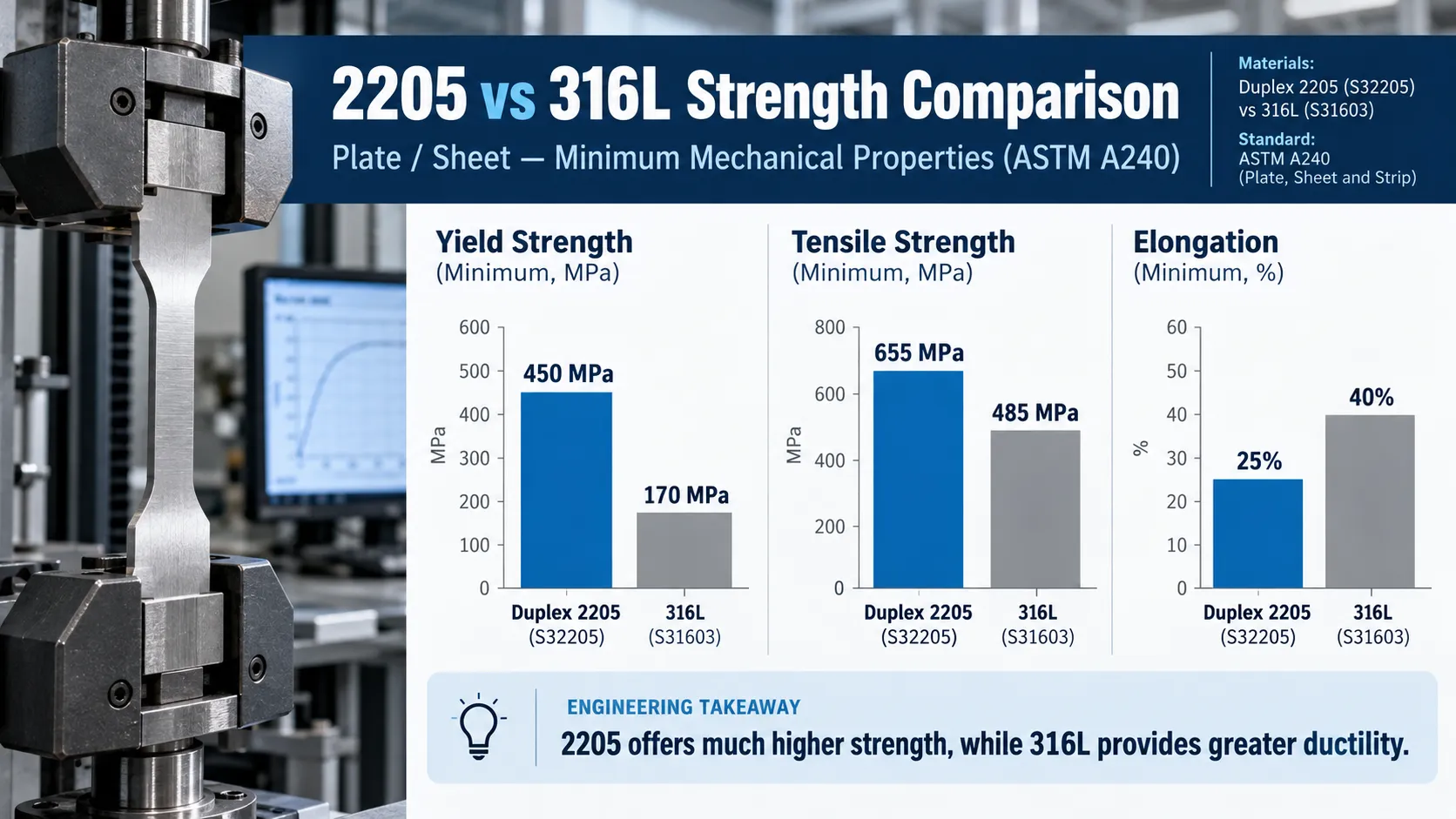
Minimum Mechanical Properties
| Milik | 2205 S32205 | 316L S31603 |
|---|---|---|
| Kekuatan luluh | 450 MPa | 170 MPa |
| Kekuatan tarik | 655 MPa | 485 MPa |
| Pemanjangan | 25% | 40% |
| Kepadatan | ~7.82 g/cm³ | ~8.03 g/cm³ |
These values represent specified minimum properties for the referenced plate condition, not actual test results from an individual production heat.
Kekuatan luluh
Yield strength represents the stress at which permanent plastic deformation begins.
The difference is substantial:
- 2205: minimum 450 MPa
- 316L: minimum 170 MPa
This makes 2205 attractive for components where resisting permanent deformation is important.
Kekuatan tarik
Tensile strength describes the maximum stress a material can withstand under tensile loading before fracture.
2205 also has a higher minimum tensile strength.
However, actual engineering design must use the allowable stress values specified by the relevant design code, not simply the minimum tensile strength.
Keuletan
316L typically offers greater elongation.
This is advantageous for applications requiring substantial forming, bending, or deformation during manufacturing.
Although 2205 can be successfully fabricated, greater forming forces and more careful procedure control are often necessary.
Can Duplex 2205 Reduce Plate Thickness or Pipe Wall Thickness?
Possibly, but only when supported by the design calculation.
Higher yield strength can allow thinner sections in certain applications.
For example, a pressure component may benefit if the governing allowable stress is substantially higher for 2205.
However, the design must also consider:
- Design pressure
- Suhu desain
- Stres yang diijinkan berdasarkan kode etik yang berlaku
- Tunjangan korosi
- Efisiensi sambungan las
- Tekanan eksternal dan tekuk
- Pemuatan kelelahan
- Defleksi dan kekakuan
- Ketebalan produksi minimum
- Toleransi fabrikasi
Bahan dengan kekuatan luluh minimum 2,6 kali tidak secara otomatis memungkinkan pengurangan ketebalan dinding sebesar 61%.
Untuk bejana tekan, desainnya harus mengikuti kode peralatan tekanan yang berlaku.
Untuk perpipaan, ketebalan dinding harus memenuhi kode perpipaan dan persyaratan proyek yang relevan.
Manfaat nyata dari 2205 bukan sekadar material yang lebih kuat; ini adalah kemungkinan untuk mencapai struktur rekayasa yang lebih efisien.
Ketahanan Korosi: Apakah 2205 Lebih Baik Dari 316L?
In many chloride-containing environments, Duplex 2205 offers significantly better resistance to pitting, crevice corrosion, and chloride stress corrosion cracking than 316L.
However, corrosion behavior depends on more than alloy designation.
Temperature, chemical composition, pH, chloride concentration, oxygen, deposits, flow conditions, and crevice geometry can all influence the result.
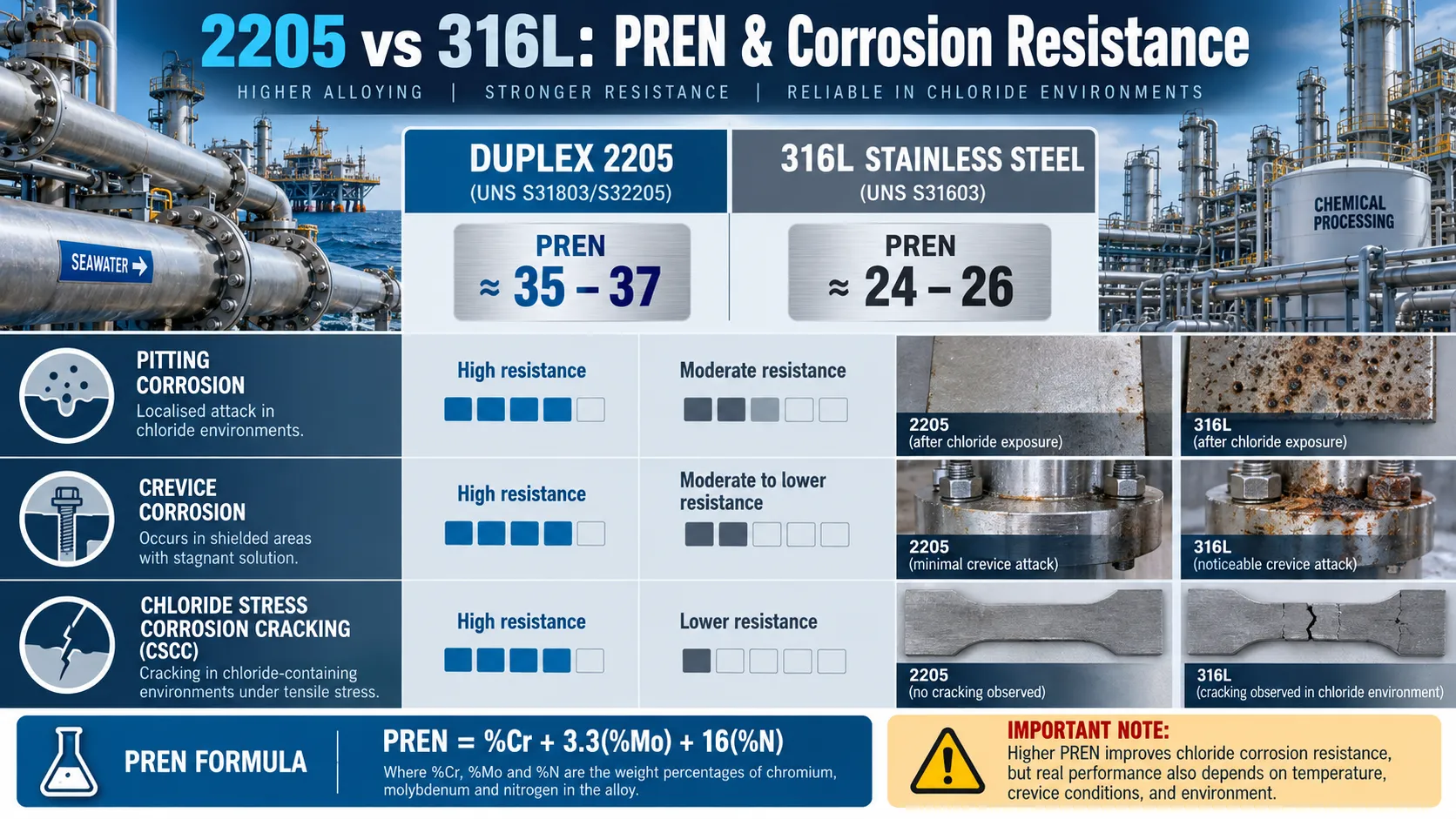
Illustrative comparison only. The corrosion specimens shown are conceptual images, not actual test results or evidence of a specific service-life difference.
Korosi Lubang
Pitting is a localized form of corrosion that can create small but deep cavities.
Chlorides can destabilize the passive film on stainless steel and contribute to pit initiation.
2205 generally offers greater resistance to chloride pitting because of its higher chromium, molybdenum, and nitrogen contents.
This advantage is valuable in selected:
- Chemical processing systems
- Chloride-containing process water
- Water treatment facilities
- Marine-related equipment
- Pulp and paper applications
Korosi Celah
Crevice corrosion occurs in narrow spaces where local solution chemistry can become more aggressive.
Contohnya meliputi:
- Flanged connections
- Gasket interfaces
- Bolted joints
- Overlapping metal surfaces
- Deposits
- Stagnant liquid areas
2205 offers improved resistance compared with 316L in many chloride environments.
Nevertheless, severe crevice conditions can cause corrosion in 2205 as well.
Good mechanical design, drainage, and material selection remain important.
Chloride Stress Corrosion Cracking
Stress corrosion cracking occurs when susceptible material, tensile stress, and an aggressive environment interact.
Austenitic stainless steels such as 316L can be vulnerable to chloride SCC under certain temperature and environmental conditions.
Duplex 2205 generally provides significantly greater resistance to this failure mechanism.
However, it is not immune to every form of environmental cracking.
In particular, hydrogen-related cracking and sulfide stress cracking in certain sour-service environments require separate assessment.
Seawater and Marine Applications
2205 is frequently considered for marine and seawater-related equipment.
Its improved corrosion resistance makes it a stronger starting material than 316L in many chloride-containing systems.
But 2205 should not be described as universally seawater-proof.
Warm seawater, stagnant conditions, crevices, deposits, high chloride levels, and particular flow conditions can create severe corrosion risks.
For highly demanding seawater applications, super duplex 2507, 6Mo stainless steel, or other corrosion-resistant alloys may be necessary.
Chemical Corrosion
Neither 2205 nor 316L is universally superior in every chemical.
Some environments favor austenitic grades because of the chemistry involved, while others favor duplex stainless steel.
Material selection should consider the actual process fluid and operating temperature.
Do not assume that higher PREN automatically means superior resistance to every acid or chemical solution.
PREN Comparison: 2205 vs 316L
PREN stands for Pitting Resistance Equivalent Number.
It is a calculated index commonly used to compare the potential localized corrosion resistance of stainless steels in chloride-containing environments.
A widely used formula is:
PREN = %Cr + 3.3 × %Mo + 16 × %N
Where:
- Cr = Chromium content, weight %
- Mo = Molybdenum content, weight %
- N = Nitrogen content, weight %
Typical PREN Values
| Nilai | PREN yang khas |
|---|---|
| 304 stainless steel | ~18–20 |
| 316L stainless steel | ~24–26 |
| Dupleks 2205 S32205 | ~35–37 |
| Super Duplex 2507 | ~40–43 or higher, depending on chemistry |
The values are indicative and depend on the actual chemical composition.
Example PREN Calculation for 2205
Assume an illustrative 2205 composition of:
- Chromium: 22%
- Molybdenum: 3.1%
- Nitrogen: 0.17%
PREN = 22 + (3.3 × 3.1) + (16 × 0.17)
PREN = 22 + 10.23 + 2.72
PREN ≈ 34.95
Does Higher PREN Mean Better Corrosion Resistance?
A higher PREN generally indicates improved potential pitting resistance in chloride-containing environments.
However, PREN does not directly predict service life.
It does not fully account for:
- Kondisi permukaan
- Welding defects
- Intermetallic phases
- Suhu
- Crevice geometry
- Solution chemistry
- Flow conditions
- Microbiological activity
For critical applications, use appropriate corrosion test data and project-specific material evaluation.
S31803 vs S32205: Are Both Duplex 2205?
Yes. Both UNS S31803 and UNS S32205 are commonly associated with Duplex 2205.
However, they are not identical chemical specifications.
This distinction matters when purchasing stainless steel for chloride-sensitive applications.
Chemical Composition Differences
| Elemen | S31803 | S32205 |
|---|---|---|
| Kromium | 21.0–23.0% | 22,0–23,0% |
| Nikel | 4,5–6,5% | 4,5–6,5% |
| Molybdenum | 2.5–3.5% | 3,0–3,5% |
| Nitrogen | 0.08–0.20% | 00,14–0,20% |
| Karbon | ≤0,030% | ≤0,030% |
S32205 has tighter minimum requirements for chromium, molybdenum, and nitrogen.
These limits provide greater confidence in the corrosion-resistance characteristics expected from modern 2205 material.
Can S32205 Be Dual-Certified as S31803?
A heat of material meeting the requirements of S32205 may also meet those of S31803, allowing dual certification when all applicable conditions are satisfied.
However, material meeting S31803 does not automatically meet S32205.
The purchaser should verify the actual chemical analysis and specification requirements.
What Should Buyers Specify?
Untuk proyek yang memerlukan bahan kimia modern 2205 yang lebih ketat, tentukan:
Dupleks 2205 / UNS S32205
Jika sertifikasi ganda diperlukan, nyatakan secara eksplisit.
Misalnya:
“Pelat Duplex 2205, sertifikasi ganda UNS S32205/S31803, ASTM A240/A240M, solusi anil, diperlukan MTC.”
Kata-kata yang benar bergantung pada spesifikasi material proyek.
Pengelasan dan Fabrikasi Duplex 2205 vs 316L
Kedua tingkatan tersebut dapat dilas dan dibuat dengan sukses, namun persyaratan pemrosesannya berbeda.
316L umumnya lebih mudah dibuat menggunakan prosedur baja tahan karat austenitik yang sudah dikenal.
Duplex 2205 memerlukan perhatian tambahan pada struktur mikro logam las dan zona yang terkena dampak panas.
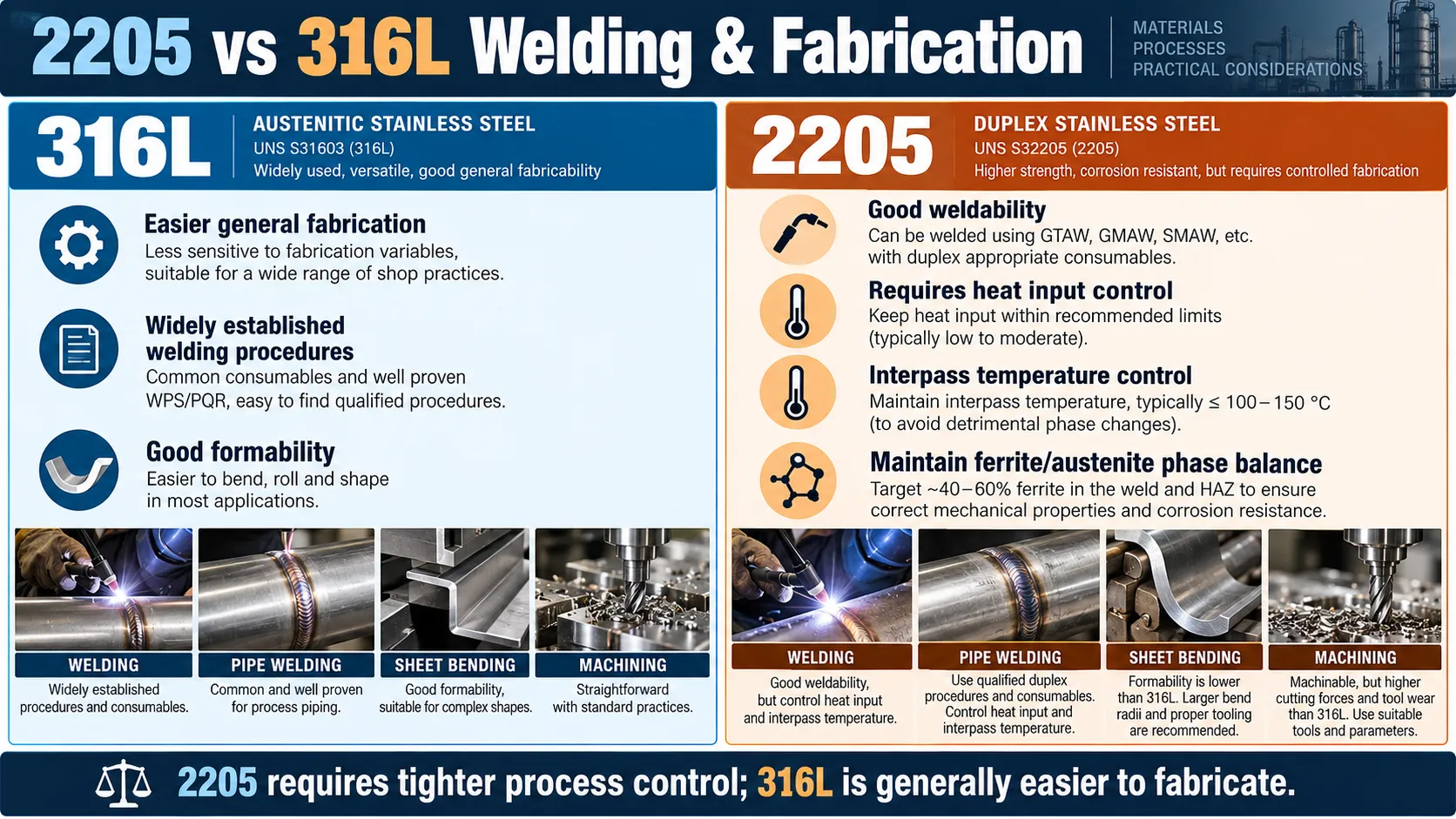
Welding 316L
316L is widely used in welded industrial equipment.
Suitable welding processes include:
- GTAW / TIG
- GMAW / MIG
- SMAW
- Other qualified procedures
Its low carbon content helps reduce sensitization concerns.
Nevertheless, welding quality, filler selection, heat input, joint design, and post-weld cleaning remain important.
Welding Duplex 2205
2205 is weldable, but its properties depend on maintaining a suitable microstructure after welding.
If cooling conditions or heat exposure are unsuitable, excessive ferrite or undesirable secondary phases may develop.
These changes can reduce toughness and corrosion resistance.
Ferrite and Austenite Phase Balance
Proper duplex welding procedures aim to maintain an acceptable ferrite/austenite balance.
This is achieved through control of:
- Heat input
- Interpass temperature
- Welding process
- Filler metal
- Shielding gas
- Joint geometry
- Cooling conditions
Acceptance criteria for ferrite content depend on the governing specification and welding procedure qualification.
Welding Consumables
For welding 2205 to similar duplex material, ER2209 and E2209-type consumables are commonly used.
These fillers are designed to help produce appropriate weld-metal chemistry and microstructure.
Different filler metals may be selected for dissimilar joints or more demanding corrosion conditions.
Heat Input and Interpass Temperature
Manufacturers of duplex stainless steel commonly recommend controlled heat input and relatively low interpass temperatures.
For example, published recommendations for certain 2205 products include interpass temperatures below approximately 150°C.
However, this must not be treated as a universal welding rule.
The project should use an approved Welding Procedure Specification (WPS) and supporting procedure qualification records.
Membungkuk dan Membentuk
316L generally requires lower forming forces.
2205 has higher strength and can therefore require:
- Greater press capacity
- Higher bending force
- Larger forming allowances
- More attention to springback
- Suitable tooling
Both grades can be fabricated, but process planning must reflect their different properties.
Pemesinan
2205 is generally more demanding to machine than 316L because of its higher strength and work-hardening behavior.
Appropriate tooling, cutting speeds, feeds, and coolant management are important.
For precision machined components, fabrication cost should be considered during material selection.
Temperature Limits: When Is 316L Better?
An important limitation of duplex stainless steels is their temperature-dependent microstructural stability.
2205 can provide excellent performance within its intended temperature range, but prolonged exposure at elevated temperatures may cause undesirable metallurgical changes.
Elevated-Temperature Service
Duplex stainless steels can undergo embrittlement or formation of detrimental phases after certain thermal exposures.
For this reason, continuous service at elevated temperatures often requires stricter limitations than for conventional austenitic stainless steels.
Depending on the product standard and design code, the practical allowable temperature may be restricted to approximately 250–300°C or another specified limit.
A single universal maximum temperature should not be used for every duplex product.
316L may offer advantages in some higher-temperature applications, although its own mechanical and corrosion limitations must still be evaluated.
Low-Temperature Service
316L generally offers better low-temperature toughness than 2205.
The austenitic structure of 316L is particularly advantageous in cryogenic service.
Duplex 2205 can be used in some subzero-temperature applications when properly qualified, but its ferrite-containing microstructure can limit toughness at sufficiently low temperatures.
For cryogenic equipment, 316L is generally the more appropriate starting material unless a qualified engineering assessment supports another choice.
Intermetallic Phase Formation
Improper thermal exposure can produce undesirable phases in duplex stainless steels.
These phases may impair:
- Kekerasan
- Resistensi korosi
- Keuletan
- Welded-joint performance
This is one reason heat treatment, welding procedures, and inspection requirements deserve special attention when specifying duplex materials.
Duplex 2205 vs 316L Cost Comparison
The cost comparison is more complicated than simply comparing two material prices.
2205 often involves more specialized production, qualification, and fabrication requirements.
316L generally benefits from broad availability and established fabrication practices.
However, alloy prices fluctuate, and the relative price per kilogram can change with nickel, molybdenum, product form, market conditions, and order quantity.
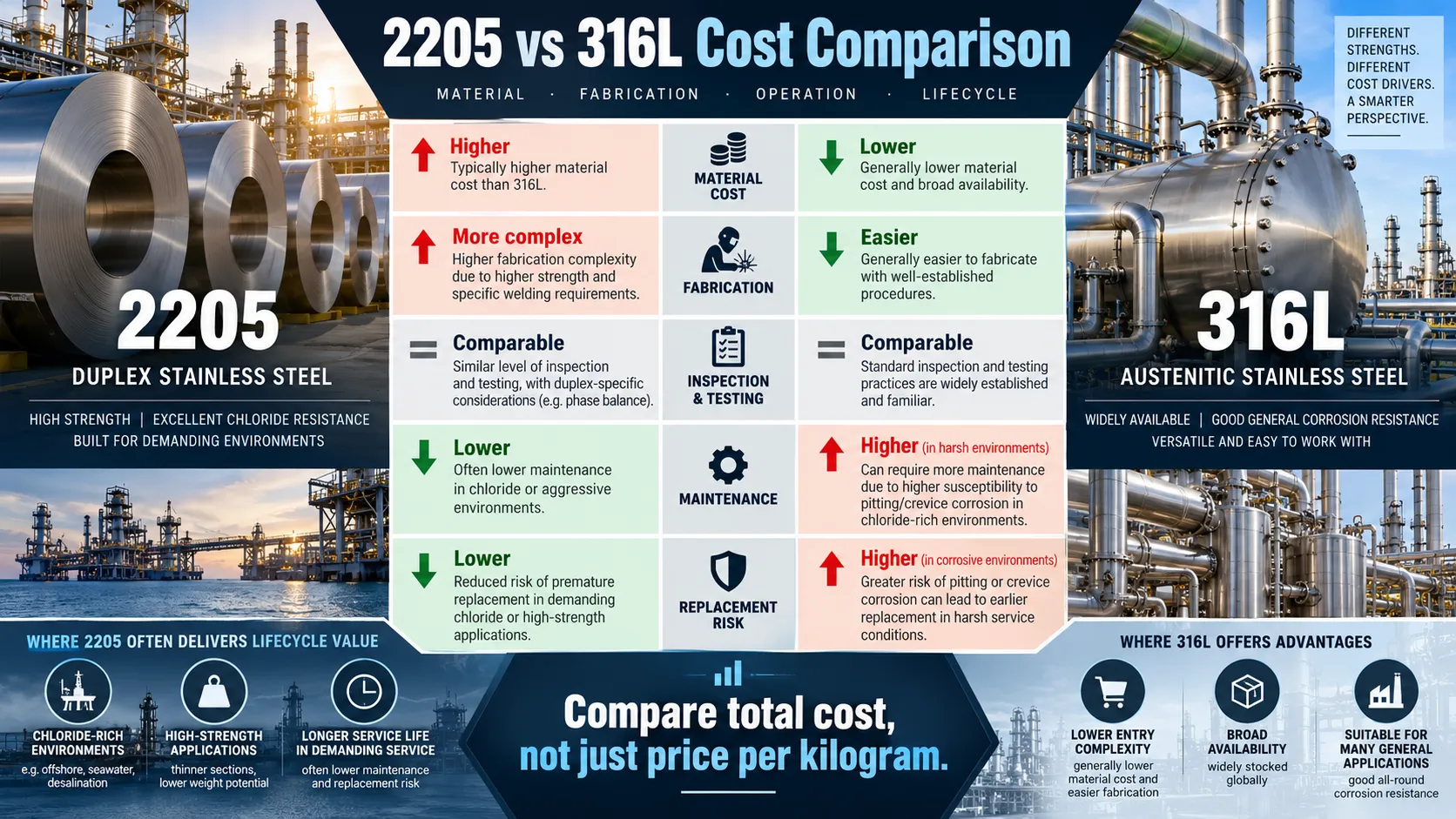
Material Cost
2205 may have a higher purchase price for certain products.
However, it contains less nickel than 316L.
Depending on alloy market conditions and mill production routes, the relative material cost can change.
It is therefore better to request quotations for the actual product specification rather than use a fixed percentage difference.
Fabrication Cost
2205 can require additional attention to:
- Welding procedures
- Heat input
- Filler metal
- Phase balance
- Pemesinan
- Pembentukan
- Inspeksi
For complex fabrication, this can increase manufacturing cost.
316L often offers advantages where the project involves many welded connections or complicated formed components.
Weight Savings
2205’s greater strength may permit thinner components where strength controls the design.
If engineering calculations support such a reduction, this can lower the quantity of material required.
For large vessels, piping systems, and structural components, material weight can influence both manufacturing and installation costs.
Maintenance and Replacement
In chloride environments where 316L is inadequate, properly selected 2205 may reduce corrosion-related maintenance and replacement risk.
That potential advantage can be particularly important in remote offshore facilities or industrial plants where downtime is expensive.
However, 2205 should not be assumed to provide a fixed service-life advantage without project-specific evidence.
Total Cost of Ownership
A realistic calculation should consider:
Total Project Cost = Material + Fabrication + Inspection + Installation + Maintenance + Downtime + Replacement
| Faktor Biaya | 2205 | 316L |
|---|---|---|
| Initial Material Cost | Market- and specification-dependent | Market- and specification-dependent |
| Welding Complexity | Higher process-control requirements | Umumnya lebih mudah |
| Forming Cost | Potentially higher | Biasanya lebih rendah |
| Inspeksi | May require duplex-specific testing | Conventional testing often sufficient |
| Potential Weight Reduction | Greater when design permits | Lebih terbatas |
| Chloride Corrosion Risk | Generally lower | Generally higher |
| Pemeliharaan | May be lower in appropriate chloride service | Depends on environment |
| Replacement Risk | May be lower when properly selected | Higher if corrosion limits are exceeded |
The best financial choice is the alloy that meets the service requirements with the lowest justified total project cost.
2205 vs 316L: Which Is Better for Different Applications?
The following application table provides a preliminary selection framework.
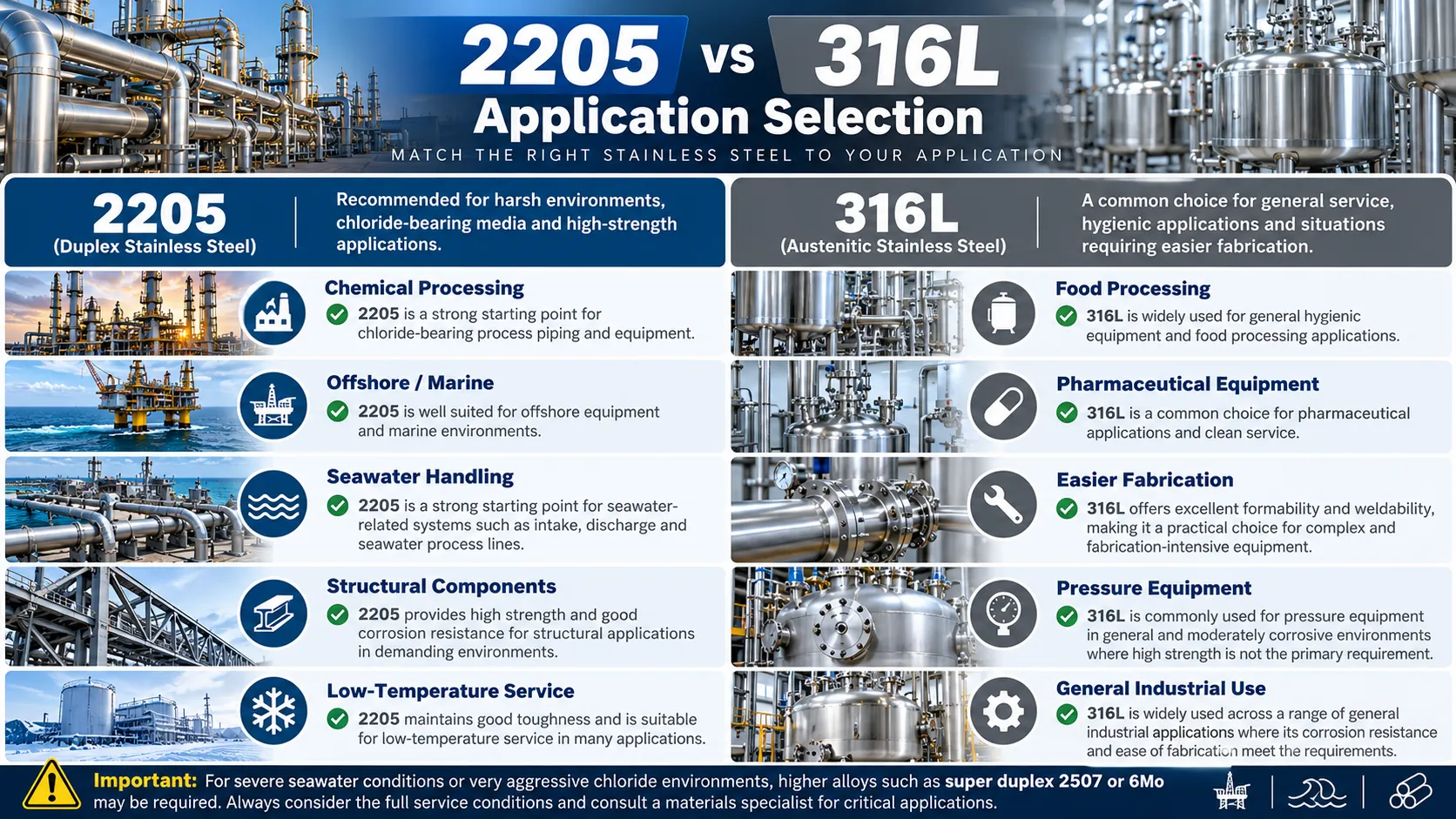
Application selection is illustrative. For low-temperature or cryogenic service, 316L generally deserves priority consideration over 2205; verify the relevant impact-toughness and design requirements.
| Aplikasi | Suggested Starting Grade | Pertimbangan Utama |
|---|---|---|
| General Chemical Tanks | 316L / 2205 | Exact process chemistry |
| Chloride-Bearing Process Piping | 2205 | Pitting and SCC resistance |
| Offshore Process Equipment | 2205 / higher alloys | Chlorides, pressure, temperature |
| Pendinginan Air Laut | 2205/2507/6Bulan | Risiko korosi lokal yang parah |
| Peralatan Desalinasi | 2205 atau lebih tinggi | Paparan klorida |
| Pengolahan Makanan Umum | 316L | Kebersihan dan fabrikasi |
| Peralatan Farmasi | 316L | Pembersihan dan kualitas permukaan |
| Bagian Struktural Berkekuatan Tinggi | 2205 | Kekuatan luluh |
| Kapal Tekanan | 316L / 2205 | Kode desain dan korosi |
| Tangki Industri Umum | 316L | Biaya dan fabrikasi |
| Peralatan Kriogenik | 316L | Ketangguhan suhu rendah |
| H₂S-Containing Oil & Gas Systems | Bahan berkualitas | Persyaratan layanan asam |
Rekomendasi-rekomendasi ini bukan pengganti penilaian pemilihan material formal.
Pemrosesan Kimia
2205 adalah kandidat kuat untuk beberapa aliran proses kimia yang mengandung klorida.
316L mungkin cukup untuk bahan kimia yang tidak terlalu agresif atau lingkungan yang kompatibilitas prosesnya cukup memuaskan.
Untuk asam pekat atau campuran kimia yang tidak biasa, tidak ada tingkatan yang boleh dipilih hanya pada PREN.
Peralatan Lepas Pantai dan Kelautan
2205 menawarkan kekuatan mekanik dan ketahanan korosi klorida yang berguna.
Hal ini menjadikannya berharga untuk struktur, perpipaan, dan peralatan proses lepas pantai tertentu.
Namun, tingkat keparahan paparan air laut harus dievaluasi secara hati-hati.
Dalam aplikasi bawah laut dan air laut yang agresif, material dengan paduan lebih tinggi mungkin diperlukan.
Kapal Tekanan
Kedua tingkatan tersebut digunakan untuk peralatan bertekanan jika diizinkan oleh kode yang berlaku.
2205 mungkin menawarkan peluang untuk mengurangi ketebalan dinding karena kekuatan izinnya yang tinggi.
316L dapat menyederhanakan fabrikasi dan pengelasan.
Pilihan terakhir harus mempertimbangkan tekanan, suhu, korosi, efisiensi sambungan, inspeksi, dan kode bejana tekan yang relevan.
Peralatan Makanan dan Farmasi
316L is widely used in hygienic systems because of its corrosion resistance, cleanability, and fabrication characteristics.
2205 may be considered where higher strength or more aggressive chloride conditions justify it.
For hygienic applications, the surface finish, weld quality, cleaning chemistry, and regulatory requirements are also important.
Oil and Gas Equipment
2205 is used in certain oil and gas environments.
However, H₂S-containing service requires a separate evaluation.
Materials must meet the relevant requirements of NACE MR0175 / ISO 15156 or other applicable sour-service standards.
Do not assume all 2205 products are automatically suitable for any H₂S environment.
For related material selection, see Steel1Stop’s guide to stainless steel in the oil and gas industry.
ASTM Standards for Duplex 2205 and 316L
The correct material standard depends on the product form.
A plate specification cannot automatically be applied to pipe, tubing, or forgings.
| Standar | Aplikasi |
|---|---|
| ASTM A240/A240M | Stainless steel plate, sheet, strip |
| ASTM A480/A480M | General flat-rolled stainless product requirements |
| ASTM A790/A790M | Seamless and welded duplex stainless steel pipe |
| ASTM A789/A789M | Seamless and welded duplex stainless steel tubing |
| ASTM A928/A928M | Electric-fusion-welded duplex stainless steel pipe |
| ASTM A182/A182M | Forged or rolled alloy and stainless steel piping components |
| ASTM A815/A815M | Wrought duplex stainless steel fittings |
| ASTM A312/A312M | Austenitic stainless steel pipe, including applicable 316L products |
| ASTM A269/A269M | Applicable austenitic stainless steel tubing |
| ASTM A923 | Detection of detrimental intermetallic phases in certain duplex stainless steels |
| ASTM G48 | Laboratory pitting and crevice corrosion testing |
Not every standard applies to every material grade or product condition.
The purchase order should use the applicable product specification and required edition.
ASTM A240/A240M
ASTM A240/A240M covers applicable stainless steel plate, sheet, and strip products.
For 2205 S32205 and 316L S31603, this standard provides relevant requirements for chemical composition and mechanical properties.
The applicable standard edition should be specified in the purchase order.
ASTM A923: Detrimental Intermetallic Phases
ASTM A923 provides methods for detecting detrimental intermetallic phases in certain duplex stainless steels.
These phases can reduce toughness and corrosion resistance.
The standard includes methods involving:
- Metallographic etching
- Charpy impact testing
- Ferric chloride corrosion testing
The applicable method and acceptance criteria must be defined according to the procurement or project requirements.
ASTM G48: Pitting and Crevice Corrosion Testing
ASTM G48 includes laboratory procedures for evaluating resistance to pitting and crevice corrosion in ferric chloride solutions.
It is useful for comparing materials and evaluating specific product or processing conditions.
However, a G48 test does not automatically establish performance in actual seawater or process chemistry.
ASTM A923 and ASTM G48 serve different purposes and should not be treated as interchangeable tests.
How to Verify Duplex 2205 Before Shipment
For high-value industrial projects, material verification is essential.
Spesifikasi pembelian harus menetapkan pengujian dan dokumentasi yang diperlukan sebelum produksi.
Sertifikat Uji Pabrik
MTC harus mengidentifikasi:
- Produsen atau pabrik
- Tingkat material
- penunjukan AS
- Nomor panas
- Komposisi Kimia
- Sifat mekanik
- Dimensi produk
- Kondisi perlakuan panas
- Standar yang berlaku
- Hasil pemeriksaan yang diperlukan
Verifikasi Kimia S32205
Jika proyek menentukan S32205, pastikan persyaratan kromium, molibdenum, dan nitrogen yang lebih ketat.
Hal ini sangat penting ketika pemasok mendeskripsikan S31803 dan S32205 hanya sebagai “2205.”
Pengujian PMI / XRF
XRF genggam dapat berguna untuk memeriksa elemen paduan utama termasuk kromium, nikel, dan molibdenum.
Namun, XRF genggam tidak dapat mengukur nitrogen atau karbon dengan andal.
Karena nitrogen penting bagi kimia S32205, analisis laboratorium yang sesuai diperlukan jika verifikasi independen terhadap kandungan nitrogen diperlukan.
Weld and Microstructure Inspection
Depending on the project requirements, duplex products or fabricated assemblies may require:
- Ferrite-content assessment
- Metallographic examination
- Corrosion testing
- Impact testing
- Weld inspection
- Inspeksi dimensi
Not every order requires all these tests.
Inspection requirements should reflect the product specification, service criticality, applicable codes, and contract.
How to Specify Duplex 2205 or 316L on an RFQ
A complete Request for Quotation helps suppliers identify the right material and provide more accurate pricing.
| Persyaratan | Contoh |
|---|---|
| Bahan | Duplex 2205 Stainless Steel |
| nilai AS | S32205 |
| Produk | Plate / Coil / Pipe / Tube |
| Standar | ASTM A240/A240M for plate |
| Ketebalan | 6 mm |
| Lebar | 1500 mm |
| Panjang | 6000 mm |
| Perlakuan panas | Solution annealed |
| Permukaan akhir | No.1 / specified finish |
| Kuantitas | 10 metric tons |
| MTC | Required, specified certificate type |
| PMI | As required |
| Corrosion Testing | If required by project |
| Impact Testing | If applicable |
| Sedang mengemas | Export packing |
| Tujuan | Negara dan pelabuhan |
Example RFQ: Duplex 2205 Plate
Material: Duplex 2205 Stainless Steel Plate
Grade: UNS S32205
Standar: ASTM A240/A240M
Thickness: 6 mm
Width: 1500 mm
Length: 6000 mm
Condition: Solution Annealed
Finish: No.1
Quantity: 10 Metric Tons
MTC: Required with heat-number traceability
Additional Testing: According to approved project specification
Tujuan: Untuk direkomendasikan
For pipe or tubing, also include:
- Diameter luar
- Wall thickness or schedule
- Seamless or welded construction
- Pipe length
- End preparation
- Pressure or service requirements
- Applicable dimensional and material standards
For pipe purchasing guidance, see our stainless steel pipe guide Dan panduan tabung metrik baja tahan karat.
Pertanyaan yang Sering Diajukan
Is Duplex 2205 stronger than 316L?
Ya. Berdasarkan spesifikasi pelat ASTM A240 yang mewakili, S32205 memiliki kekuatan leleh minimum 450 MPa dibandingkan dengan 170 MPa untuk 316L. Desain akhir tetap harus menggunakan tegangan ijin yang ditentukan oleh kode yang berlaku.
Apakah 2205 lebih tahan korosi dibandingkan 316L?
2205 umumnya menawarkan ketahanan yang lebih besar terhadap lubang klorida, korosi celah, dan retak korosi tegangan klorida. Namun, perilaku korosi bergantung pada lingkungan, dan 2205 tidak unggul di setiap media kimia.
Berapa PREN Duplex 2205?
S32205 modern biasanya memiliki PREN sekitar 35–37, bergantung pada komposisi sebenarnya dan perhitungan yang digunakan.
Berapa PREN baja tahan karat 316L?
316L umumnya memiliki PREN sekitar 24–26, meskipun nilai pastinya bergantung pada kimia paduannya.
Can 2205 replace 316L?
Sometimes. Substitution may offer advantages in high-strength or chloride-sensitive applications, but the design, fabrication procedures, operating temperature, standards, and service environment must be reviewed first.
Is 2205 suitable for seawater?
2205 can be suitable for selected seawater-related applications, but it is not universally resistant to all seawater conditions. Warm, stagnant, or severe crevice conditions may require more highly alloyed materials such as super duplex 2507 or 6Mo.
Is Duplex 2205 magnetic?
Yes. Duplex 2205 contains ferrite and is normally magnetic. Annealed 316L is usually weakly magnetic, although cold working can increase its magnetic response.
Can Duplex 2205 be welded to 316L?
Yes, dissimilar welding is possible using appropriately selected filler materials and qualified welding procedures. Weld-metal chemistry, microstructure, corrosion requirements, and service conditions must be considered.
Is S31803 the same as S32205?
Both are associated with 2205 duplex stainless steel, but S32205 has tighter minimum requirements for chromium, molybdenum, and nitrogen. A material meeting S31803 does not necessarily meet S32205.
Is 2205 more expensive than 316L?
It can be, especially for specialized products and fabrication-intensive projects. However, the actual price difference depends on alloy markets, product form, quantity, and certification requirements. Obtain current quotations for a reliable comparison.
Is 2205 suitable for pressure vessels?
Yes, it may be used in pressure equipment when permitted by the applicable material and design codes. Its higher strength can provide design advantages, but material selection and allowable stresses must be verified.
Is 2205 better for cryogenic service?
Not generally. Austenitic 316L is usually the preferred starting point for cryogenic service because of its low-temperature toughness. Duplex 2205 requires specific toughness and design qualification for low-temperature use.
What is the typical welding filler for 2205?
ER2209 or E2209-type consumables are commonly used for welding 2205 to similar duplex material. The final filler selection must follow the qualified welding procedure and service requirements.
What tests should buyers require for Duplex 2205?
At minimum, verify the applicable material standard, grade chemistry, mechanical properties, and MTC. For critical applications, ferrite assessment, ASTM A923, ASTM G48, impact testing, PMI, or additional inspections may be required.
When should I choose Super Duplex 2507 instead of 2205?
2507 may be appropriate for more severe chloride environments or when higher localized corrosion resistance is required. Selection should be based on actual operating conditions, corrosion testing, and engineering requirements.
Final Verdict: Duplex 2205 or 316L?
Duplex 2205 and 316L are both established industrial stainless steels, but they serve different engineering priorities.
Duplex 2205 is the strength- and chloride-resistance-oriented option.
It provides much higher specified yield strength and generally better resistance to chloride pitting, crevice corrosion, and chloride stress corrosion cracking.
It is particularly valuable when these performance characteristics justify its fabrication and inspection requirements.
316L is the versatile austenitic option.
It offers good corrosion resistance, excellent general fabrication characteristics, established welding procedures, and favorable low-temperature toughness.
For many industrial applications, 316L is fully adequate and may offer a more economical overall solution.
The correct decision should always consider:
Chemical Environment + Temperature + Pressure + Strength + Welding + Standards + Inspection + Lifecycle Cost
At Steel1Stop, we support international customers sourcing stainless steel materials for manufacturing, construction, industrial piping, chemical processing, and other engineering projects.
Explore our Duplex 2205 Stainless Steel Coil, Kumparan baja tahan karat 316L, Dan stainless steel plate and sheet product pages for material options and procurement information.
For accurate quotations, provide the required UNS grade, product standard, dimensions, quantity, service conditions, and inspection requirements.
Choosing the appropriate stainless steel grade before procurement helps control project costs, reduce material substitution risks, and improve long-term equipment performance.
