
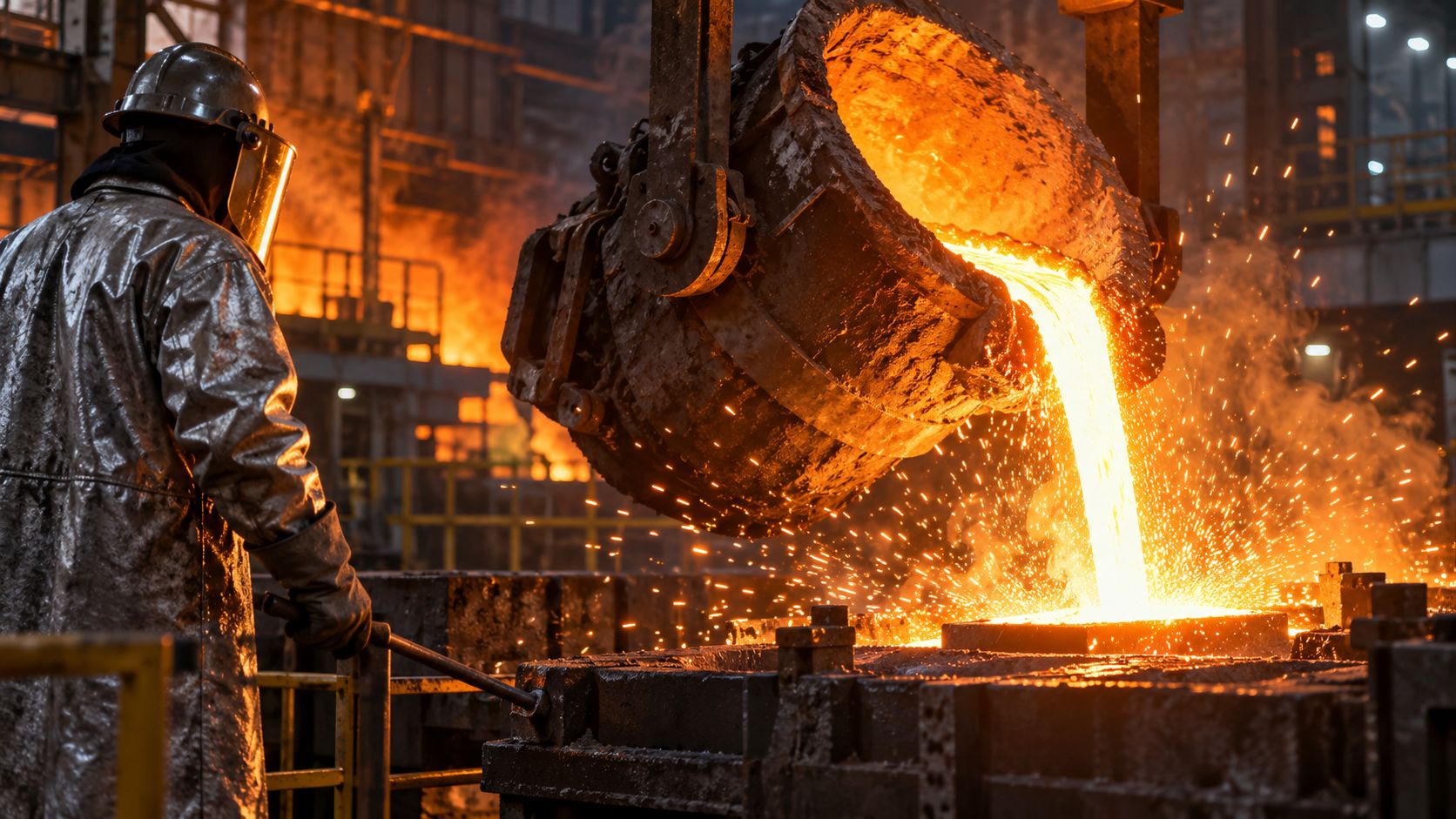
The melting point of a metal is the temperature at which it changes from a solid to a liquid. For pure metals, this transition normally occurs at a well-defined temperature. For engineering alloys such as carbon steel, stainless steel, brass, 6061 aluminum and 7075 aluminum, however, melting usually occurs across a temperature range rather than at one exact point.
For a quick reference:
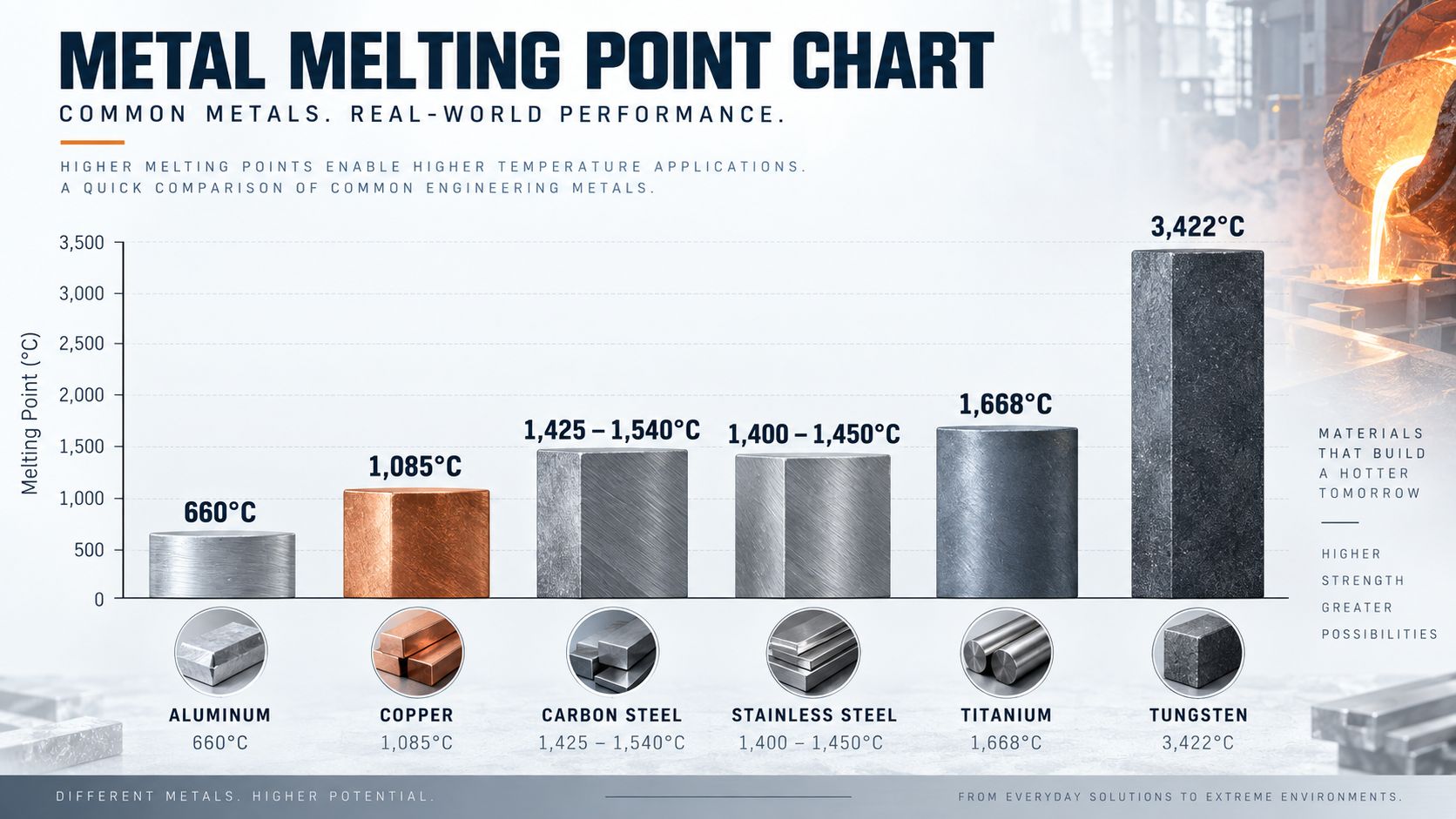
- Aluminiu: about 660°C / 1220°F
- Copper: about 1085°C / 1985°F
- Carbon steel: broadly about 1370–1540°C / 2500–2800°F depending on composition
- 304 stainless steel: about 1400–1450°C / 2550–2640°F
- Pure iron: about 1538°C / 2800°F
- Titanium: about 1668°C / 3034°F
- Tungsten: approximately 3420°C / 6190°F
The important engineering point is that melting point is not the same as maximum service temperature. A metal may lose strength, oxidize, creep or distort hundreds of degrees before it approaches its melting temperature.
Metal Melting Point Chart
The following chart compares common pure metals and engineering alloys.
For pure metals, the solidus and liquidus are essentially the same temperature. For alloys, the two values may be separated by tens or even hundreds of degrees.
| Metal or Alloy | Solidus / Melting Start | Liquidus / Fully Molten | Approx. °F Range | Tip de material |
|---|---|---|---|---|
| Tin | 232°C | 232°C | 449°F | Pure metal |
| Lead | 327°C | 327°C | 621°F | Pure metal |
| Zinc | 420°C | 420°C | 788°F | Pure metal |
| 7075 Aluminum | 477°C | 635°C | 890–1175°F | Aliaj |
| 2024 Aluminum | ~502°C | 638°C | ~935–1180°F | Aliaj |
| 6061 aluminiu | 582°C | 652°C | 1080–1205°F | Aliaj |
| 5052 Aluminum | ~607°C | 649°C | 1125–1200°F | Aliaj |
| 6063 Aluminum | 615°C | 655°C | 1139–1211°F | Aliaj |
| Pure Aluminum | 660°C | 660°C | 1220°F | Pure metal |
| Yellow Brass | ~905°C | ~932°C | ~1660–1710°F | Aliaj |
| Cupru | 1085°C | 1085°C | 1985°F | Pure metal |
| Cast Iron | ~1125°C | ~1205°C | ~2060–2200°F | Aliaj |
| Oțel de carbon | ~1370°C* | ~1540°C | ~2500–2800°F | Aliaj |
| 316 / 316L Stainless Steel | ~1375°C | ~1400°C | ~2507–2552°F | Aliaj |
| 304 / 304L Stainless Steel | ~1400°C | ~1450°C | ~2552–2642°F | Aliaj |
| Nichel | ~1455°C | ~1455°C | ~2651°F | Pure metal |
| Pure Iron | 1538°C | 1538°C | 2800°F | Pure metal |
| Titan | ~1668°C | ~1668°C | ~3034°F | Pure metal |
| Molibden | ~2620°C | ~2620°C | ~4750°F | Pure metal |
| Tantalum | ~3017°C | ~3017°C | ~5463°F | Pure metal |
| Tungsten | ~3420°C | ~3420°C | ~6190°F | Pure metal |
*Carbon steel covers a broad range of compositions. Many common low- and medium-carbon steels begin melting at temperatures closer to roughly 1425°C, while higher-carbon or differently alloyed materials can have lower solidus temperatures.
Values in melting-point tables should therefore be treated as engineering reference values rather than universal processing specifications. Exact melting behavior depends on chemical composition and, for some alloys, processing history.
What Is the Melting Point of a Metal?
A melting point is the temperature at which the solid and liquid phases of a material can coexist under a specified pressure.
For a relatively pure metal, the transition is sharp.
Pure aluminum, for example, melts at approximately 660.3°C. Pure copper melts at approximately 1084.6°C, while pure iron melts at approximately 1538°C.
Engineering materials are more complicated because most of the metals used in structures, machinery, vehicles and industrial equipment are not pure elements.
Steel contains iron plus carbon and other elements.
304 stainless steel contains iron, chromium, nickel and other controlled additions.
6061 aluminum contains magnesium, silicon, copper and other elements.
Brass is primarily an alloy of copper and zinc.
Because these alloying elements change phase at different temperatures and interact with each other, an alloy normally does not move instantly from 100% solid to 100% liquid.
Instead, it passes through a melting range.
Melting Point vs. Melting Range
This distinction is one of the most important things to understand when reading a metal melting point chart.
Pure Metals Have a Defined Melting Point
A pure metal usually has one characteristic melting temperature.
Examples include:
| Pure Metal | Approximate Melting Point |
|---|---|
| Aluminiu | 660°C |
| Cupru | 1085°C |
| Nichel | 1455°C |
| Fier | 1538°C |
| Titan | 1668°C |
| Tungsten | ~3420°C |
When pure aluminum reaches approximately 660°C under normal atmospheric conditions, the solid-to-liquid phase transition occurs around that temperature.
Alloys Usually Have a Melting Range
An alloy contains two or more elements, so different phases within the material do not necessarily melt simultaneously.
Examples include:
- carbon steel
- oţel inoxidabil
- 6061 aluminum
- 7075 aluminum
- brass
- bronze
- nickel alloys
For these materials, it is more technically useful to specify:
Solidus temperature → Liquidus temperature
rather than just one “melting point.”

What Are Solidus and Liquidus Temperatures?
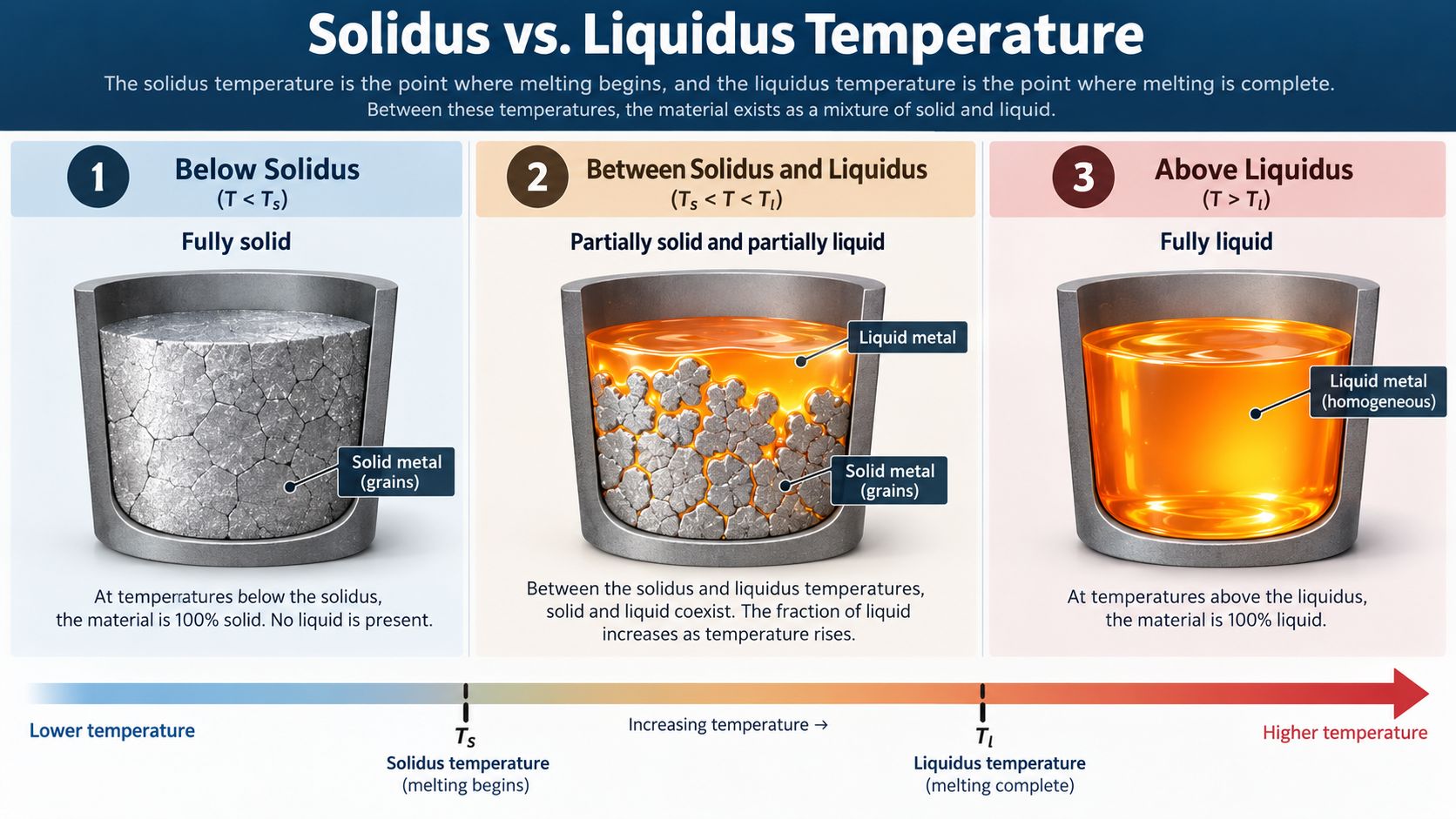
The solidus temperature is the temperature below which an alloy is completely solid.
The liquidus temperature is the temperature above which it is completely liquid.
Between them, solid and liquid phases coexist.
Below the Solidus
The material remains fully solid.
For 6061 aluminum, for example, the typical solidus is around 582°C.
At temperatures below that value, the material remains essentially solid.
Between Solidus and Liquidus
Partial melting occurs.
Some phases are liquid while others remain solid.
This semi-solid region matters in:
- casting
- welding
- brazing
- Tratament termic
- metal refining
- additive manufacturing
- semi-solid forming
Above the Liquidus
The alloy is fully molten.
For 6061 aluminum, this occurs at approximately 652°C.
This does not mean a foundry should simply operate at 652°C. Casting and melting processes normally require temperatures above the liquidus to maintain fluidity and compensate for heat loss during transfer and pouring.
What Is the Melting Point of Steel?
There is no single universal melting point for steel.
Steel is an iron-based alloy, and its melting behavior changes with:
- carbon content
- manganese content
- chromium
- nickel
- molybdenum
- silicon
- other alloying elements
A broad reference range for carbon steels is approximately 1370–1540°C (2500–2800°F).
For many common low- and medium-carbon steels, practical melting ranges are often concentrated closer to approximately 1425–1540°C.
This is why saying simply:
“Steel melts at 1500°C”
can be useful as a rough estimate but is not precise enough for process engineering.
Pure Iron vs. Carbon Steel
Pure iron melts at approximately 1538°C.
Adding carbon changes the iron-carbon phase system and generally lowers the temperatures at which melting begins.
That is why cast iron, which contains substantially more carbon than typical structural carbon steel, can begin melting at much lower temperatures.
A simplified comparison is:
| Iron-Based Material | Approximate Melting Behavior |
|---|---|
| Cast iron | ~1125–1205°C |
| Carbon steel | ~1370–1540°C |
| otel inoxidabil 304 | ~1400–1450°C |
| Pure iron | 1538°C |

Carbon content is only one part of material selection. Two low-carbon steels can still have different specifications, mechanical properties and intended applications. For example, our guide to 1018 vs A36 steel explains why two materials that are both commonly described as low-carbon steel should not automatically be treated as interchangeable.
What Is the Melting Point of Stainless Steel?
Stainless steel also does not have one melting point.
Different stainless steel grades contain different combinations of chromium, nickel, molybdenum, manganese and other alloying elements.
Typical melting ranges include:
| Stainless Steel Grade | Approximate Melting Range |
|---|---|
| 304 | 1400–1450°C |
| 304L | 1400–1450°C |
| 316 | 1375–1400°C |
| 316L | 1375–1400°C |
| 321 | 1400–1425°C |
| 310 | 1400–1450°C |
| 2205 Duplex | ~1385–1445°C |
| 430 | ~1425–1510°C |
| 410 | ~1480–1530°C |
One interesting result is that a higher melting range does not necessarily mean better high-temperature service performance.
For example, alloy composition that improves oxidation resistance or creep performance may not significantly raise the melting point.
This distinction is important when choosing stainless material for furnace components, exhaust systems, heat exchangers or other elevated-temperature equipment.
Steel1Stop supplies multiple stainless grades and tubing specifications, including 304/304L, 316/316L, 321, 310S and duplex grades. See our stainless steel metric tubing guide for grade selection in actual tubing applications.
What Is the Melting Point of Aluminum?
Pure aluminum melts at approximately:
660.3°C / 1220.5°F
That number appears in almost every aluminum melting point chart.
However, most aluminum products used in engineering are aluminum alloys rather than commercially pure aluminum.
Adding magnesium, silicon, copper, zinc and other alloying elements changes both mechanical properties and melting behavior.
Aluminum Alloy Melting Range Chart
| Aliaj de aluminiu | Solidus | Liquidus | Approximate Range |
|---|---|---|---|
| Pure Aluminum | 660°C | 660°C | 660°C |
| 6061 | 582°C | 652°C | 582–652°C |
| 6063 | 615°C | 655°C | 615–655°C |
| 2024 | ~502°C | 638°C | ~502–638°C |
| 5052 | ~607°C | 649°C | ~607–649°C |
| 7075 | 477°C | 635°C | 477–635°C |

Why Does 7075 Start Melting at a Lower Temperature Than Pure Aluminum?
This is an excellent example of why alloy melting behavior can appear counterintuitive.
7075 is substantially stronger than pure aluminum at room temperature, yet its solidus temperature is much lower.
The reason is composition.
7075 contains significant zinc along with magnesium, copper and other alloying elements. These additions strengthen the alloy but also change the phase relationships within the material.
Therefore:
Higher mechanical strength does not mean higher melting point.
This is important in welding and heat treatment. An aluminum alloy can experience localized incipient melting in certain phases even though the bulk material is still below the temperature people associate with “melting aluminum.”
6061 Aluminum Melting Range
6061 typically has a melting range of approximately:
582–652°C / 1080–1205°F
6061 is one of the most widely used engineering aluminum alloys because it combines good strength, weldability, machinability and corrosion resistance.
If you are selecting tube rather than simply comparing thermal properties, see our 6061 aluminum tubing guide.
6063 Aluminum Melting Range
6063 typically melts over approximately:
615–655°C / 1139–1211°F
It is particularly common in architectural extrusions because of its excellent extrudability and surface finish.
For applications, tempers and available forms, see tub din aluminiu 6063.
2024 Aluminum Melting Range
2024 aluminum typically has a melting range of approximately:
502–638°C / 935–1180°F
Its copper-rich chemistry gives it high strength and good fatigue performance, making it particularly important in aerospace structures, but also contributes to a significantly lower solidus than pure aluminum.
See our detailed 2024 aluminum tube guide for its mechanical properties, tempers and applications.
For a broader comparison of aluminum grades and available tube forms, visit our aluminum tubing guide.
Copper, Brass and Bronze Melting Points
Copper melts at approximately:
1084.6°C / 1984°F
Unlike copper, brass and bronze are alloys, so they generally melt across ranges.
Typical reference values include:
| Material | Approximate Melting Temperature |
|---|---|
| Pure Copper | 1085°C |
| Yellow Brass | ~905–932°C |
| Red Brass | ~990–1025°C |
| Bronze | commonly around 850–1050°C depending on composition |
| Aluminum Bronze | commonly around 1025–1040°C depending on grade |
The wide variation in bronze is especially important.
“Bronze” does not describe one chemical composition. Tin bronze, aluminum bronze, silicon bronze and other copper alloys can behave very differently.
For procurement or manufacturing, always identify the actual alloy designation before using a generic melting-point value.
Which Metal Has the Highest Melting Point?
Among elemental metals, tungsten has the highest melting point.
Its melting temperature is approximately:
3420°C / 6190°F
Published reference values differ slightly, commonly appearing around 3414–3422°C depending on the reference dataset and rounding convention.
Other high-melting-point metals include:
| Metal | Approximate Melting Point |
|---|---|
| Titan | 1668°C |
| Crom | ~1907°C |
| Molibden | ~2620°C |
| Tantalum | ~3017°C |
| Tungsten | ~3420°C |
Tungsten’s extremely high melting temperature is one reason it is used in very high-temperature applications.
However, once again, melting point alone does not determine whether a material is suitable for a particular high-temperature environment.
Oxidation resistance, thermal shock, creep, brittleness, atmosphere and cost may be more important.
Which Metal Has the Lowest Melting Point?
When all elemental metals are considered, mercury has an exceptionally low melting point of about -38.8°C, which is why it is liquid at ordinary room temperature.
Several other unusual metals also melt near room temperature.
For conventional solid engineering metals, some familiar low-melting examples are:
- Tin: about 232°C
- Lead: about 327°C
- Zinc: about 420°C
- Magnesium: about 650°C
- Aluminum: about 660°C
Therefore, statements such as “lead has the lowest melting point of metals” are only true within a restricted list of materials, not across the periodic table.
Why Do Different Metals Have Different Melting Points?
Melting requires enough thermal energy to disrupt the ordered solid structure of a material.
How much energy is required depends on several factors.
Atomic Bonding
Stronger bonding between atoms generally requires more energy to overcome.
This helps explain why refractory metals such as tungsten remain solid at temperatures where aluminum or copper would already be liquid.
Crystal Structure
Metals can have different crystal structures, including:
- body-centered cubic
- face-centered cubic
- hexagonal close-packed
Crystal structure affects how atoms are arranged and contributes to the thermal and mechanical behavior of the metal.
Compoziție chimică
In alloys, adding other elements changes phase stability.
Carbon changes the melting behavior of iron.
Nickel and chromium modify stainless steel.
Magnesium and silicon modify 6000-series aluminum.
Copper strongly influences 2000-series aluminum.
Zinc is a major alloying element in 7000-series aluminum.
Multiple Phases
Many engineering alloys contain more than one phase.
Different phases can begin melting at different temperatures, creating the solidus-to-liquidus range seen in alloy data sheets.
How Alloying Changes Melting Temperature
A common misconception is:
If an alloy is stronger, it must also withstand a higher temperature before melting.
This is not generally true.
Consider three examples.
Pure Aluminum vs. 7075 Aluminum
Pure aluminum:
~660°C melting point
7075 aluminum:
~477–635°C melting range
7075 is much stronger at room temperature, but its first liquid phase can appear far below the melting point of pure aluminum.
Pure Iron vs. Carbon Steel
Pure iron:
1538°C
Carbon steel:
generally melts across a range below or approaching pure iron depending on carbon and alloy content.
Adding carbon fundamentally changes the iron-carbon phase diagram.
Copper vs. Brass
Pure copper:
1085°C
Yellow brass:
approximately 905–932°C
Adding zinc lowers the melting range while producing an alloy with different strength, machinability, corrosion characteristics and appearance.
These examples illustrate an important material-selection principle:
Alloying is used to engineer a combination of properties, not simply to maximize melting temperature.
Melting Point Is Not Maximum Service Temperature
This is perhaps the biggest practical mistake when using metal melting-point charts.
Suppose a steel does not melt until around 1450°C.
That does nu mean a steel component can safely operate at 1300°C.
Long before melting occurs, high temperature can cause major changes.

Strength Loss
Yield strength and tensile strength normally decrease as temperature increases.
A component may permanently deform under a load that would be completely safe at room temperature.
Creep
Creep is slow, time-dependent deformation under sustained load at elevated temperature.
It can occur while the material remains completely solid.
This makes creep strength particularly important for:
- furnaces
- boilers
- power-generation equipment
- heat exchangers
- pressure systems
- high-temperature piping
Oxidation and Scaling
Many metals react more rapidly with oxygen as temperature increases.
Carbon steel may form heavy oxide scale well below its melting point.
Stainless steels resist high-temperature oxidation more effectively because of their chromium-containing protective oxide layer, although their performance still depends strongly on grade and atmosphere.
Distortion
Uneven heating creates thermal expansion.
When different regions of a component experience different temperatures, the resulting thermal stresses can produce:
- warping
- distortion
- buckling
- cracking
- dimensional instability
Metallurgical Changes
Elevated temperatures can also change:
- grain size
- precipitates
- hardness
- temper
- phase balance
- residual stress
For heat-treated aluminum alloys, mechanical strength can be seriously affected at temperatures far below the melting range.
Therefore:
Melting point is an absolute phase-change property. Maximum service temperature is an engineering design limit.
They should never be treated as the same number.
Why Melting Point Matters in Manufacturing
Although melting point alone should not determine material selection, it is extremely important in manufacturing.
| Proces | Why Melting Temperature Matters |
|---|---|
| Casting | Determines furnace and pouring temperature requirements |
| Sudare | Influences weld-pool formation and heat input |
| Brazing | Base material must remain solid while filler metal melts |
| Soldering | Uses filler metals with relatively low melting points |
| Forging | Helps define suitable hot-working temperature windows |
| Tratament termic | Prevents overheating and incipient melting |
| Metal Recycling | Helps plan sorting, remelting and refining |
| Additive Manufacturing | Influences energy input and melt-pool behavior |
| Furnace Design | Determines refractory and heating-system requirements |
| Alloy Production | Liquidus and solidus affect casting and solidification |
Casting
For casting, reaching the liquidus temperature is not enough.
The molten metal generally requires some degree of superheat above the liquidus so that it remains fluid while being transferred and poured.
The correct amount depends on:
- alloy
- casting method
- section thickness
- mold material
- pouring distance
- furnace
- desired microstructure
Sudare
During fusion welding, the weld pool exceeds the local liquidus temperature.
The surrounding heat-affected zone does not melt, but its microstructure and mechanical properties can still change dramatically.
This is especially important with heat-treated aluminum alloys and certain high-strength steels.
Tratament termic
Melting data defines a hard upper limit.
Certain alloys have a narrow margin between their normal solution-treatment temperature and the onset of localized melting.
That makes accurate temperature control essential.
How to Select a Metal for High-Temperature Applications
If your application involves elevated temperature, do not rank materials using melting point alone.
Consider the full operating environment.
1. Continuous Operating Temperature
A component exposed to 600°C continuously is a very different design problem from a component that briefly reaches 600°C during processing.
2. Mechanical Load at Temperature
Check high-temperature:
- puterea de curgere
- tensile strength
- creep strength
- stress-rupture performance
Room-temperature strength values may not represent performance at elevated temperature.
3. Oxidation Resistance
Atmosphere matters.
A material may perform differently in:
- air
- steam
- reducing atmosphere
- vacuum
- combustion gas
- carburizing conditions
4. Thermal Expansion
Repeated heating and cooling can produce:
- dimensional changes
- thermal fatigue
- joint stress
- coating failure
5. Thermal Conductivity
Copper and aluminum conduct heat rapidly.
Stainless steel conducts heat much more slowly.
This can influence temperature gradients, cooling rates and thermal distortion.
6. Corrosion Environment
High temperature and corrosion can act together.
For example, a material selected only for high melting temperature may perform poorly in a chloride, sulfur-containing or strongly oxidizing environment.
7. Fabrication Requirements
Also consider whether the material must be:
- welded
- machined
- bent
- extrudat
- forged
- cast
- anodized
- polished
The best material is the one that satisfies the complete set of operating and manufacturing requirements—not necessarily the one with the highest melting point.
Celsius to Fahrenheit Melting Point Conversion
Metal melting temperatures are commonly listed in both Celsius and Fahrenheit.
Utilizare:
°F = (°C × 9/5) + 32
For example, pure aluminum melts at approximately 660°C:
(660 × 9/5) + 32 ≈ 1220°F
To convert Fahrenheit to Celsius:
°C = (°F − 32) × 5/9
For engineering work, use the temperature values stated in the relevant material specification or technical data for the exact grade rather than relying on rounded conversions when tight process control is required.
Întrebări frecvente
What is the melting point of steel?
Steel does not have one exact melting point because it is an alloy. Carbon steels generally melt over approximately 1370–1540°C (2500–2800°F), with the exact solidus and liquidus depending on composition.
What is the melting point of stainless steel?
It depends on the grade. 304 stainless steel typically melts over approximately 1400–1450°C, în timp ce 316/316L is typically around 1375–1400°C.
What is the melting point of aluminum?
Pure aluminum melts at approximately 660.3°C / 1220.5°F.
Does 6061 aluminum melt at 660°C?
Not exactly. 6061 is an alloy and typically melts over approximately 582–652°C. Pure aluminum melts at about 660°C.
What is the melting point of 6063 aluminum?
6063 aluminum has a typical melting range of approximately 615–655°C / 1139–1211°F.
What is the melting point of 7075 aluminum?
7075 aluminum typically has a solidus around 477°C and liquidus around 635°C, giving it a relatively wide melting range.
Why does an alloy have a melting range?
An alloy contains multiple elements and may contain multiple phases. These phases do not necessarily melt simultaneously, so partial melting begins at the solidus and continues until the liquidus is reached.
What is the difference between solidus and liquidus?
The solidus is the temperature below which an alloy is completely solid. The liquidus is the temperature above which the alloy is completely liquid. Between the two, solid and liquid coexist.
Which metal has the highest melting point?
Tungsten has the highest melting point among elemental metals, at approximately 3420°C / 6190°F.
Which common engineering metal has a low melting point?
Tin melts at only about 232°C, while lead melts at about 327°C. Aluminum is also relatively low compared with iron-based materials, melting at approximately 660°C in pure form.
Does carbon content affect the melting point of steel?
Yes. Carbon changes the iron-carbon phase system, and increasing carbon generally lowers the temperatures associated with melting compared with pure iron. Other alloying elements also influence the solidus and liquidus.
Does stainless steel have a higher melting point than carbon steel?
Not necessarily. Their ranges overlap, and the result depends on the specific grades and compositions being compared.
Can a metal fail before it melts?
Absolutely. Metals can lose strength, creep, oxidize, distort or undergo metallurgical changes hundreds of degrees below their melting temperature.
Is melting point the same as heat resistance?
No. Heat resistance depends on properties such as oxidation resistance, creep strength, strength retention, thermal expansion and environmental conditions. Melting point is only one material property.
Final Takeaway
A metal melting point chart is useful for quick comparison, but engineering materials should not be selected from one temperature number alone.
The most important distinction is:
Pure metal → usually one defined melting point
Engineering alloy → usually a solidus-to-liquidus melting range
Pure aluminum melts at about 660°C, copper at about 1085°C, iron at about 1538°C and tungsten at roughly 3420°C. But common engineering alloys such as 6061 aluminum, carbon steel and stainless steel melt over ranges determined by their chemical composition.
For manufacturing and material selection, also remember:
melting point ≠ maximum service temperature
Strength loss, creep, oxidation and distortion can become critical long before a material melts.
Steel1Stop supplies carbon steel, stainless steel and aluminum products in multiple grades, specifications and forms for global manufacturing and fabrication projects. When specifying material for elevated-temperature service, identify the exact alloy or grade, operating temperature, exposure time, atmosphere and mechanical load rather than selecting a material only by its nominal melting point.
