

Stainless steel sheet sizes vary by manufacturing route, grade, market and supplier. Common metric formats include 1000 × 2000 mm, 1250 × 2500 mm and 1500 × 3000 mm. Common imperial formats include 4 × 8 ft, 4 × 10 ft and 5 × 10 ft.
Choosing the right size involves more than matching length and width. Thickness, finish, edge condition, flatness, cutting requirements, material utilization and shipping weight can all affect the purchase.
This guide explains common stainless steel sheet dimensions, metric and imperial conversions, thickness options, sheet-versus-plate differences, theoretical weight, cut-to-size services and the information buyers should provide when requesting a quotation.
1. Standard Stainless Steel Sheet Sizes at a Glance
The following dimensions are commonly encountered in stainless steel purchasing. They are commercial reference formats, not a guarantee that every grade, thickness, finish or production route is available in every size.
Common Metric Stainless Steel Sheet Sizes
| Nominal Size | Area | Typical Market Use |
|---|---|---|
| 1000 × 2000 mm | 2.00 m² | General metric sheet supply |
| 1219 × 2438 mm | 2.97 m² | Approximate 4 × 8 ft format |
| 1250 × 2500 mm | 3.13 m² | Common metric sheet format |
| 1500 × 3000 mm | 4.50 m² | Wider and longer sheet applications |
| 1524 × 3048 mm | 4.65 m² | Exact 5 × 10 ft conversion |
| 2000 × 4000 mm | 8.00 m² | Selected large-format plate products |
| 2000 × 6000 mm | 12.00 m² | Selected plate and project supply |
Common Imperial Stainless Steel Sheet Sizes
| Commercial Size | Exact Metric Conversion | Area |
|---|---|---|
| 3 × 8 ft | 914.4 × 2438.4 mm | 2.23 m² |
| 4 × 8 ft | 1219.2 × 2438.4 mm | 2.97 m² |
| 4 × 10 ft | 1219.2 × 3048 mm | 3.72 m² |
| 4 × 12 ft | 1219.2 × 3657.6 mm | 4.46 m² |
| 5 × 10 ft | 1524 × 3048 mm | 4.65 m² |
The metric values in the imperial table are mathematical conversions. Commercially supplied sheets may be described using rounded nominal dimensions, so confirm actual ordered dimensions with the supplier.
Important: 4 × 8 ft is not the same as 1250 × 2500 mm. A 4 × 8 ft sheet converts to 1219.2 × 2438.4 mm. A 1250 × 2500 mm sheet is a different, slightly larger metric format. The difference can matter when loading a cutting table, fitting an existing machine or nesting parts around a fixed layout.

2. What Is a Standard Stainless Steel Sheet Size?
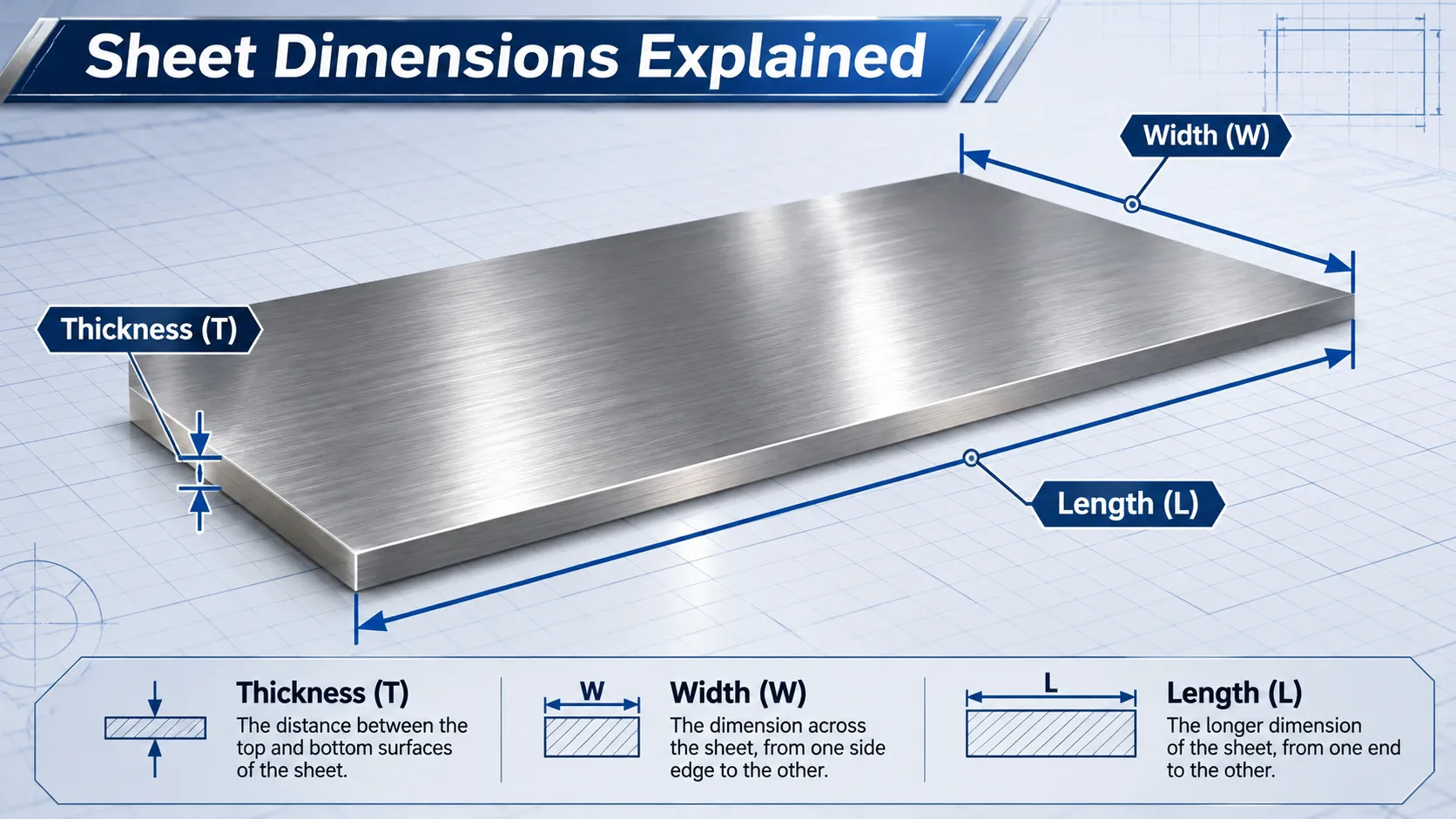
A stainless steel sheet is normally specified by three dimensions:
- Thickness (T): the distance between the two sheet surfaces.
- Width (W): the shorter plan dimension of a rectangular sheet in the agreed orientation.
- Length (L): the longer plan dimension.
A purchase description such as 304 stainless steel sheet, 1.5 × 1250 × 2500 mm generally identifies grade, thickness, width and length. The order should also identify the material standard, dimensional requirements, surface finish, edge condition and quantity.
Standard commercial sizes help suppliers plan production, stocking, cutting and packaging. However, there is no single worldwide list that every stainless steel mill must stock. Available dimensions depend on rolling range, coil width, finishing line, cutting equipment, grade, thickness and order quantity.
How Sheet Dimensions Are Written
| Saghas | Brí |
|---|---|
| 1.5 × 1250 × 2500 mm | 1.5 mm thick, 1250 mm wide, 2500 mm long |
| 0.060 × 48 × 96 in | 0.060 inch thick, 48 inches wide, 96 inches long |
| 2.0 mm × 1500 mm coil | 2.0 mm thick coil with 1500 mm nominal width; coil weight or length specified separately |
For coils, buyers normally specify thickness, width, inside diameter, outside diameter or coil weight, winding direction where relevant, and edge condition. A coil is not a sheet with a fixed length unless it has been cut to length.
3. Stainless Steel Sheet Sizes in Millimeters
| Leithead | Ar fad | Area | Purchasing Notes |
|---|---|---|---|
| 1000 mm | 2000 mm | 2.00 m² | Common general-purpose format |
| 1219 mm | 2438 mm | 2.97 m² | Approximate 4 × 8 ft format |
| 1250 mm | 2500 mm | 3.13 m² | Common metric format |
| 1500 mm | 3000 mm | 4.50 m² | Larger sheet format |
| 1524 mm | 3048 mm | 4.65 m² | Exact 5 × 10 ft conversion |
| 2000 mm | 4000 mm | 8.00 m² | Large-format plate; product-specific |
| 2000 mm | 6000 mm | 12.00 m² | Project or plate supply; confirm production route |
These are reference formats, not a universal stock list. A 0.5 mm cold-rolled decorative sheet and a 12 mm hot-rolled plate may have very different available width and length combinations.
- 1000 × 2000 mm: useful for compact general fabrication and smaller parts.
- 1250 × 2500 mm: a common metric format for general fabrication and sheet-metal processing.
- 1500 × 3000 mm: useful for larger panels and layouts that benefit from a wider or longer blank.
- Large-format plate: may suit heavy fabrication, but requires confirmation of mill capability, handling equipment, transport and cutting capacity.
The largest sheet is not automatically the most economical. Choose a format that meets part dimensions and production constraints with acceptable waste and handling cost.
4. 4 × 8, 4 × 10, 4 × 12 and 5 × 10 Stainless Steel Sheets
Imperial sheet sizes remain common in North American purchasing and projects designed around inch-based dimensions.
| Méid | Leithead | Ar fad | Approximate Area |
|---|---|---|---|
| 3 × 8 ft | 914.4 mm | 2438.4 mm | 2.23 m² |
| 4 × 8 ft | 1219.2 mm | 2438.4 mm | 2.97 m² |
| 4 × 10 ft | 1219.2 mm | 3048 mm | 3.72 m² |
| 4 × 12 ft | 1219.2 mm | 3657.6 mm | 4.46 m² |
| 5 × 10 ft | 1524 mm | 3048 mm | 4.65 m² |
4 × 8 Stainless Steel Sheet
A 4 × 8 ft sheet measures 48 × 96 inches, or 1219.2 × 2438.4 mm. It is a familiar format for general fabrication, equipment panels, kitchen components and many sheet-metal applications.
4 × 10 Stainless Steel Sheet
A 4 × 10 ft sheet is 48 × 120 inches, or 1219.2 × 3048 mm. The extra length can reduce joining or help fit longer components. Confirm machine-bed length, storage space and safe handling.
5 × 10 Stainless Steel Sheet
A 5 × 10 ft sheet is 60 × 120 inches, or 1524 × 3048 mm. It provides a larger working area than a 4 × 8 sheet, but requires suitable loading and cutting equipment.
4 × 12 Stainless Steel Sheet
A 4 × 12 ft sheet is 48 × 144 inches, or 1219.2 × 3657.6 mm. This longer format may suit long panels, but can be less convenient to store and handle.
5. Standard Stainless Steel Sheet Thicknesses
Áirítear ar thiús méadrach a shonraítear go coitianta:
| Tiús Ainmniúil | Approximate Inches | Typical Purchasing Context |
|---|---|---|
| 0.30 mm | 0.0118 in | Thin sheet and strip |
| 0.40 mm | 0.0157 in | Lightweight formed parts |
| 0.50 mm | 0.0197 in | Panels and light fabrication |
| 0.60 mm | 0.0236 in | Formed sheet components |
| 0.80 mm | 0.0315 in | Enclosures and appliance parts |
| 1.00 mm | 0.0394 in | General sheet-metal fabrication |
| 1.20 mm | 0.0472 in | Panels and equipment components |
| 1.50 mm | 0.0591 in | General industrial fabrication |
| 2.00 mm | 0.0787 in | Comhpháirteanna leathán-mhiotail níos troime |
| 2.50 mm | 0.0984 in | Trealamh déanta as |
| 3.00 mm | 0.1181 in | Heavy sheet and plate applications |
| 4.00 mm | 0.1575 in | Monarú pláta agus struchtúrach |
| 5.00 mm | 0.1969 in | Iarratais pláta tionsclaíoch |
| 6.00 mm | 0.2362 in | Heavy-duty fabrication |
These are commonly specified thicknesses, not a guarantee that every size is available in every grade and finish. A supplier may offer a narrower range for a particular cold-rolled finish or a different range for hot-rolled plate.
Thickness selection should consider applied loads, unsupported span, required stiffness, forming method, bend radius, welding, corrosion environment, applicable design code and available production tolerances. For load-bearing or pressure-containing components, use the relevant engineering design requirements.
6. Stainless Steel Gauge vs. Thickness in Millimeters
Gauge is a traditional sheet-metal thickness designation. It is not a universal metric unit, and different materials can use different gauge conventions. The following values are commonly used as stainless steel gauge references; confirm the convention with the supplier.
| Stainless Steel Gauge | Approx. Thickness (inch) | Approx. Thickness (mm) |
|---|---|---|
| 10 | 0.1406 | 3.57 |
| 12 12 | 0.1094 | 2.78 |
| 14 | 0.0781 | 1. 98 |
| 16 16 | 0.0625 | 1. 59 |
| 18 18 18 | 0.0500 | 1.27 |
| 20 | 0.0375 | 0.95 |
| 22 | 0.0313 | 0.79 |
| 24 | 0.0250 | 0.64 |
| 26 | 0.0188 | 0.48 |
Gauge is a reference designation, not a substitute for a precise thickness specification. For international orders, state the required thickness in millimeters or decimal inches.
For a detailed explanation of nominal thickness, actual thickness, ASTM A480, ISO 9445 and measurement requirements, see the related Steel1Stop guide: Stainless Steel Sheet Thickness & Tolerance Guide.
7. Stainless Steel Sheet vs. Plate vs. Coil
Sheet, plate and coil describe different product forms. Their dimensions and availability are influenced by manufacturing route and the applicable product specification.
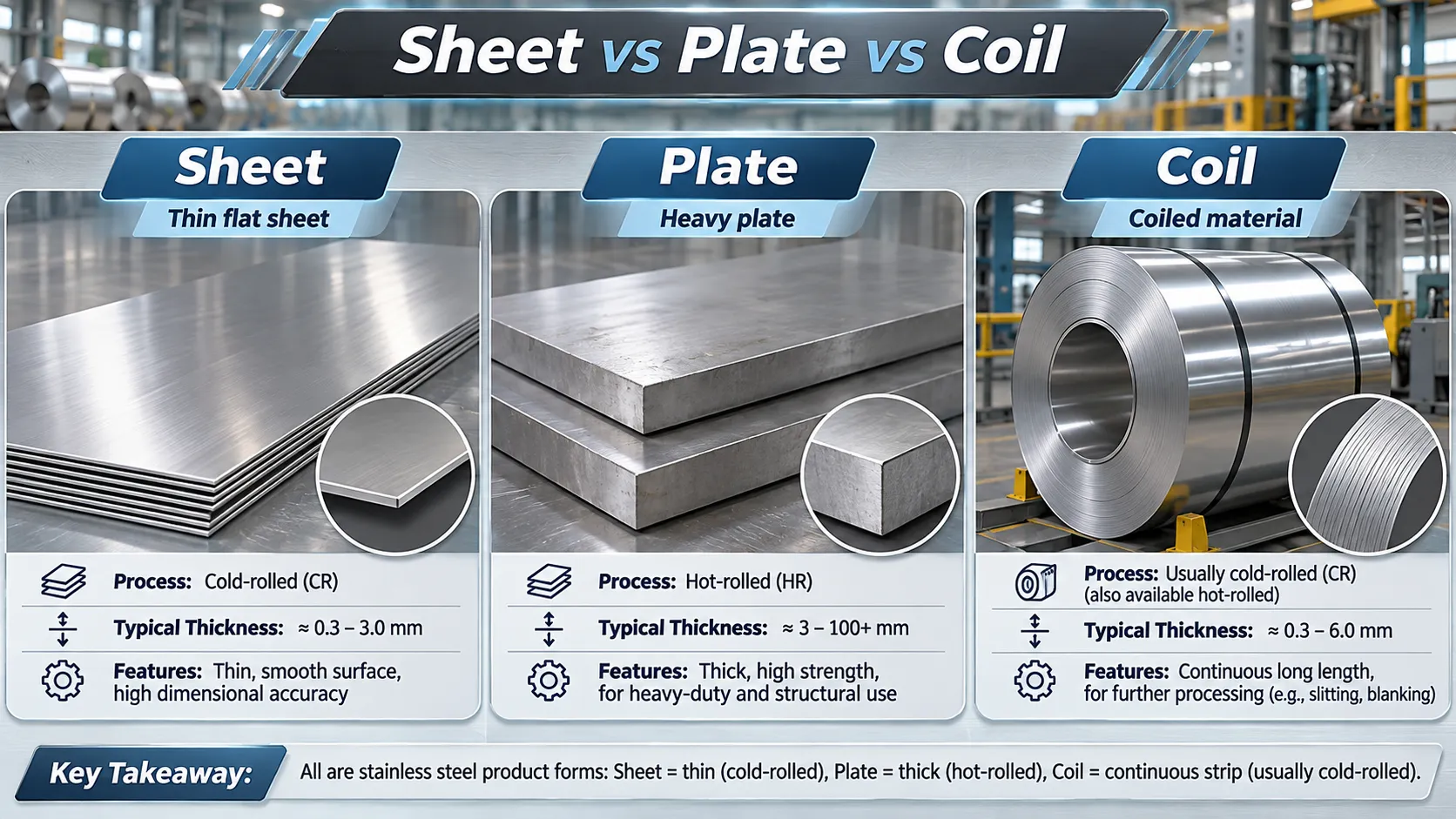
| Foirm táirgí | Physical Form | Common Supply Description | Typical Considerations |
|---|---|---|---|
| Bileog Cruach Dhosmálta | Flat, cut piece | Thickness × width × length | Finish, flatness and cut dimensions |
| Stainless Steel Plate | Flat, generally heavier product | Thickness × width × length | Plate standard, thickness and handling |
| Corna cruach dhosmálta | Continuous rolled strip | Thickness × width × coil weight or length | Coil ID/OD, weight, edge and slitting |
Bileog Cruach Dhosmálta



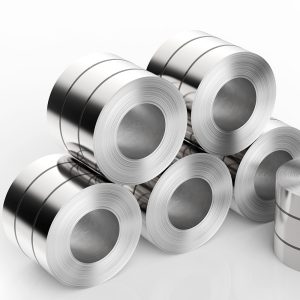

Coil is supplied in continuous rolled form. Buyers may purchase a full coil, a slit coil, or sheet cut to length from a coil. Coil can suit high-volume production and automated processing. Specify coil weight, width, inside diameter, outside diameter, edge condition and processing requirements.
8. Stainless Steel Sheet Sizes by Grade: 304, 316L, 201 and 430
Common stainless steel grades can be available in similar commercial sheet dimensions, but actual availability varies by mill, thickness, surface finish and order quantity.
| Grád | General Characteristics | Comhiarratais | Purchasing Notes |
|---|---|---|---|
| 201 | Austenitic stainless steel with lower nickel content than 304 in typical compositions | Decorative products, indoor equipment and selected formed parts | Confirm corrosion environment and exact grade |
| 304 | General-purpose austenitic stainless steel with broad fabrication use | Food equipment, appliances, architectural and industrial components | Widely used sheet grade; confirm finish and dimensions |
| 316L | Low-carbon, molybdenum-bearing austenitic stainless steel | Chemical equipment and selected chloride-exposed applications | Often selected for improved resistance to localized corrosion |
| 430 | Ferritic stainless steel | Appliances, decorative panels and selected indoor components | Magnetic; confirm forming and corrosion requirements |
The grade does not independently determine the available sheet size. A 304 sheet and a 316L sheet may share nominal dimensions, but stock and production options can differ.
When requesting a quotation, identify the exact grade and applicable material standard. Do not use a broad description such as “stainless steel” when the application requires a specific alloy.
Explore Steel1Stop product information:
- 304 Bileog cruach dhosmálta
- 201 Bileog cruach dhosmálta
- Stainless Steel Plate and Sheet
- 316L corna cruach dhosmálta
9. How Surface Finish Affects Available Sheet Sizes
Surface finish can influence which thicknesses, widths and lengths a supplier can provide.
| Bailchríoch | General Description | Iarratais tipiciúla |
|---|---|---|
| 2B | Smooth, reflective cold-rolled finish | General fabrication and industrial equipment |
| BA | Bright annealed finish | Decorative and appliance applications |
| Uimh.4 | Directional brushed finish | Kitchen equipment, elevators and architectural panels |
| HL | Hairline directional finish | Architectural decoration and interior panels |
| Scáthán | Críochnú snasta an-léiritheach | Decorative cladding and specialty applications |
| No. 1 | Hot-rolled, annealed and pickled finish | Industrial and heavy fabrication |
A finish is not simply a cosmetic choice. It may affect processing, protective film, handling, scratch visibility and the direction in which parts should be nested or cut.
For brushed or hairline materials, grain direction may need to be specified. A part rotated by 90 degrees can have a visibly different appearance after cutting and assembly.
Before ordering, confirm the finish designation, availability in the selected grade and thickness, protective film requirements, grain direction and available sheet dimensions.
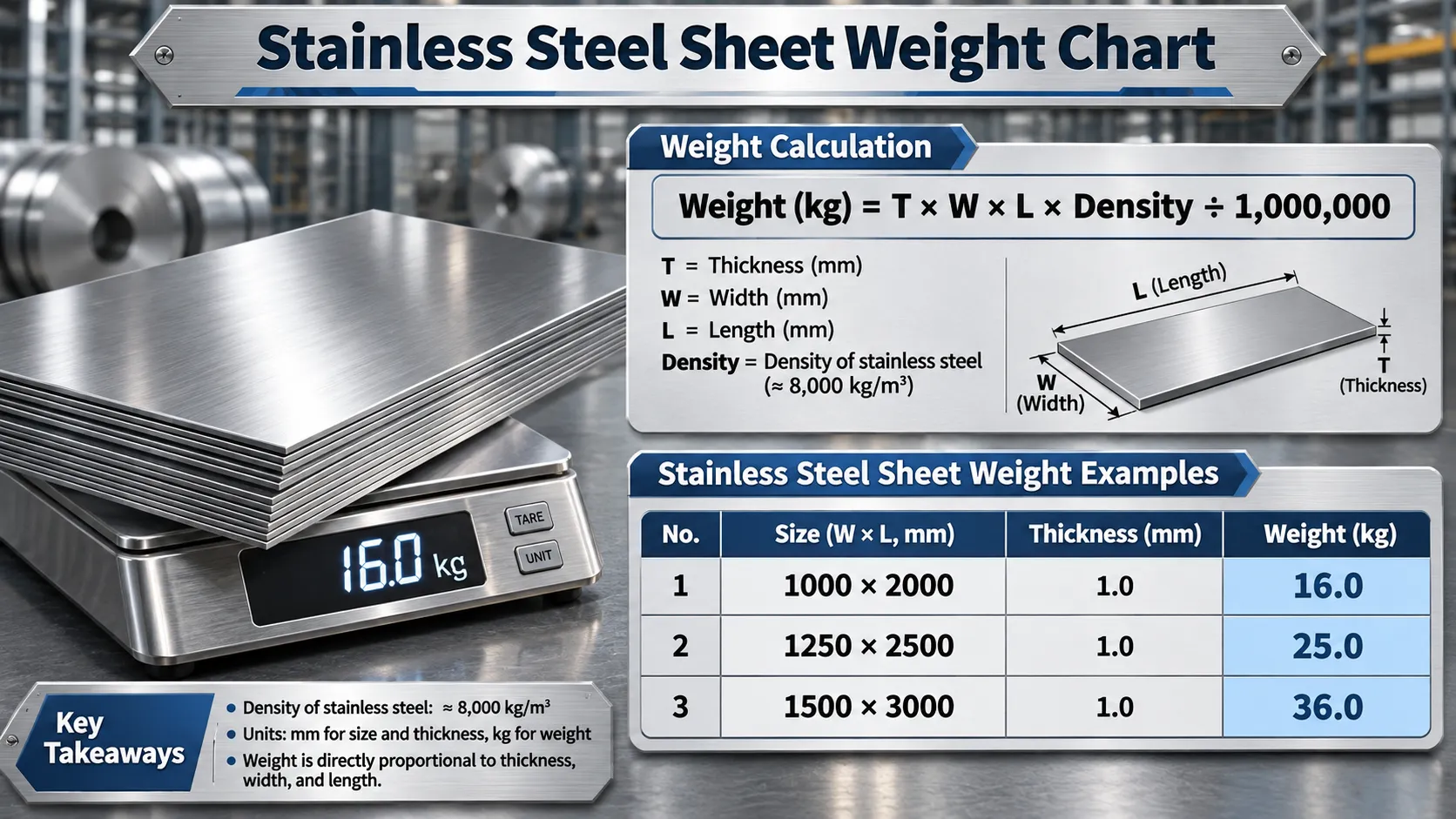
10. Stainless Steel Sheet Weight Chart
Sheet weight affects material cost, handling, packaging and freight planning.
Meáchan (kg) = Tiús (mm) × Leithead (mm) × Fad (mm) × Dlús (g/cm³) ÷ 1,000,000
For a simplified reference calculation using a density of 8.00 g/cm³:
Meáchan (kg) = Tiús × Leithead × Fad × 8.00 ÷ 1,000,000
Example: 1 mm Stainless Steel Sheet, 1250 × 2500 mm
- Tiús: 1.00 mm
- Width: 1250 mm
- Length: 2500 mm
- Reference density: 8.00 g/cm³
1.00 × 1250 × 2500 × 8.00 ÷ 1,000,000 = 25.00 kg per sheet
Theoretical Weight by Common Sheet Size
The following table uses a reference density of 8.00 g/cm³. It is a planning reference, not a substitute for actual weighing or grade-specific density data.
| Tiús | 1000 × 2000 mm | 1250 × 2500 mm | 1500 × 3000 mm |
|---|---|---|---|
| 0.8 mm | 12.8 kg | 20.0 kg | 28.8 kg |
| 1.0 mm | 16.0 kg | 25.0 kg | 36.0 kg |
| 1.2 mm | 19.2 kg | 30.0 kg | 43.2 kg |
| 1.5 mm | 24.0 kg | 37.5 kg | 54.0 kg |
| 2.0 mm | 32.0 kg | 50.0 kg | 72.0 kg |
| 2.5 mm | 40.0 kg | 62.5 kg | 90.0 kg |
| 3.0 mm | 48.0 kg | 75.0 kg | 108.0 kg |
| 4.0 mm | 64.0 kg | 100.0 kg | 144.0 kg |
| 5.0 mm | 80.0 kg | 125.0 kg | 180.0 kg |
| 6.0 mm | 96.0 kg | 150.0 kg | 216.0 kg |
Actual theoretical weight should use a density appropriate to the specified grade. Actual shipment weight can also differ because of dimensional variation, surface condition, packaging and the supplier’s weighing method.
How Many Sheets Are in One Metric Ton?
The approximate number of sheets per metric ton can be estimated by dividing 1,000 kg by theoretical weight per sheet.
If one 1.0 mm × 1250 × 2500 mm sheet weighs approximately 25 kg:
1,000 ÷ 25 = 40 sheets per metric ton
This is a theoretical estimate. Confirm actual sheet weight and commercial billing terms with the supplier.
11. How to Choose the Best Sheet Size for Laser Cutting
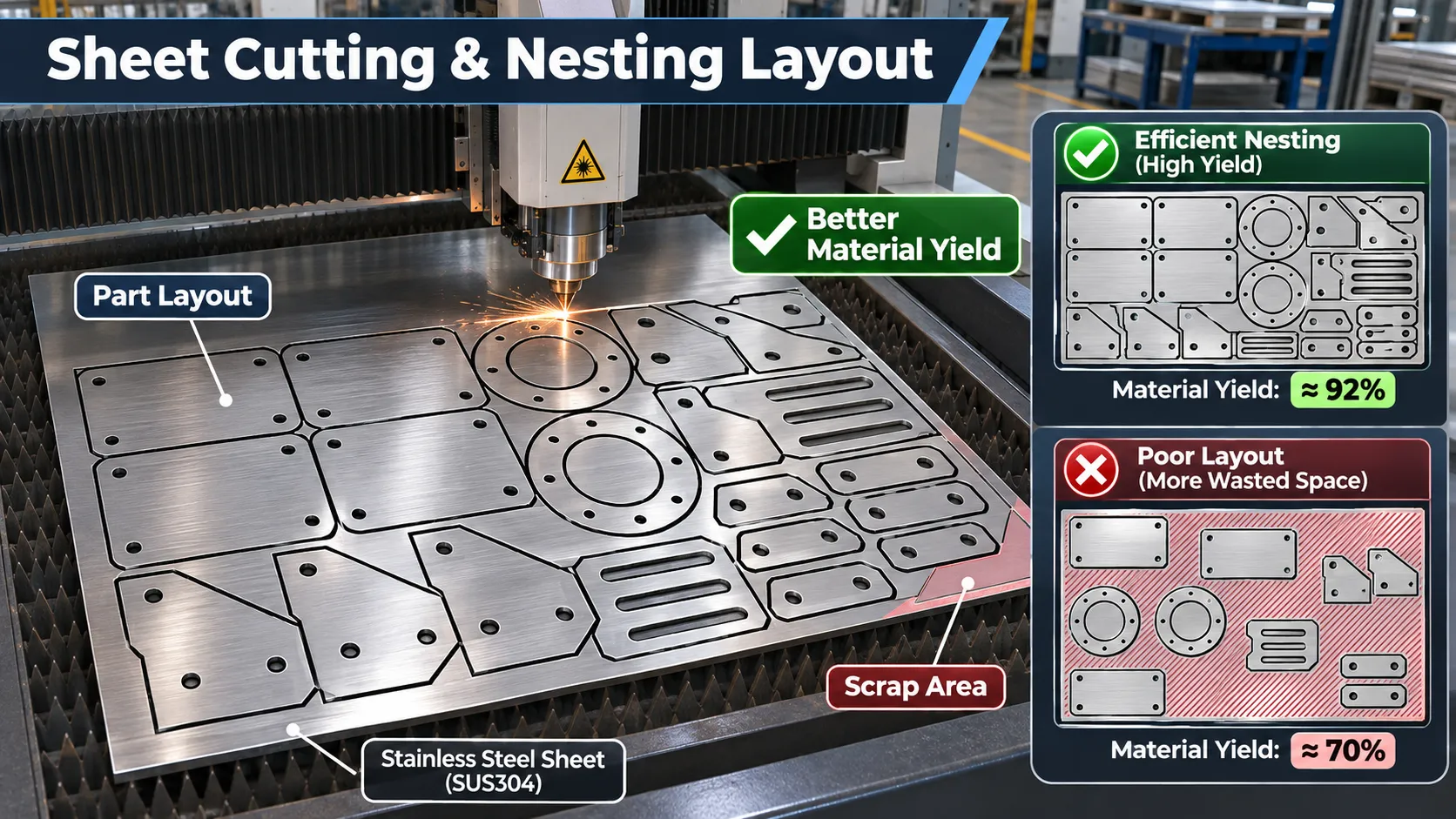
Selecting the correct original sheet size can reduce material waste and improve production efficiency. Consider finished part dimensions, required quantity, cutting process, machine working area, material grain direction and remaining usable offcuts.
Consider the Cutting Machine Working Area
Before ordering large sheets, confirm the maximum working dimensions of the laser cutting machine or other processing equipment. A 1500 × 3000 mm sheet is not suitable for a machine that cannot safely load or process that format.
Also consider loading equipment, sheet weight, support arrangements and available floor space.
Plan the Part Layout
Suppose a project requires rectangular parts measuring 400 × 300 mm. The nesting layout should consider:
- Sheet width and length.
- Part orientation.
- Cutting kerf.
- Minimum part-to-part spacing.
- Edge allowance.
- Clamping and support areas.
- Grain direction for brushed or patterned finishes.
- Quantity and repeatability.
The simple ratio of total part area to sheet area gives only a theoretical upper limit. It does not account for cutting gaps, irregular shapes, edge trim or unusable offcuts.
Compare Material Utilization
Material Utilization (%) = Total Net Part Area ÷ Original Sheet Area × 100
If the net area of all parts is 2.40 m² and the original sheet area is 3.00 m²:
2.40 ÷ 3.00 × 100 = 80% theoretical area utilization
Actual production yield may be lower after accounting for kerf, spacing, edge trim, defects and unusable offcuts.
When Is a Larger Sheet More Economical?
A larger sheet may reduce the number of sheets required or improve nesting efficiency. However, it can also increase handling difficulty, transport cost, storage requirements and the risk of unusable remnants.
Evaluate total delivered and processed cost, not material price per kilogram alone.
12. Standard Size vs. Cut-to-Size Stainless Steel Sheet
Buyers can often choose between standard commercial sheet sizes and custom cut dimensions.
| Supply Option | Saghas | Príomhbhuntáiste | Breithniú |
|---|---|---|---|
| Standard Sheet | Supplier’s regular commercial dimensions | May be easier to source | May create more offcut |
| Cut-to-Size Sheet | Sheet cut to specified length and width | Better fit for the project | Cutting charge and dimensional requirements |
| Coil Slitting | Wide coil slit into narrower widths | Suitable for strip and repeat production | Slit width and edge requirements |
| Cut-to-Length | Coil processed into specified sheet lengths | Consistent production lengths | Flatness and cut-length requirements |
| Custom Plate Cutting | Heavy plate cut to project dimensions | Supports larger components | Handling, cutting method and lead time |
When requesting cut-to-size stainless steel, specify material grade, thickness, width, length, quantity per size, surface finish, edge condition, dimensional tolerance, protective film requirements, drawings or nesting files, and packaging requirements.
Cutting can change the edge condition and may affect finished dimensions. Confirm whether the quoted dimensions refer to the incoming blank or the finished cut part.
13. Thickness, Width, Length and Flatness Tolerances
Nominal dimensions are not always identical to measured dimensions. Acceptable variation depends on the applicable product and dimensional standards, production route, dimensions and any special requirements agreed between buyer and supplier.
Relevant dimensional considerations include:
- Thickness tolerance.
- Width tolerance.
- Length tolerance.
- Flatness.
- Edge camber.
- Squareness.
- Measurement locations.
- Sampling and inspection procedure.
ASTM A480/A480M is an important general requirements specification for applicable flat-rolled stainless steel products. ISO 9445 covers dimensional and form tolerances for specified continuously cold-rolled stainless steel strip and sheet products.
These standards have defined scopes and should not be treated as interchangeable universal tolerance charts.
For detailed examples, measurement methods and the distinction between nominal and actual thickness, read the Stainless Steel Sheet Thickness & Tolerance Guide.
If a project requires a minimum actual thickness, special flatness or a tighter dimensional range, state it explicitly in the RFQ and obtain supplier confirmation before production.
14. How Sheet Sizes Affect Material Cost and Waste
The lowest price per kilogram does not always produce the lowest finished-part cost. Original sheet size can influence how much material becomes usable parts, recyclable scrap or leftover stock.
| Fachtóir Costas | How It Affects the Project |
|---|---|
| Material Grade | Alloy composition and market conditions affect price |
| Tiús | Influences weight, material consumption and processing |
| Sheet Size | Affects part nesting and leftover material |
| Bailchríoch | May affect price, handling and protective film |
| Gearradh | Adds processing cost and may generate scrap |
| Coinníoll Imeall | May require trimming or additional processing |
| Cainníocht | Affects production planning and purchasing efficiency |
| Pacáistiú | Depends on sheet size, weight and surface protection |
| Lastais | Influenced by shipment weight, dimensions and destination |
Consider two suppliers offering the same grade and nominal thickness. Supplier A may offer a lower price per kilogram but only a sheet format that creates substantial offcuts. Supplier B may offer a slightly higher material price but a more suitable size that improves nesting.
The better choice depends on total usable material cost, cutting fees, shipping and remaining scrap value. For repeat production, review nesting layouts before confirming the sheet size and order quantity.
15. How Stainless Steel Sheets Are Packed and Shipped
Stainless steel sheets require suitable packaging to prevent surface damage, deformation, contamination and handling problems during transportation.
Packaging should be selected according to sheet dimensions, thickness, finish, weight, destination and transport method.
Common considerations include:
- Protective film for specified decorative or polished finishes.
- Interleaving or surface protection where required.
- Suitable pallets, skids or support frames.
- Secure strapping and edge protection.
- Moisture protection appropriate to the route and packaging arrangement.
- Labels identifying grade, size, thickness, quantity and batch information.
- Safe lifting and handling provisions.
Shipping and Container Planning
Before shipment, confirm total net material weight, gross package weight, package dimensions, number of bundles or pallets, loading and unloading equipment, destination, transport mode and carrier or container payload restrictions.
Do not estimate container loading based only on the number of sheets. Thickness, dimensions, packaging and total shipment weight all matter. For large-format plate, agree lifting and unloading arrangements before dispatch.
16. How to Order Stainless Steel Sheets from China
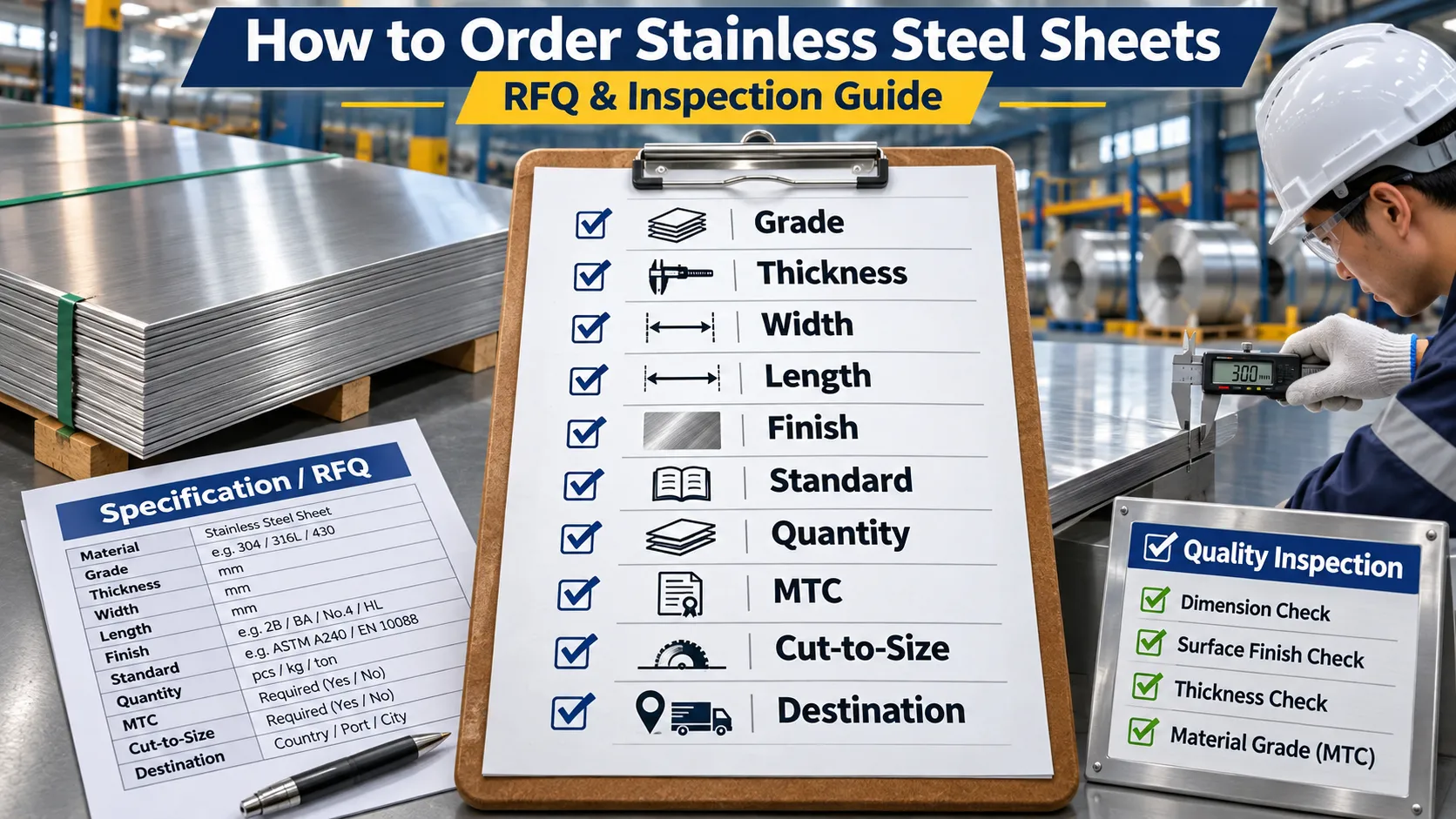
A complete purchase specification helps the supplier identify the correct material and provide an accurate quotation. Provide not only grade and thickness, but also width, length, finish, tolerance, quantity, documentation and delivery details.
Bileog Cruach Dhosmálta Seicliosta RFQ
| Mír | Information Required | Sampla |
|---|---|---|
| Toradh | Bileog / Pláta / Coil | Bileog Cruach Dhosmálta |
| Grád | Grád ábhair | 304 / UNS S30400 |
| Caighdeán Ábhar | Sonraíocht is infheidhme | ASTM A240/A240M |
| Tiús | Nominal thickness | 1.50 mm |
| Leithead | Leithead riachtanach | 1250 mm |
| Ar fad | Fad riachtanach | 2500 mm |
| Bailchríoch | Críochnú dromchla | 2B |
| Ciumhais a chur le | Coinníoll imeall | Mar a aontaíodh |
| Glacadh | Applicable dimensional requirements | Per agreed standard |
| Cainníocht | Sheets, pieces or metric tons | 500 bileog |
| Thuisíonn | Additional cutting or slitting | Cut-to-size if required |
| Doiciméadú | Material certificate | MTC as specified |
| Iniúchadh | Required checks | Dimensions and surface condition |
| Pacáistiú | Easpórtáil pacáil | Suitable export packaging |
| Ceann Scríbe | Port or delivery location | Ceannaitheora a shonrú |
| Trade Terms | Agreed Incoterm | FOB / CIF / other agreed term |
Example Purchase Request
Táirge: 304 Bileog Cruach Dhosmálta
Grád: 304 / UNS S30400
Ábhar Caighdeán: ASTM A240/A240M
Thickness: 1.50 mm
Width: 1250 mm
Length: 2500 mm
Críoch: 2B
Imeall: Mar a aontaíodh
Dimensional Tolerance: According to the applicable agreed specification
Cainníocht: 500 bileog
Doiciméadú: Teastas Tástála Muileann
Inspection: Thickness, width, length and surface condition
Packaging: Export packaging
Destination: To be confirmed
If the project requires a special thickness tolerance, minimum actual thickness or flatness requirement, add it separately and obtain written confirmation.
Questions to Ask Your Stainless Steel Supplier
Before placing an order, confirm:
- Is the requested grade available in the selected thickness?
- Can the supplier provide the required width and length?
- Is the material cold-rolled or hot-rolled?
- Which material and dimensional standards apply?
- What surface finishes are available?
- Can the material be cut to the requested dimensions?
- What are the agreed tolerances?
- What material certificates and inspection records are supplied?
- How will the sheets be protected and packed?
- What is the production lead time and shipping arrangement?
17. Frequently Asked Questions
What are the standard sizes of stainless steel sheets?
Common metric formats include 1000 × 2000 mm, 1250 × 2500 mm and 1500 × 3000 mm. Common imperial formats include 3 × 8 ft, 4 × 8 ft, 4 × 10 ft, 4 × 12 ft and 5 × 10 ft. Availability depends on grade, thickness, finish and supplier.
What size is a 4 × 8 stainless steel sheet in mm?
A 4 × 8 ft sheet measures 48 × 96 inches, equivalent to 1219.2 × 2438.4 mm.
Is 1250 × 2500 mm the same as 4 × 8 ft?
No. A 4 × 8 ft sheet is 1219.2 × 2438.4 mm. A 1250 × 2500 mm sheet is a larger metric format.
What size is a 5 × 10 stainless steel sheet?
A 5 × 10 ft sheet measures 60 × 120 inches, equivalent to 1524 × 3048 mm.
What is the most common stainless steel sheet size?
Commonly encountered formats include 1000 × 2000 mm, 1250 × 2500 mm, 1500 × 3000 mm and 4 × 8 ft. The most common size depends on country, supplier, production route and application.
What thicknesses are available for stainless steel sheets?
Commonly specified thicknesses include 0.5, 0.8, 1.0, 1.2, 1.5, 2.0, 3.0 and 4.0 mm, among others. The actual range depends on grade, product form, finish and mill capability.
How much does a 1 mm stainless steel sheet weigh?
A 1 mm sheet measuring 1250 × 2500 mm weighs approximately 25 kg using a reference density of 8.00 g/cm³. Actual weight depends on material density and actual dimensions.
How much does a 4 × 8 stainless steel sheet weigh?
For a 1 mm thick 4 × 8 ft sheet and a reference density of 8.00 g/cm³, theoretical weight is approximately 23.78 kg. Different thicknesses and grades produce different weights.
What is the difference between stainless steel sheet and plate?
The terms generally distinguish different product thickness ranges and manufacturing forms, but exact definitions depend on the applicable standard and market. Identify the product specification rather than relying only on the commercial name.
Can stainless steel sheets be cut to custom sizes?
Yes. Depending on material and supplier capabilities, sheets can be cut to length, slit, sheared or processed using other cutting methods. Confirm finished dimensions, tolerance, edge condition and surface protection.
Are 304 and 316L stainless steel sheets available in the same sizes?
They may be available in similar commercial dimensions, but actual stock and production options can differ by supplier, thickness, finish and order quantity.
Can I order stainless steel sheets by weight instead of by piece?
Yes. Many commercial transactions are quoted by metric ton or kilogram, while some processed products are quoted per sheet or piece. Confirm the pricing basis, theoretical or actual weight method and invoicing terms.
What information is needed to get a stainless steel sheet quotation?
At minimum, provide grade, thickness, width, length, surface finish, quantity, applicable standard, tolerance requirements and destination. Include drawings or processing requirements where applicable.
Can a supplier provide different sheet sizes in one order?
This depends on stock, production planning and minimum order requirements. Provide a size schedule showing each dimension and quantity when requesting a quotation.
18. Final Buying Guide: Choose the Right Stainless Steel Sheet Size
Selecting a stainless steel sheet size is a purchasing and production decision. The right format should meet component dimensions, processing equipment, material utilization targets and delivery requirements.
Before placing an order:
- Select the correct stainless steel grade for the operating environment.
- Confirm the required thickness and applicable material standard.
- Choose a metric or imperial sheet format based on the actual dimensions needed.
- Check whether the selected width and length fit the cutting equipment.
- Estimate theoretical weight and total order tonnage.
- Review the cutting layout and potential material waste.
- Confirm surface finish, edge condition and dimensional tolerances.
- Specify documentation, packaging and delivery requirements.
Steel1Stop supplies stainless steel and other metal products for international industrial, fabrication and project procurement.
Déan iniúchadh ar ár Stainless Steel Plate and Sheet, 304 Bileog cruach dhosmálta is 201 Bileog cruach dhosmálta faisnéis táirge.
For a quotation, provide your required grade, thickness, width, length, finish, quantity and destination. For custom dimensions or project-specific requirements, include relevant drawings and inspection specifications.
Choosing the right stainless steel sheet size can improve material utilization, simplify fabrication and reduce unnecessary purchasing and processing costs.
