
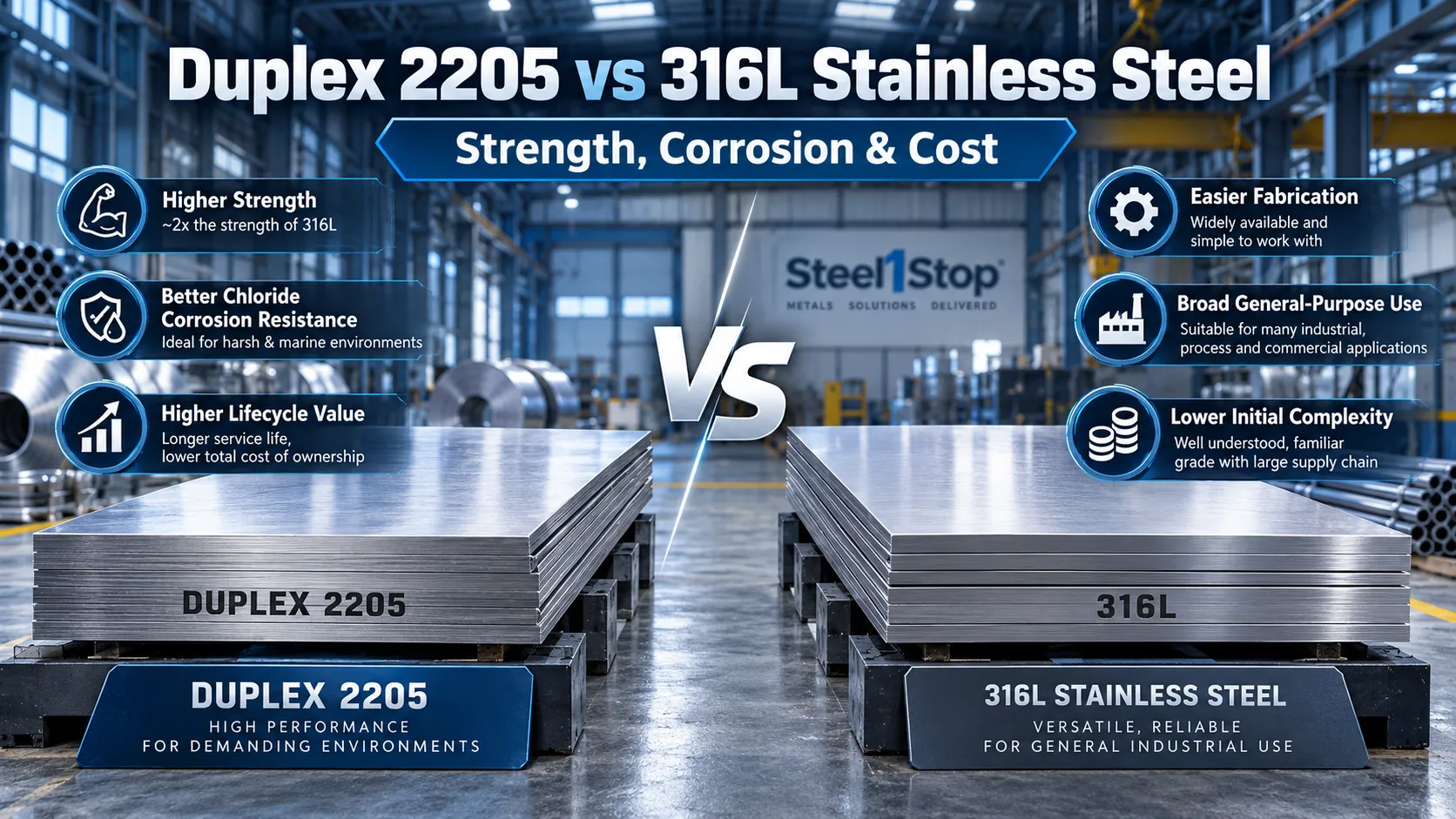
Beim Vergleich Duplex 2205 vs. Edelstahl 316LDie wichtigsten Unterschiede sind mechanische Festigkeit, Chloridkorrosionsbeständigkeit, Mikrostruktur, Fertigungsanforderungen und Gesamtprojektkosten.
Duplex 2205 ist im Allgemeinen der bessere Ausgangspunkt, wenn hohe Festigkeit, Beständigkeit gegen chloridinduzierte Lochfraßbildung und Chlorid-Spannungsrisskorrosion von entscheidender Bedeutung sind. 316L ist oft praktischer für allgemeine chemische Prozesse, Hygienegeräte, komplexe Fertigungen und Anwendungen, bei denen die Korrosionsbeständigkeit bereits ausreichend ist.
The difference is substantial. Under commonly referenced ASTM A240 plate specifications, Duplex 2205 (UNS S32205) has a minimum yield strength of 450 MPa compared with 170 MPa for 316L (UNS S31603).
However, this does not mean 2205 is automatically the better material for every project. Duplex steel requires more attention to welding procedure qualification, phase balance, temperature limitations, and material verification.
For industrial buyers sourcing stainless steel plate, coil, pipe, or pressure equipment, the correct decision should consider corrosion exposure, operating temperature, design pressure, fabrication requirements, applicable standards, and total lifecycle cost.
Duplex 2205 vs 316L Stainless Steel: Quick Comparison
The following table summarizes the major differences between the two grades.
| Eigentum | Duplex 2205 (S32205) | 316L (S31603) |
|---|---|---|
| Stainless Steel Family | Duplex | Austenitisch |
| Mikrostruktur | Ferrite + Austenite | Austenite |
| UNS Grade | S32205 / S31803 | S31603 |
| Common EN Grade | 1.4462 | 1.4404 |
| Chrom | 22–23% | 16–18% |
| Nickel | 4.5–6.5% | 10–14% |
| Molybdän | 3.0–3.5% | 2.0–3.0% |
| Stickstoff | 0.14–0.20% | ≤0.10% |
| Minimum Yield Strength | 450 MPa | 170 MPa |
| Minimum Tensile Strength | 655 MPa | 485 MPa |
| Minimum Elongation | 25% | 40 % |
| Typical PREN | 35–37 | 24–26 |
| General Corrosion Resistance | Very good in many environments | Very good in many environments |
| Chloride Pitting Resistance | Höher | Untere |
| Chloride SCC Resistance | Significantly higher | More susceptible |
| Schweißbarkeit | Good with controlled procedures | Generally easier |
| Cold Formability | More demanding | Besser |
| Verarbeitbarkeit | Schwieriger | Generally easier |
| Magnetic Behavior | Magnetisch | Usually weakly magnetic when annealed |
| Elevated Temperature | More restricted | Broader potential application range |
| Cryogenic Applications | Requires careful qualification | Generally preferred |
| Typische Anwendungen | Offshore, desalination, chemical equipment, high-strength systems | Food processing, pharmaceuticals, general industrial piping and tanks |
Mechanical properties are minimum specified values for annealed plate products under the relevant ASTM A240 requirements. Properties of pipes, tubes, bars, forgings, and cold-worked products may differ.
Quick Selection Guide
Wählen Duplex 2205 when:
- Higher yield strength is required.
- Chloride pitting and crevice corrosion are major concerns.
- The application involves potential chloride stress corrosion cracking.
- Reduced structural weight could be valuable after engineering verification.
- The project can accommodate qualified duplex welding and inspection procedures.
Wählen 316L when:
- Its corrosion resistance is sufficient for the intended environment.
- Complex forming or fabrication is important.
- The equipment requires established austenitic welding procedures.
- Low-temperature toughness is a major consideration.
- Greater material availability and straightforward processing are priorities.
What Is Duplex 2205 Stainless Steel?
Duplex 2205 is a chromium-nickel-molybdenum-nitrogen stainless steel containing both ferrite and austenite in its microstructure.
The term duplex refers to this two-phase structure.
Unlike conventional austenitic stainless steels, which consist primarily of austenite after proper annealing, Duplex 2205 contains substantial proportions of both phases.
A typical solution-annealed 2205 structure has approximately balanced ferrite and austenite, although the exact proportions vary with composition and processing.
Why Does Duplex Microstructure Matter?
Ferrite and austenite contribute different material properties.
Ferrite contributes to high strength and improved resistance to chloride stress corrosion cracking.
Austenite contributes ductility and toughness.
When the phases are properly balanced, the alloy combines characteristics that are particularly valuable in demanding industrial environments.
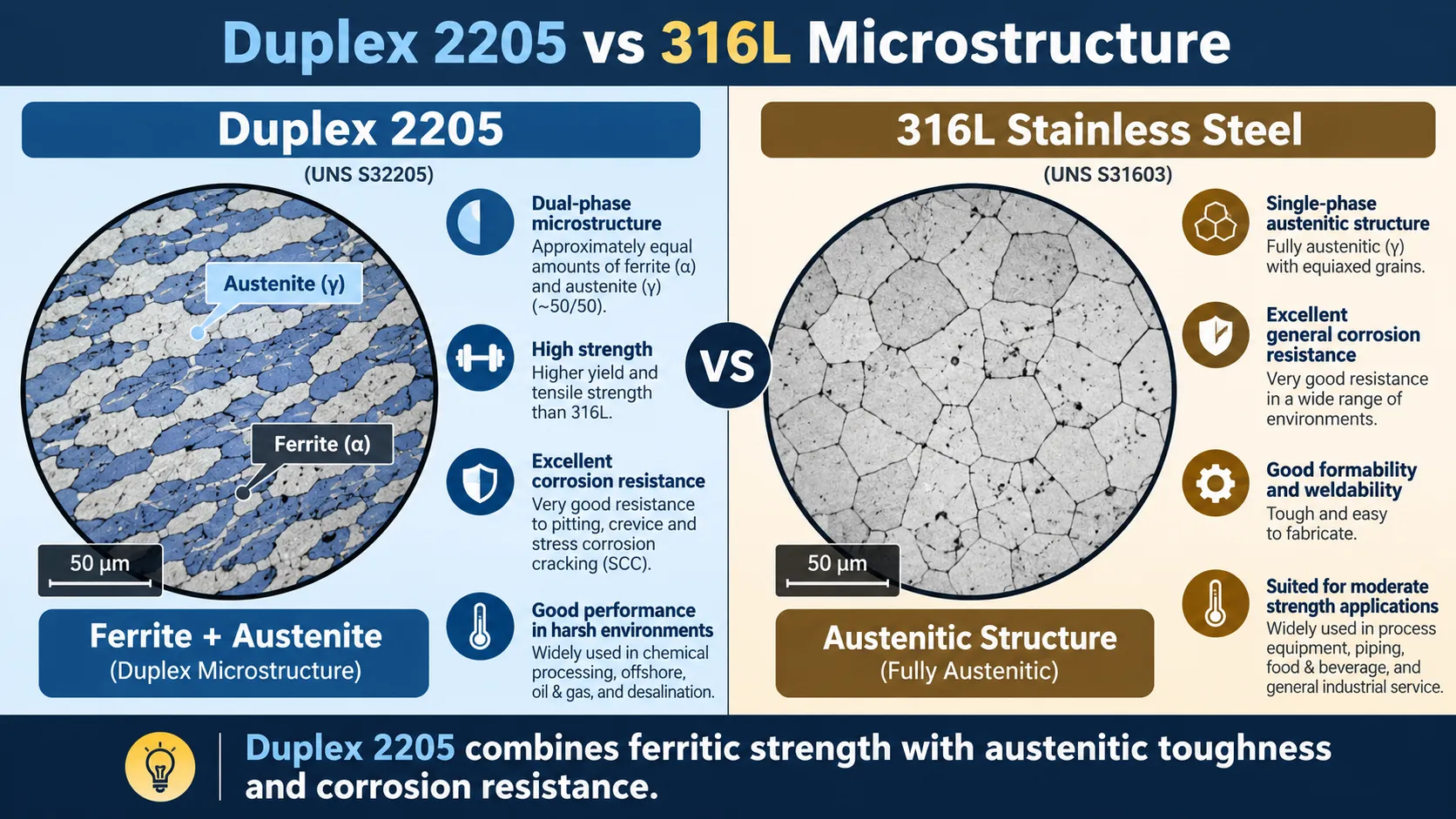
The microstructures shown are engineering illustrations rather than certified metallographic measurements.
Key Advantages of Duplex 2205
High mechanical strength
2205 provides significantly higher specified yield strength than conventional annealed 316L.
This can offer advantages in pressure equipment, fabricated structures, and components where strength controls design.
Improved chloride corrosion resistance
The combination of chromium, molybdenum, and nitrogen improves resistance to chloride-induced pitting and crevice corrosion.
Better resistance to chloride SCC
Duplex stainless steels are generally more resistant than standard austenitic grades to chloride stress corrosion cracking under comparable conditions.
Potential weight reduction
Higher strength may allow lighter designs when the governing design standards permit it.
Useful performance in demanding industrial systems
2205 is widely considered for chemical processing, pulp and paper equipment, offshore facilities, and selected water-treatment applications.
Limitations of Duplex 2205
Trotz dieser Vorteile erfordert 2205 eine sorgfältige Anwendungsbewertung.
Zu den möglichen Einschränkungen gehören:
- Anspruchsvollere Schweißprozesssteuerung
- Höhere Umformkräfte
- Schwierigere Bearbeitung
- Eingeschränkter Langzeitbetrieb bei erhöhten Temperaturen
- Geringere Eignung für kryogene Anwendungen als viele austenitische Sorten
- Zusätzliche Prüfanforderungen bei kritischen Anwendungen
Steel1Stop-Angebote Duplex 2205 Edelstahlspule für industrielle Anwendungen, die eine höhere Festigkeit und Korrosionsbeständigkeit erfordern.
Was ist Edelstahl 316L?
316L ist ein austenitischer Edelstahl mit niedrigem Kohlenstoffgehalt, der Chrom, Nickel und Molybdän enthält.
Die UNS-Bezeichnung lautet S31603.
Der Brief L weist auf einen niedrigeren maximalen Kohlenstoffgehalt als herkömmlicher Werkstoff 316 hin und trägt so dazu bei, die Anfälligkeit für Sensibilisierung und interkristalline Korrosion im Zusammenhang mit bestimmten thermischen Belastungen und Schweißbedingungen zu verringern.
316L wird häufig verwendet, da es eine praktische Kombination aus Korrosionsbeständigkeit, Duktilität, Zähigkeit und Vielseitigkeit bei der Herstellung bietet.
Vorteile von Edelstahl 316L
Gute allgemeine Korrosionsbeständigkeit
Der Molybdänzusatz verbessert die Beständigkeit gegen lokale Korrosion im Vergleich zu herkömmlichem Edelstahl 304.
Hervorragende Verarbeitungseigenschaften
316L kann mit etablierten Fertigungstechniken geschnitten, gebogen, gerollt, geschweißt und verarbeitet werden.
Gute Kältezähigkeit
Seine austenitische Struktur macht es für viele Tieftemperatur- und Tieftemperaturanwendungen attraktiv, vorbehaltlich der entsprechenden Material- und Designspezifikationen.
Breite industrielle Akzeptanz
316L wird häufig in der chemischen Verarbeitung, Lebensmittelausrüstung, pharmazeutischen Systemen, Tanks und Rohrleitungen spezifiziert.
Gut etablierte Lieferkette
316L is widely available in numerous product forms and dimensions.
Limitations of 316L
316L has substantially lower yield strength than 2205.
It is also more susceptible to chloride stress corrosion cracking under certain conditions.
Although 316L offers better chloride resistance than 304, it is not suitable for every marine or high-chloride application.
For available grades, finishes, and dimensions, see our 316L stainless steel coil product page.
Chemical Composition: Duplex 2205 vs 316L
Chemical composition explains much of the performance difference between these two alloys.
Chemical Composition Comparison
| Element | Duplex 2205 S32205 | 316L S31603 |
|---|---|---|
| Chrom (Cr) | 22.0–23.0% | 16.0–18.0% |
| Nickel (Ni) | 4.5–6.5% | 10.0–14.0% |
| Molybdän (MO) | 3.0–3.5% | 2.0–3.0% |
| Stickstoff (N) | 0.14–0.20% | ≤0.10% |
| Kohlenstoff (c) | ≤0.030% | ≤0.030% |
| Mangan (MN) | ≤2.00% | ≤2.00% |
| Silizium (Si) | ≤1.00% | ≤0.75% |
| Eisen (Fe) | Gleichgewicht | Gleichgewicht |
Chemische Grenzwerte basieren auf den allgemein referenzierten ASTM-Spezifikationen für Flachprodukte. Bestätigen Sie die tatsächliche Chemie anhand der geltenden Standardausgabe und des Mill Test Certificate.
Chrom: Passiver Filmschutz
Chrom ist für die Bildung des schützenden Passivfilms auf Edelstahl unerlässlich.
2205 enthält deutlich mehr Chrom als 316L.
Dies trägt insbesondere in Kombination mit Molybdän und Stickstoff zu seiner Korrosionsbeständigkeit bei.
Molybdän: Lokalisierte Korrosionsbeständigkeit
Molybdän verbessert die Beständigkeit gegen lokale Korrosion, insbesondere Loch- und Spaltkorrosion in chloridhaltigen Umgebungen.
2205 enthält im Allgemeinen mehr Molybdän als 316L.
Molybdän allein entscheidet jedoch nicht darüber, ob eine bestimmte Legierung für eine aggressive chemische Umgebung geeignet ist.
Nitrogen: Strength and Corrosion Resistance
Nitrogen is especially important in modern duplex stainless steels.
It contributes to:
- Austenite stabilization
- Higher mechanical strength
- Improved pitting corrosion resistance
- Appropriate phase balance
The higher specified nitrogen content of S32205 is one reason its chemistry must be distinguished from the broader S31803 specification.
Why Does 2205 Contain Less Nickel?
Nickel stabilizes austenite.
Because 2205 is designed to contain both ferrite and austenite, its composition does not require the same nickel content as fully austenitic 316L.
This difference can influence alloy cost, although actual market prices depend on the total alloy composition, production route, and commercial conditions.
Mechanical Properties: How Much Stronger Is Duplex 2205?
Einer der wichtigsten Gründe, 2205 in Betracht zu ziehen, ist seine hohe Streckgrenze.
Gemäß den repräsentativen ASTM A240-Plattenanforderungen weist 2205 S32205 mehr als das Doppelte der Mindeststreckgrenze von 316L auf.
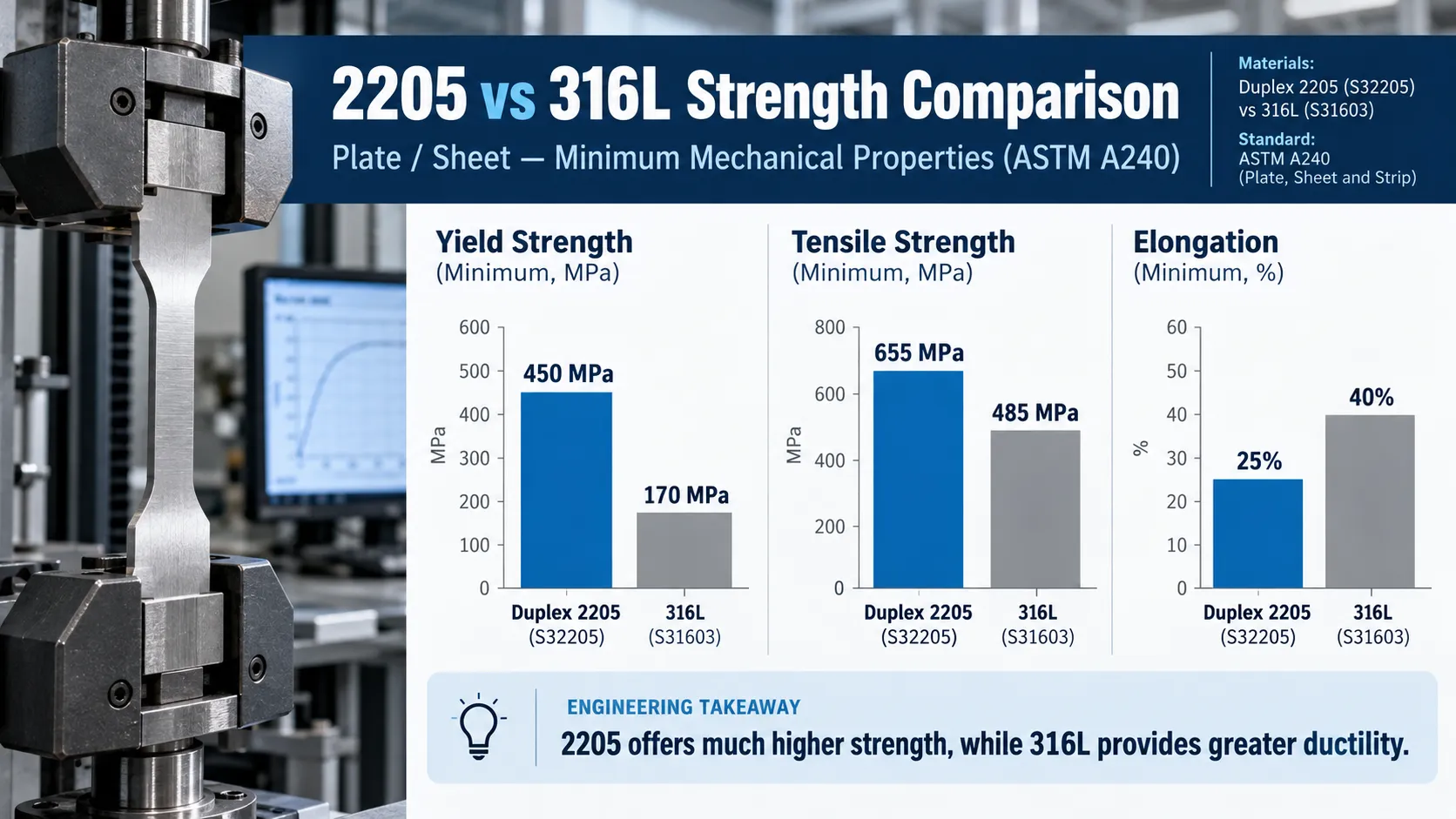
Minimale mechanische Eigenschaften
| Eigentum | 2205 S32205 | 316L S31603 |
|---|---|---|
| Ertragsfestigkeit | 450 MPa | 170 MPa |
| Zugfestigkeit | 655 MPa | 485 MPa |
| Verlängerung | 25% | 40 % |
| Dichte | ~7,82 g/cm³ | ~8,03 g/cm³ |
Bei diesen Werten handelt es sich um spezifizierte Mindesteigenschaften für den jeweiligen Plattenzustand, nicht um tatsächliche Testergebnisse einer einzelnen Produktionsschmelze.
Ertragsfestigkeit
Die Streckgrenze stellt die Spannung dar, bei der eine dauerhafte plastische Verformung einsetzt.
Der Unterschied ist erheblich:
- 2205: mindestens 450 MPa
- 316L: mindestens 170 MPa
Dies macht 2205 attraktiv für Komponenten, bei denen es wichtig ist, einer dauerhaften Verformung standzuhalten.
Zugfestigkeit
Die Zugfestigkeit beschreibt die maximale Belastung, der ein Material unter Zugbelastung standhalten kann, bevor es bricht.
2205 hat auch eine höhere Mindestzugfestigkeit.
Bei der eigentlichen technischen Konstruktion müssen jedoch die zulässigen Spannungswerte verwendet werden, die in der entsprechenden Konstruktionsvorschrift festgelegt sind, und nicht nur die Mindestzugfestigkeit.
Duktilität
316L bietet typischerweise eine größere Dehnung.
Dies ist von Vorteil für Anwendungen, die während der Herstellung erhebliche Formen, Biegungen oder Verformungen erfordern.
Obwohl 2205 erfolgreich hergestellt werden kann, sind oft größere Umformkräfte und eine sorgfältigere Verfahrenskontrolle erforderlich.
Kann Duplex 2205 die Plattendicke oder Rohrwanddicke reduzieren?
Möglicherweise, aber nur, wenn dies durch die Auslegungsberechnung unterstützt wird.
Eine höhere Streckgrenze kann in bestimmten Anwendungen dünnere Abschnitte ermöglichen.
For example, a pressure component may benefit if the governing allowable stress is substantially higher for 2205.
However, the design must also consider:
- Design pressure
- Design temperature
- Allowable stress under the applicable code
- Corrosion allowance
- Weld joint efficiency
- External pressure and buckling
- Fatigue loading
- Deflection and stiffness
- Minimum manufacturing thickness
- Fabrication tolerances
A material with 2.6 times the minimum yield strength does not automatically allow a 61% reduction in wall thickness.
For pressure vessels, the design must follow the applicable pressure equipment code.
For piping, wall thickness must satisfy the relevant piping code and project requirements.
Der wahre Vorteil von 2205 ist nicht nur das stärkere Material; Es ist die Möglichkeit, eine effizientere technische Struktur zu erreichen.
Korrosionsbeständigkeit: Ist 2205 besser als 316L?
In vielen chloridhaltigen Umgebungen bietet Duplex 2205 eine deutlich bessere Beständigkeit gegen Lochfraß, Spaltkorrosion und Chlorid-Spannungsrisskorrosion als 316L.
Allerdings hängt das Korrosionsverhalten nicht nur von der Legierungsbezeichnung ab.
Temperatur, chemische Zusammensetzung, pH-Wert, Chloridkonzentration, Sauerstoff, Ablagerungen, Strömungsbedingungen und Spaltgeometrie können das Ergebnis beeinflussen.
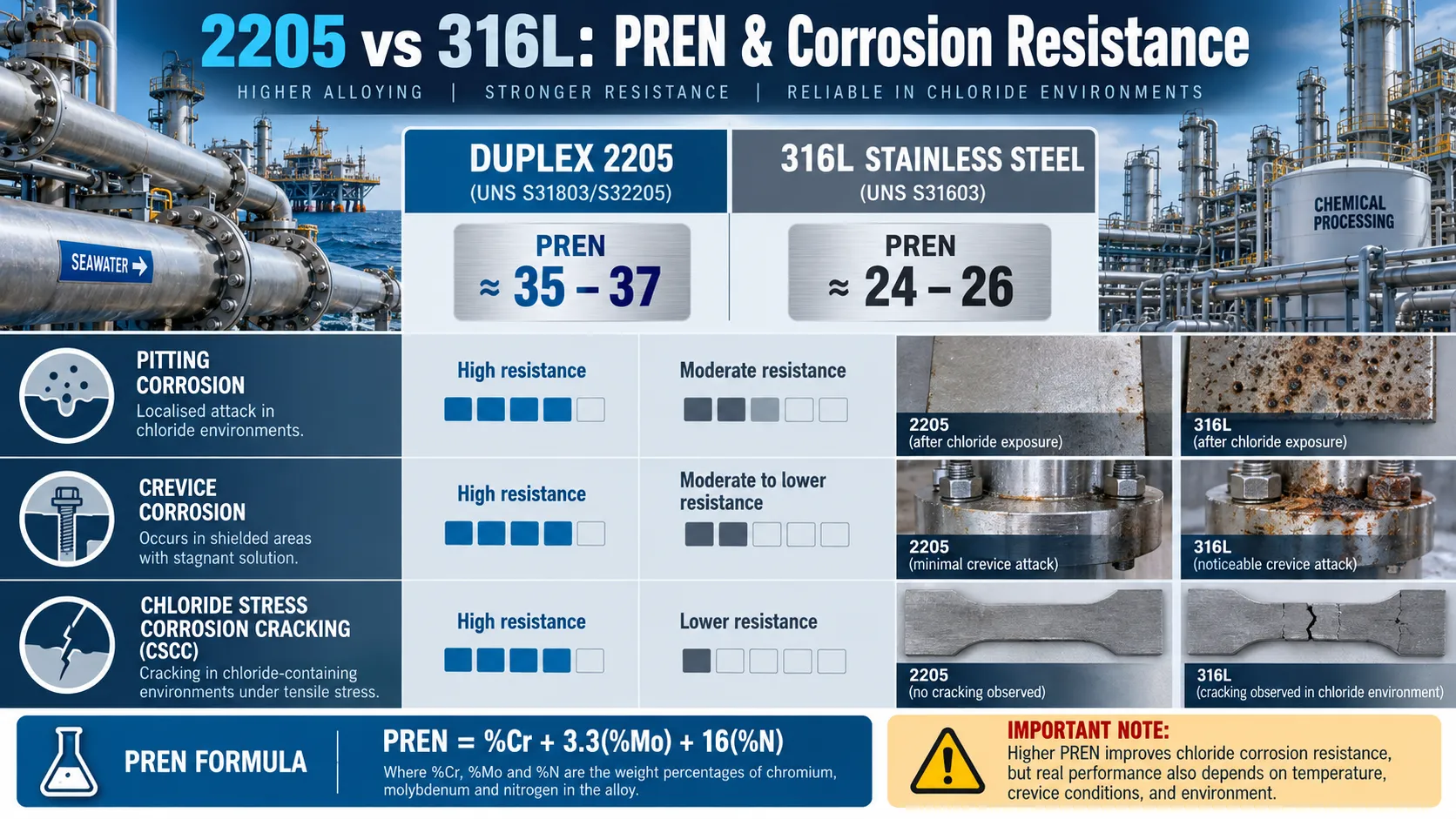
Illustrative comparison only. The corrosion specimens shown are conceptual images, not actual test results or evidence of a specific service-life difference.
Lochfraß
Pitting is a localized form of corrosion that can create small but deep cavities.
Chlorides can destabilize the passive film on stainless steel and contribute to pit initiation.
2205 generally offers greater resistance to chloride pitting because of its higher chromium, molybdenum, and nitrogen contents.
This advantage is valuable in selected:
- Chemical processing systems
- Chloride-containing process water
- Water treatment facilities
- Marine-related equipment
- Pulp and paper applications
Spaltkorrosion
Crevice corrosion occurs in narrow spaces where local solution chemistry can become more aggressive.
Beispiele hierfür sind:
- Flanged connections
- Gasket interfaces
- Bolted joints
- Overlapping metal surfaces
- Deposits
- Stagnant liquid areas
2205 offers improved resistance compared with 316L in many chloride environments.
Nevertheless, severe crevice conditions can cause corrosion in 2205 as well.
Good mechanical design, drainage, and material selection remain important.
Chloride Stress Corrosion Cracking
Stress corrosion cracking occurs when susceptible material, tensile stress, and an aggressive environment interact.
Austenitic stainless steels such as 316L can be vulnerable to chloride SCC under certain temperature and environmental conditions.
Duplex 2205 generally provides significantly greater resistance to this failure mechanism.
However, it is not immune to every form of environmental cracking.
In particular, hydrogen-related cracking and sulfide stress cracking in certain sour-service environments require separate assessment.
Seawater and Marine Applications
2205 is frequently considered for marine and seawater-related equipment.
Its improved corrosion resistance makes it a stronger starting material than 316L in many chloride-containing systems.
But 2205 should not be described as universally seawater-proof.
Warm seawater, stagnant conditions, crevices, deposits, high chloride levels, and particular flow conditions can create severe corrosion risks.
For highly demanding seawater applications, super duplex 2507, 6Mo stainless steel, or other corrosion-resistant alloys may be necessary.
Chemical Corrosion
Neither 2205 nor 316L is universally superior in every chemical.
Some environments favor austenitic grades because of the chemistry involved, while others favor duplex stainless steel.
Material selection should consider the actual process fluid and operating temperature.
Do not assume that higher PREN automatically means superior resistance to every acid or chemical solution.
PREN Comparison: 2205 vs 316L
PREN stands for Pitting Resistance Equivalent Number.
It is a calculated index commonly used to compare the potential localized corrosion resistance of stainless steels in chloride-containing environments.
A widely used formula is:
PREN = %Cr + 3.3 × %Mo + 16 × %N
Where:
- Cr = Chromium content, weight %
- Mo = Molybdenum content, weight %
- N = Nitrogen content, weight %
Typical PREN Values
| Grad | Typical PREN |
|---|---|
| 304 Edelstahl | ~18–20 |
| 316L Edelstahl | ~24–26 |
| Duplex 2205 S32205 | ~35–37 |
| Super Duplex 2507 | ~40–43 or higher, depending on chemistry |
The values are indicative and depend on the actual chemical composition.
Example PREN Calculation for 2205
Assume an illustrative 2205 composition of:
- Chromium: 22%
- Molybdenum: 3.1%
- Nitrogen: 0.17%
PREN = 22 + (3.3 × 3.1) + (16 × 0.17)
PREN = 22 + 10.23 + 2.72
PREN ≈ 34.95
Does Higher PREN Mean Better Corrosion Resistance?
A higher PREN generally indicates improved potential pitting resistance in chloride-containing environments.
However, PREN does not directly predict service life.
It does not fully account for:
- Oberflächenzustand
- Welding defects
- Intermetallic phases
- Temperatur
- Crevice geometry
- Solution chemistry
- Flow conditions
- Microbiological activity
For critical applications, use appropriate corrosion test data and project-specific material evaluation.
S31803 vs S32205: Are Both Duplex 2205?
Yes. Both UNS S31803 and UNS S32205 are commonly associated with Duplex 2205.
However, they are not identical chemical specifications.
This distinction matters when purchasing stainless steel for chloride-sensitive applications.
Chemical Composition Differences
| Element | S31803 | S32205 |
|---|---|---|
| Chrom | 21.0–23.0% | 22.0–23.0% |
| Nickel | 4.5–6.5% | 4.5–6.5% |
| Molybdän | 2.5–3.5% | 3.0–3.5% |
| Stickstoff | 0.08–0.20% | 0.14–0.20% |
| Kohlenstoff | ≤0.030% | ≤0.030% |
S32205 has tighter minimum requirements for chromium, molybdenum, and nitrogen.
These limits provide greater confidence in the corrosion-resistance characteristics expected from modern 2205 material.
Can S32205 Be Dual-Certified as S31803?
A heat of material meeting the requirements of S32205 may also meet those of S31803, allowing dual certification when all applicable conditions are satisfied.
Die Materialerfüllung S31803 entspricht jedoch nicht automatisch der Erfüllung von S32205.
Der Käufer sollte die tatsächlichen chemischen Analyse- und Spezifikationsanforderungen überprüfen.
Was sollten Käufer angeben?
Für Projekte, die die strengere moderne 2205-Chemie erfordern, geben Sie Folgendes an:
Duplex 2205 / UNS S32205
Wenn eine Doppelzertifizierung erforderlich ist, geben Sie dies ausdrücklich an.
Zum Beispiel:
„Duplex 2205-Blech, Doppelzertifizierung UNS S32205/S31803, ASTM A240/A240M, lösungsgeglüht, MTC erforderlich.“
Die richtige Formulierung hängt von der Materialspezifikation des Projekts ab.
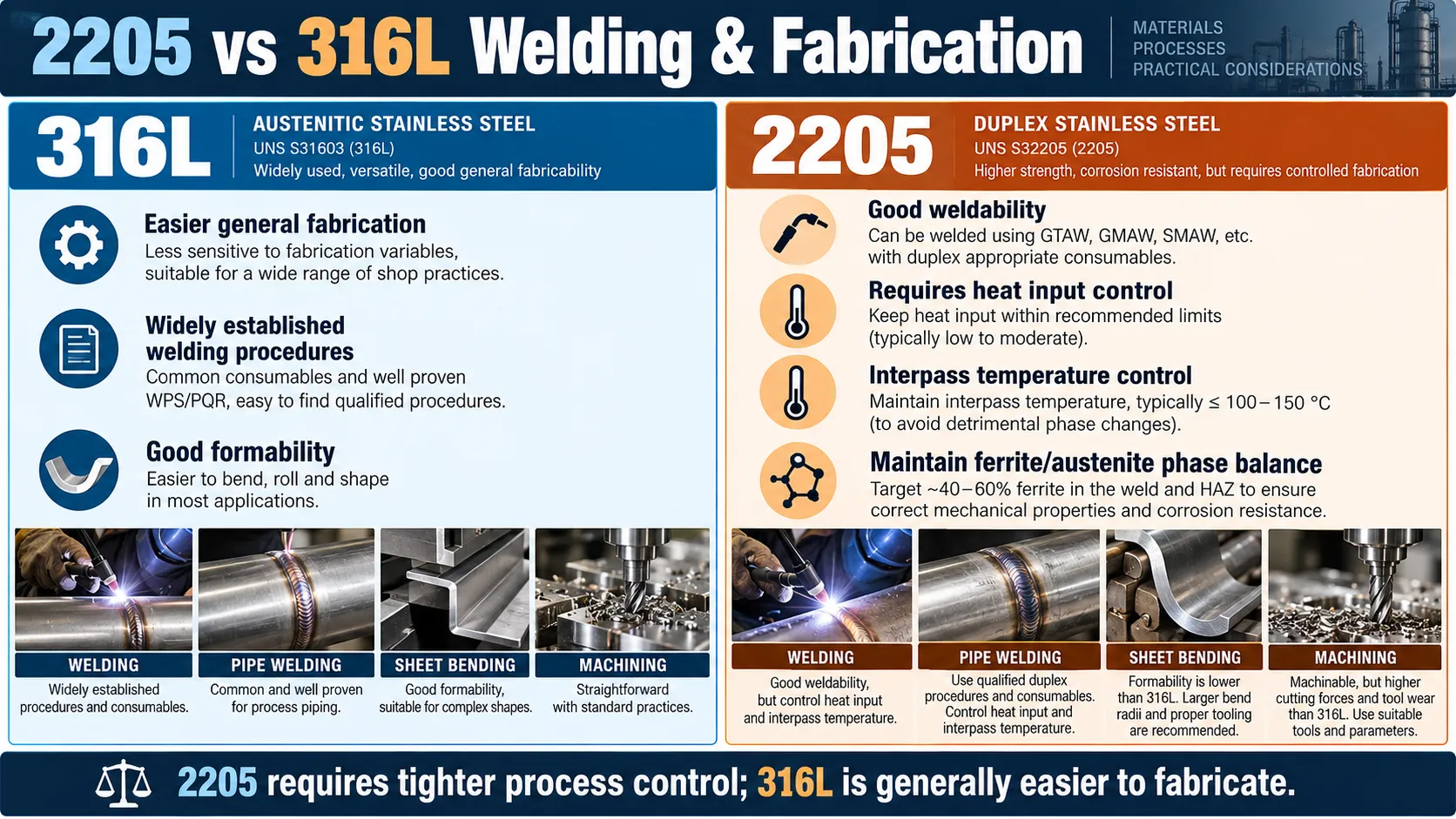
Duplex 2205 vs. 316L Schweißen und Fertigung
Beide Qualitäten können erfolgreich geschweißt und verarbeitet werden, ihre Verarbeitungsanforderungen unterscheiden sich jedoch.
316L lässt sich im Allgemeinen einfacher mit den bekannten Verfahren für austenitischen Edelstahl herstellen.
Duplex 2205 requires additional attention to the microstructure of both the weld metal and heat-affected zone.
Welding 316L
316L is widely used in welded industrial equipment.
Suitable welding processes include:
- GTAW / TIG
- GMAW / MIG
- SMAW
- Other qualified procedures
Its low carbon content helps reduce sensitization concerns.
Nevertheless, welding quality, filler selection, heat input, joint design, and post-weld cleaning remain important.
Welding Duplex 2205
2205 is weldable, but its properties depend on maintaining a suitable microstructure after welding.
If cooling conditions or heat exposure are unsuitable, excessive ferrite or undesirable secondary phases may develop.
These changes can reduce toughness and corrosion resistance.
Ferrite and Austenite Phase Balance
Proper duplex welding procedures aim to maintain an acceptable ferrite/austenite balance.
This is achieved through control of:
- Heat input
- Interpass temperature
- Welding process
- Filler metal
- Shielding gas
- Joint geometry
- Cooling conditions
Acceptance criteria for ferrite content depend on the governing specification and welding procedure qualification.
Welding Consumables
For welding 2205 to similar duplex material, ER2209 and E2209-type consumables are commonly used.
These fillers are designed to help produce appropriate weld-metal chemistry and microstructure.
Different filler metals may be selected for dissimilar joints or more demanding corrosion conditions.
Heat Input and Interpass Temperature
Manufacturers of duplex stainless steel commonly recommend controlled heat input and relatively low interpass temperatures.
For example, published recommendations for certain 2205 products include interpass temperatures below approximately 150°C.
However, this must not be treated as a universal welding rule.
The project should use an approved Welding Procedure Specification (WPS) and supporting procedure qualification records.
Bending and Forming
316L generally requires lower forming forces.
2205 has higher strength and can therefore require:
- Greater press capacity
- Higher bending force
- Larger forming allowances
- More attention to springback
- Suitable tooling
Both grades can be fabricated, but process planning must reflect their different properties.
Bearbeitung
2205 ist aufgrund seiner höheren Festigkeit und seines Kaltverfestigungsverhaltens im Allgemeinen anspruchsvoller zu bearbeiten als 316L.
Geeignete Werkzeuge, Schnittgeschwindigkeiten, Vorschübe und Kühlmittelmanagement sind wichtig.
Bei präzisionsgefertigten Komponenten sollten die Herstellungskosten bei der Materialauswahl berücksichtigt werden.
Temperaturgrenzen: Wann ist 316L besser?
Eine wichtige Einschränkung von Duplex-Edelstählen ist ihre temperaturabhängige mikrostrukturelle Stabilität.
2205 kann innerhalb des vorgesehenen Temperaturbereichs eine hervorragende Leistung erbringen, eine längere Einwirkung erhöhter Temperaturen kann jedoch zu unerwünschten metallurgischen Veränderungen führen.
Service bei erhöhter Temperatur
Duplex-Edelstähle können nach bestimmten thermischen Belastungen verspröden oder schädliche Phasen bilden.
For this reason, continuous service at elevated temperatures often requires stricter limitations than for conventional austenitic stainless steels.
Depending on the product standard and design code, the practical allowable temperature may be restricted to approximately 250–300°C or another specified limit.
A single universal maximum temperature should not be used for every duplex product.
316L may offer advantages in some higher-temperature applications, although its own mechanical and corrosion limitations must still be evaluated.
Low-Temperature Service
316L generally offers better low-temperature toughness than 2205.
The austenitic structure of 316L is particularly advantageous in cryogenic service.
Duplex 2205 can be used in some subzero-temperature applications when properly qualified, but its ferrite-containing microstructure can limit toughness at sufficiently low temperatures.
For cryogenic equipment, 316L is generally the more appropriate starting material unless a qualified engineering assessment supports another choice.
Intermetallic Phase Formation
Improper thermal exposure can produce undesirable phases in duplex stainless steels.
These phases may impair:
- Zähigkeit
- Korrosionsbeständigkeit
- Duktilität
- Welded-joint performance
This is one reason heat treatment, welding procedures, and inspection requirements deserve special attention when specifying duplex materials.
Duplex 2205 vs 316L Cost Comparison
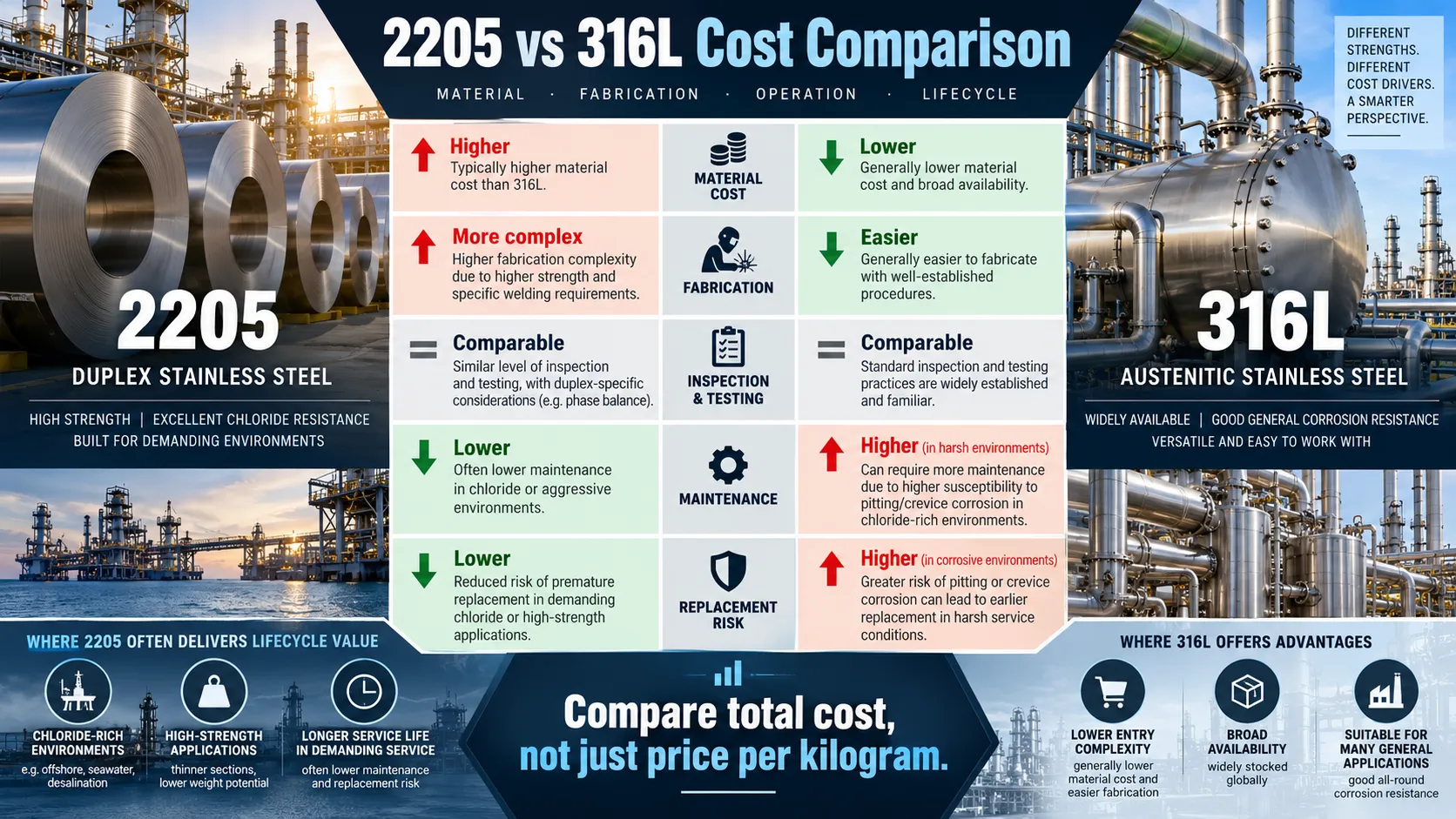
The cost comparison is more complicated than simply comparing two material prices.
2205 often involves more specialized production, qualification, and fabrication requirements.
316L generally benefits from broad availability and established fabrication practices.
However, alloy prices fluctuate, and the relative price per kilogram can change with nickel, molybdenum, product form, market conditions, and order quantity.
Material Cost
2205 may have a higher purchase price for certain products.
However, it contains less nickel than 316L.
Depending on alloy market conditions and mill production routes, the relative material cost can change.
Daher ist es besser, Angebote für die tatsächliche Produktspezifikation anzufordern, als eine feste prozentuale Differenz anzugeben.
Herstellungskosten
2205 kann zusätzliche Aufmerksamkeit erfordern auf:
- Schweißverfahren
- Heat input
- Filler metal
- Phasengleichgewicht
- Bearbeitung
- Bildung
- Inspektion
Bei komplexer Fertigung kann dies die Herstellungskosten erhöhen.
316L bietet häufig Vorteile, wenn das Projekt viele Schweißverbindungen oder kompliziert geformte Komponenten umfasst.
Gewichtsersparnis
Die höhere Festigkeit von 2205 ermöglicht möglicherweise dünnere Komponenten, bei denen die Festigkeit das Design bestimmt.
Wenn technische Berechnungen eine solche Reduzierung unterstützen, kann dies zu einer Verringerung der benötigten Materialmenge führen.
Bei großen Behältern, Rohrleitungssystemen und Strukturbauteilen kann das Materialgewicht sowohl die Herstellungs- als auch die Installationskosten beeinflussen.
Wartung und Austausch
In Chloridumgebungen, in denen 316L nicht ausreicht, kann die richtige Auswahl von 2205 das korrosionsbedingte Wartungs- und Austauschrisiko verringern.
Dieser potenzielle Vorteil kann besonders wichtig in abgelegenen Offshore-Anlagen oder Industrieanlagen sein, in denen Ausfallzeiten teuer sind.
Ohne projektspezifische Nachweise sollte jedoch nicht davon ausgegangen werden, dass 2205 einen festen Lebensdauervorteil bietet.
Gesamtbetriebskosten
Eine realistische Berechnung sollte Folgendes berücksichtigen:
Gesamtprojektkosten = Material + Herstellung + Inspektion + Installation + Wartung + Ausfallzeit + Ersatz
| Kostenfaktor | 2205 | 316L |
|---|---|---|
| Anfängliche Materialkosten | Markt- und spezifikationsabhängig | Markt- und spezifikationsabhängig |
| Schweißkomplexität | Höhere Anforderungen an die Prozesssteuerung | Generally easier |
| Umformkosten | Möglicherweise höher | Normalerweise niedriger |
| Inspektion | Möglicherweise sind Duplex-spezifische Tests erforderlich | Herkömmliche Tests reichen oft aus |
| Mögliche Gewichtsreduktion | Greater when design permits | More limited |
| Chloride Corrosion Risk | Generally lower | Generally higher |
| Wartung | May be lower in appropriate chloride service | Depends on environment |
| Replacement Risk | May be lower when properly selected | Higher if corrosion limits are exceeded |
The best financial choice is the alloy that meets the service requirements with the lowest justified total project cost.
2205 vs 316L: Which Is Better for Different Applications?
The following application table provides a preliminary selection framework.
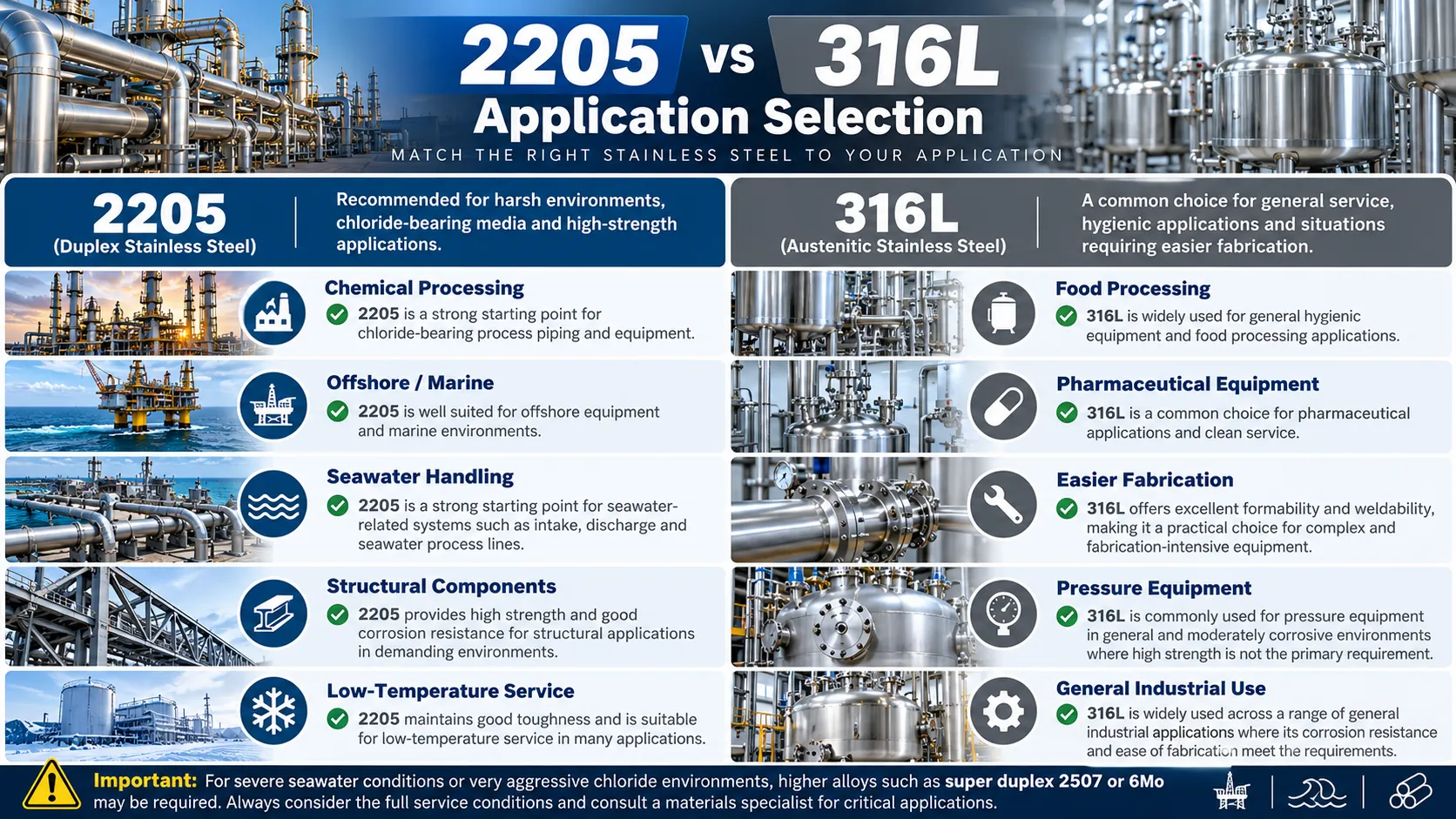
Application selection is illustrative. For low-temperature or cryogenic service, 316L generally deserves priority consideration over 2205; verify the relevant impact-toughness and design requirements.
| Anwendung | Suggested Starting Grade | Main Consideration |
|---|---|---|
| General Chemical Tanks | 316L / 2205 | Exact process chemistry |
| Chloride-Bearing Process Piping | 2205 | Pitting and SCC resistance |
| Offshore Process Equipment | 2205 / higher alloys | Chlorides, pressure, temperature |
| Seawater Cooling | 2205 / 2507 / 6Mo | Severe localized corrosion risks |
| Desalination Equipment | 2205 or higher | Chloride exposure |
| General Food Processing | 316L | Hygiene and fabrication |
| Pharmaceutical Equipment | 316L | Cleaning and surface quality |
| High-Strength Structural Parts | 2205 | Ertragsfestigkeit |
| Druckbehälter | 316L / 2205 | Design code and corrosion |
| General Industrial Tanks | 316L | Cost and fabrication |
| Cryogenic Equipment | 316L | Low-temperature toughness |
| H₂S-Containing Oil & Gas Systems | Qualified material | Sour-service requirements |
These recommendations are not a substitute for a formal material-selection assessment.
Chemische Verarbeitung
2205 is a strong candidate for some chloride-containing chemical process streams.
316L may be sufficient for less aggressive chemicals or environments where its established process compatibility is satisfactory.
For concentrated acids or unusual chemical mixtures, neither grade should be chosen solely on PREN.
Offshore and Marine Equipment
2205 offers useful mechanical strength and chloride corrosion resistance.
This makes it valuable for selected offshore structures, piping, and process equipment.
However, the severity of seawater exposure must be evaluated carefully.
In aggressive subsea and seawater applications, higher-alloy materials may be required.
Druckbehälter
Both grades are used for pressure equipment where permitted by the applicable code.
2205 may offer opportunities for reduced wall thickness because of its high allowable strength.
316L may simplify fabrication and welding.
The final choice should consider pressure, temperature, corrosion, joint efficiency, inspection, and the relevant pressure-vessel code.
Food and Pharmaceutical Equipment
316L is widely used in hygienic systems because of its corrosion resistance, cleanability, and fabrication characteristics.
2205 may be considered where higher strength or more aggressive chloride conditions justify it.
For hygienic applications, the surface finish, weld quality, cleaning chemistry, and regulatory requirements are also important.
Oil and Gas Equipment
2205 is used in certain oil and gas environments.
However, H₂S-containing service requires a separate evaluation.
Materials must meet the relevant requirements of NACE MR0175 / ISO 15156 or other applicable sour-service standards.
Do not assume all 2205 products are automatically suitable for any H₂S environment.
For related material selection, see Steel1Stop’s guide to stainless steel in the oil and gas industry.
ASTM Standards for Duplex 2205 and 316L
The correct material standard depends on the product form.
A plate specification cannot automatically be applied to pipe, tubing, or forgings.
| Standard | Anwendung |
|---|---|
| ASTM A240/A240M | Stainless steel plate, sheet, strip |
| ASTM A480/A480M | General flat-rolled stainless product requirements |
| ASTM A790/A790M | Seamless and welded duplex stainless steel pipe |
| ASTM A789/A789M | Seamless and welded duplex stainless steel tubing |
| ASTM A928/A928M | Electric-fusion-welded duplex stainless steel pipe |
| ASTM A182/A182M | Forged or rolled alloy and stainless steel piping components |
| ASTM A815/A815M | Wrought duplex stainless steel fittings |
| ASTM A312/A312M | Austenitic stainless steel pipe, including applicable 316L products |
| ASTM A269/A269M | Applicable austenitic stainless steel tubing |
| ASTM A923 | Detection of detrimental intermetallic phases in certain duplex stainless steels |
| ASTM G48 | Laboratory pitting and crevice corrosion testing |
Not every standard applies to every material grade or product condition.
The purchase order should use the applicable product specification and required edition.
ASTM A240/A240M
ASTM A240/A240M covers applicable stainless steel plate, sheet, and strip products.
For 2205 S32205 and 316L S31603, this standard provides relevant requirements for chemical composition and mechanical properties.
The applicable standard edition should be specified in the purchase order.
ASTM A923: Detrimental Intermetallic Phases
ASTM A923 provides methods for detecting detrimental intermetallic phases in certain duplex stainless steels.
These phases can reduce toughness and corrosion resistance.
The standard includes methods involving:
- Metallographic etching
- Charpy impact testing
- Ferric chloride corrosion testing
The applicable method and acceptance criteria must be defined according to the procurement or project requirements.
ASTM G48: Pitting and Crevice Corrosion Testing
ASTM G48 includes laboratory procedures for evaluating resistance to pitting and crevice corrosion in ferric chloride solutions.
It is useful for comparing materials and evaluating specific product or processing conditions.
However, a G48 test does not automatically establish performance in actual seawater or process chemistry.
ASTM A923 and ASTM G48 serve different purposes and should not be treated as interchangeable tests.
How to Verify Duplex 2205 Before Shipment
For high-value industrial projects, material verification is essential.
The purchasing specification should establish the required tests and documentation before production.
Mill Test Certificate
The MTC should identify:
- Manufacturer or mill
- Materialnote
- UNS designation
- Heat number
- Chemische Zusammensetzung
- Mechanische Eigenschaften
- Product dimensions
- Heat treatment condition
- Applicable standards
- Required inspection results
Verify S32205 Chemistry
If the project specifies S32205, confirm the tighter chromium, molybdenum, and nitrogen requirements.
This is especially important when suppliers describe both S31803 and S32205 simply as “2205.”
PMI / XRF Testing
Handheld XRF can be useful for checking major alloying elements including chromium, nickel, and molybdenum.
However, handheld XRF cannot reliably measure nitrogen or carbon.
Because nitrogen is important to S32205 chemistry, suitable laboratory analysis is necessary if independent verification of the nitrogen content is required.
Weld and Microstructure Inspection
Depending on the project requirements, duplex products or fabricated assemblies may require:
- Ferrite-content assessment
- Metallographic examination
- Corrosion testing
- Impact testing
- Weld inspection
- Maßprüfung
Not every order requires all these tests.
Inspection requirements should reflect the product specification, service criticality, applicable codes, and contract.
How to Specify Duplex 2205 or 316L on an RFQ
A complete Request for Quotation helps suppliers identify the right material and provide more accurate pricing.
| Erfordernis | Beispiel |
|---|---|
| Material | Duplex 2205 Stainless Steel |
| UNS Grade | S32205 |
| Produkt | Plate / Coil / Pipe / Tube |
| Standard | ASTM A240/A240M for plate |
| Dicke | 6 mm |
| Breite | 1500 mm |
| Länge | 6000 mm |
| Wärmebehandlung | Solution annealed |
| Oberflächenbeschaffung | No.1 / specified finish |
| Menge | 10 metric tons |
| MTC | Required, specified certificate type |
| PMI | As required |
| Corrosion Testing | If required by project |
| Impact Testing | If applicable |
| Verpackung | Export packing |
| Ziel | Country and port |
Example RFQ: Duplex 2205 Plate
Material: Duplex 2205 Stainless Steel Plate
Grade: UNS S32205
Standard: ASTM A240/A240M
Thickness: 6 mm
Width: 1500 mm
Length: 6000 mm
Condition: Solution Annealed
Finish: No.1
Quantity: 10 Metric Tons
MTC: Required with heat-number traceability
Additional Testing: According to approved project specification
Destination: To be advised
For pipe or tubing, also include:
- Außendurchmesser
- Wall thickness or schedule
- Seamless or welded construction
- Pipe length
- End preparation
- Pressure or service requirements
- Applicable dimensional and material standards
For pipe purchasing guidance, see our stainless steel pipe guide Und Metrische Rohrführung aus Edelstahl.
Häufig gestellte Fragen
Is Duplex 2205 stronger than 316L?
Yes. Under representative ASTM A240 plate specifications, S32205 has a minimum yield strength of 450 MPa compared with 170 MPa for 316L. The final design must still use the applicable code-defined allowable stresses.
Is 2205 more corrosion resistant than 316L?
2205 generally offers greater resistance to chloride pitting, crevice corrosion, and chloride stress corrosion cracking. However, corrosion behavior depends on the environment, and 2205 is not superior in every chemical medium.
What is the PREN of Duplex 2205?
Modern S32205 commonly has a PREN around 35–37, depending on actual composition and the calculation used.
What is the PREN of 316L stainless steel?
316L commonly has a PREN around 24–26, although the exact value depends on the alloy chemistry.
Can 2205 replace 316L?
Sometimes. Substitution may offer advantages in high-strength or chloride-sensitive applications, but the design, fabrication procedures, operating temperature, standards, and service environment must be reviewed first.
Is 2205 suitable for seawater?
2205 can be suitable for selected seawater-related applications, but it is not universally resistant to all seawater conditions. Warm, stagnant, or severe crevice conditions may require more highly alloyed materials such as super duplex 2507 or 6Mo.
Is Duplex 2205 magnetic?
Yes. Duplex 2205 contains ferrite and is normally magnetic. Annealed 316L is usually weakly magnetic, although cold working can increase its magnetic response.
Can Duplex 2205 be welded to 316L?
Yes, dissimilar welding is possible using appropriately selected filler materials and qualified welding procedures. Weld-metal chemistry, microstructure, corrosion requirements, and service conditions must be considered.
Is S31803 the same as S32205?
Both are associated with 2205 duplex stainless steel, but S32205 has tighter minimum requirements for chromium, molybdenum, and nitrogen. A material meeting S31803 does not necessarily meet S32205.
Is 2205 more expensive than 316L?
It can be, especially for specialized products and fabrication-intensive projects. However, the actual price difference depends on alloy markets, product form, quantity, and certification requirements. Obtain current quotations for a reliable comparison.
Is 2205 suitable for pressure vessels?
Yes, it may be used in pressure equipment when permitted by the applicable material and design codes. Its higher strength can provide design advantages, but material selection and allowable stresses must be verified.
Is 2205 better for cryogenic service?
Not generally. Austenitic 316L is usually the preferred starting point for cryogenic service because of its low-temperature toughness. Duplex 2205 requires specific toughness and design qualification for low-temperature use.
What is the typical welding filler for 2205?
ER2209 or E2209-type consumables are commonly used for welding 2205 to similar duplex material. The final filler selection must follow the qualified welding procedure and service requirements.
What tests should buyers require for Duplex 2205?
At minimum, verify the applicable material standard, grade chemistry, mechanical properties, and MTC. For critical applications, ferrite assessment, ASTM A923, ASTM G48, impact testing, PMI, or additional inspections may be required.
When should I choose Super Duplex 2507 instead of 2205?
2507 may be appropriate for more severe chloride environments or when higher localized corrosion resistance is required. Selection should be based on actual operating conditions, corrosion testing, and engineering requirements.
Final Verdict: Duplex 2205 or 316L?
Duplex 2205 and 316L are both established industrial stainless steels, but they serve different engineering priorities.
Duplex 2205 is the strength- and chloride-resistance-oriented option.
It provides much higher specified yield strength and generally better resistance to chloride pitting, crevice corrosion, and chloride stress corrosion cracking.
It is particularly valuable when these performance characteristics justify its fabrication and inspection requirements.
316L is the versatile austenitic option.
It offers good corrosion resistance, excellent general fabrication characteristics, established welding procedures, and favorable low-temperature toughness.
For many industrial applications, 316L is fully adequate and may offer a more economical overall solution.
The correct decision should always consider:
Chemical Environment + Temperature + Pressure + Strength + Welding + Standards + Inspection + Lifecycle Cost
At Steel1Stop, we support international customers sourcing stainless steel materials for manufacturing, construction, industrial piping, chemical processing, and other engineering projects.
Explore our Duplex 2205 EdelstahlspuleAnwesend 316L stainless steel coil, Und stainless steel plate and sheet product pages for material options and procurement information.
For accurate quotations, provide the required UNS grade, product standard, dimensions, quantity, service conditions, and inspection requirements.
Choosing the appropriate stainless steel grade before procurement helps control project costs, reduce material substitution risks, and improve long-term equipment performance.
