
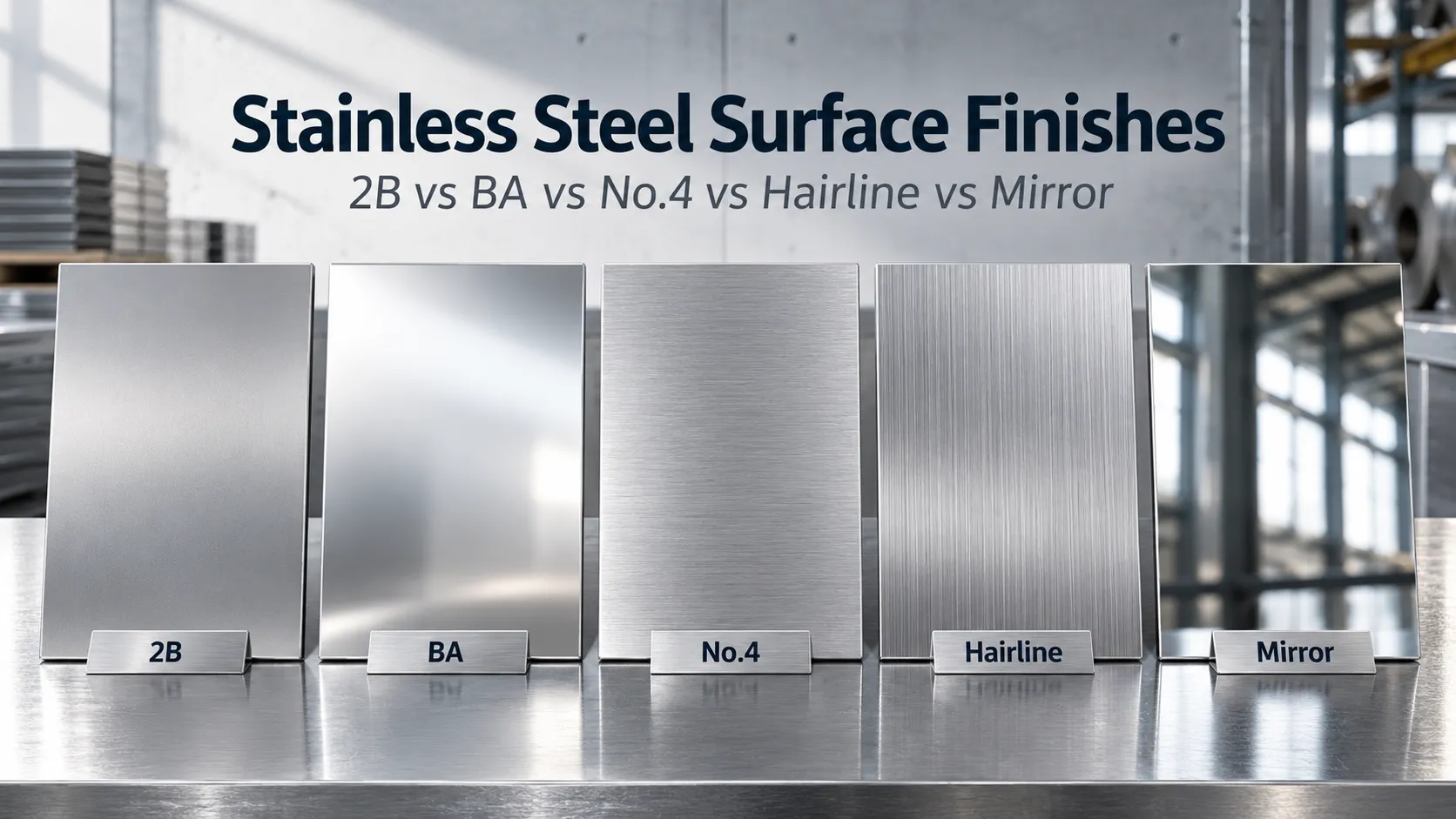
选择正确的 不锈钢表面光洁度 与选择正确的不锈钢牌号同样重要。由相同 304 不锈钢制成的两块板材可以具有完全不同的外观、制造要求、表面粗糙度、维护需求和价格。
五种最常讨论的不锈钢饰面是 2B、BA(光亮退火)、No.4、Hairline(HL)和Mirror(No.8或商用8K)。
每个都有不同的目的:
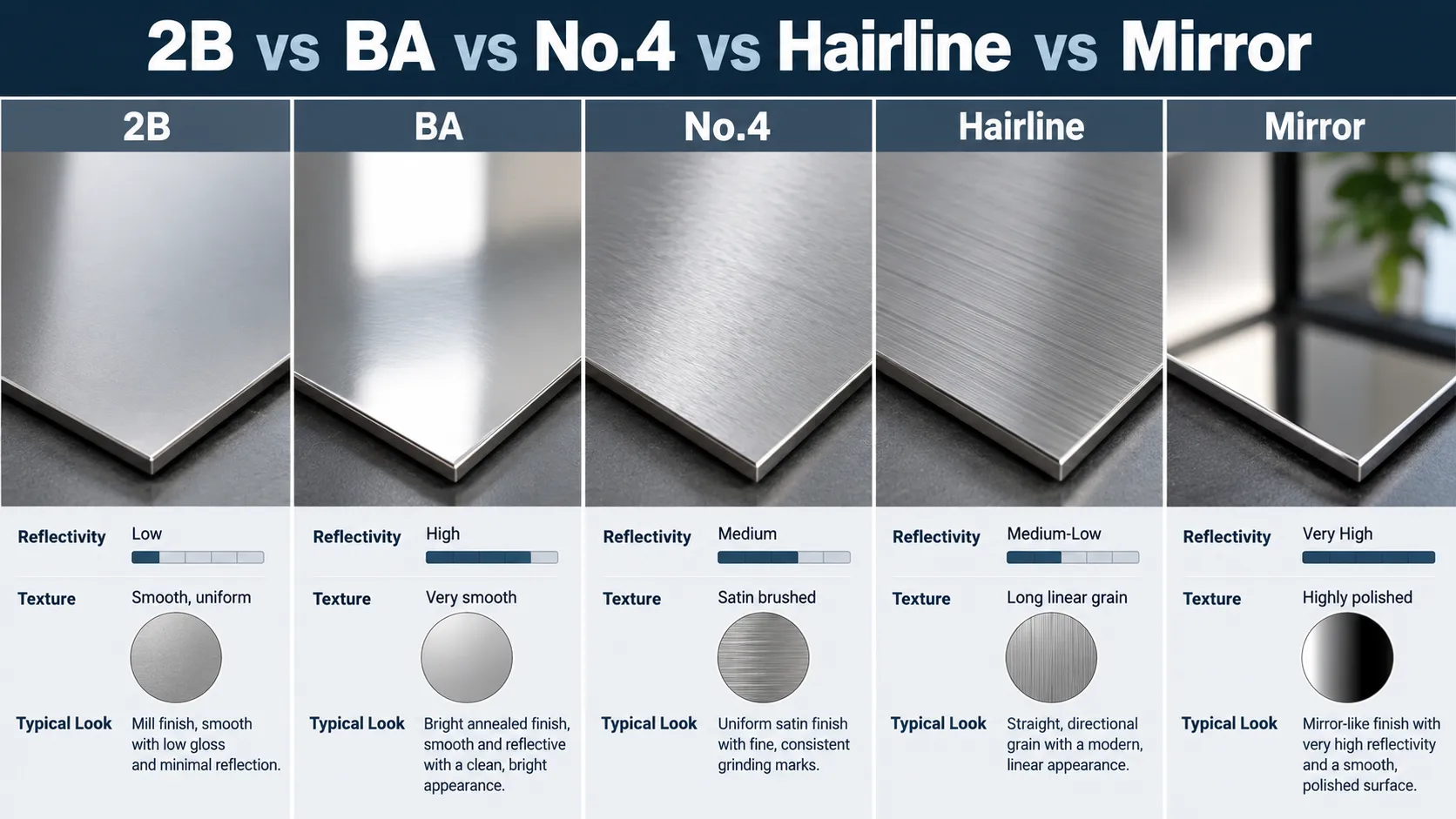
- 2B: 光滑、低光泽的研磨表面,通常用于一般制造和工业产品。
- 学士: 通过光亮退火产生明亮的反光磨光表面。
- 第四: 一种定向缎面饰面,流行于厨房设备、工作台面和内饰板。
- 发际线(HL): 一种精细、连续的线性拉丝饰面,常用于建筑和装饰应用。
- 镜子/8号: 用于装饰面板和建筑特征的高反射机械抛光饰面。
对于采购不锈钢板材或卷材的买家来说,正确的规格不仅仅是表面名称。表面粗糙度、刷涂方向、保护膜、成品面、材料等级和经批准的参考样品可能都是必需的。
本指南比较了五种饰面,解释了它们的生产方式,并展示了如何指定和检查它们以进行国际采购。
不锈钢表面处理一览
The following comparison provides a quick reference for selecting stainless steel finishes.
| 结束 | 制造方法 | Appearance | Reflectivity | 典型的应用 |
|---|---|---|---|---|
| 2B | Cold rolling, annealing, descaling and skin passing | Smooth, low-gloss | Low to moderate | General fabrication, equipment, sheet metal |
| BA / 2R | Cold rolling and bright annealing | Smooth, bright and reflective | 高的 | Appliances, decorative sheet, precision components |
| 4号 | Mechanical grinding and polishing | Directional satin grain | 缓和 | Kitchens, worktops, equipment, interiors |
| Hairline / HL | Controlled directional brushing or polishing | Fine, long linear grain | Variable, usually moderate | Elevators, wall panels, decorative cladding |
| Mirror / No.8 | Progressive fine polishing and buffing | Highly reflective, mirror-like | 很高 | Decorative panels, architectural features |
These descriptions represent typical commercial appearances.
最终的光洁度可能会因钢种、轧制条件、磨料、抛光工艺和供应商的不同而有所不同。
重要的: 2B 和 BA 是既定的铣削加工名称。 No.4 和 No.8 是 ASTM 规范中公认的表面处理术语,而发纹被广泛用作商业描述,并且通常需要就确切外观达成额外协议。
什么是不锈钢表面处理?
不锈钢表面光洁度描述了经过轧制、退火、除锈、研磨、刷光、抛光或其他精加工操作后金属表面的状况。
它影响最终产品的外观和某些功能特性。
这些可以包括:
- 表面粗糙度
- Reflectivity
- 视觉质感
- 可清洁性
- 划伤后的外观
- 适合后续加工
- 特定条件下的腐蚀性能
表面光洁度不应与不锈钢等级混淆。
例如,304 不锈钢描述了化学成分和相关材料要求。
2B 饰面描述了特定的表面生产路线。
相同的不锈钢等级可以提供多种不同的表面处理。
不锈钢等级与表面光洁度
| 规格 | 它决定什么 | 例子 |
|---|---|---|
| 年级 | 化学成分和材料性能 | 304/S30400 |
| 产品形式 | 提供实物产品 | 片材/卷材/板材/带材 |
| 表面饰面 | 表面处理及外观 | 2B / BA / No.4 |
| 表面粗糙度 | 测量表面轮廓 | Ra ≤ 0.5 μm(如果有规定) |
| 方面 | 厚度、宽度、长度 | 1.0×1219×2438毫米 |
| 表面保护 | 运输和制造过程中的保护 | PE保护膜 |
对于国际采购,这些应被视为单独的规格项目。
单独提出“304 不锈钢板”的要求并不能完全定义所购买材料的表面状况。
什么是2B不锈钢表面处理?
2B 是最常见的冷轧不锈钢表面处理之一。
它被广泛用作通用表面处理和附加制造或抛光的起始表面。
2B饰面是如何生产的?
典型的生产路线包括:
- 冷轧
- 退火
- 除锈,通常通过酸洗
- 轻最终轧制,也称为平整
Skin passing improves the surface condition and helps control flatness.
The result is a relatively smooth, uniform surface with a soft metallic appearance.
2B is commonly identified as 2B under EN 10088-2 and ASTM A480。
What Does 2B Stainless Steel Look Like?
A typical 2B sheet has:
- A uniform silvery-gray appearance
- Low to moderate reflectivity
- A smooth surface without deliberate decorative brushing
- A relatively consistent mill finish
It is not normally intended to produce clear mirror-like reflections.
However, the actual brightness can differ between mills, steel grades, and rolling processes.
Advantages of 2B Finish
2B offers a practical combination of surface quality, availability, and processing flexibility.
It is commonly selected when the stainless steel will be:
- Cut or formed
- 焊接成组件
- 用作工业板材
- 进一步抛光或拉丝
- 用于不需要装饰表面的地方
由于它是标准铣削加工,因此 2B 可以在不需要特殊视觉外观的应用中减少不必要的加工成本。
典型 2B 应用
2B不锈钢经常用于:
- 工业外壳
- 钣金加工
- 通用装备制造
- 储罐和装配式组件
- 商用电器零部件
- 进一步加工成抛光片材产品
有关常见材料等级和可用表面选项,请参阅我们的 304不锈钢板 产品页面。
什么时候应该选择2B?
当表面均匀性、一般制造性能和成本效率比装饰反射率更重要时,请选择 2B。
对于将要进行额外制造操作的组件来说,这通常是最实际的起点。
什么是 BA(光亮退火)不锈钢表面处理?
BA 代表光亮退火。
它是一种光滑、高反射性的研磨表面,通过控制退火气氛以最大限度地减少表面氧化而产生。
根据 EN 10088-2,光亮退火冷轧不锈钢通常被指定为 2R。
BA不锈钢是如何生产的?
在光亮退火中,不锈钢在受控保护气氛下加热。
目的是避免传统空气退火过程中发生的氧化。
这使得材料能够保持干净、明亮的表面,而不需要通常用于 2B 的相同退火后除鳞路线。
最终外观受原始冷轧表面和生产条件的影响。
因此,BA和2B应该被理解为不同的精加工路线,而不是BA仅仅是2B的抛光版本。
BA 的完成是什么样子的?
BA不锈钢一般有:
- 光滑、明亮的表面
- 比典型 2B 反射更强
- 很少或没有故意磨粒
- 干净的金属外观
- 正确制造时视觉均匀度高
一些 BA 产品具有非常反光的镜面外观。
然而,BA 名称并不能自动保证与机械抛光的 8 号镜面具有相同的图像清晰度。
BA 饰面的优点
当亮度和光滑度很重要但可能不需要大量机械抛光时,BA 非常有用。
Common advantages include:
- High reflectivity
- Smooth surface appearance
- Good suitability for certain forming operations
- Attractive appearance for visible components
- Availability in sheet and coil products
Typical BA Applications
BA stainless steel may be used for:
- Household appliances
- 装饰板
- Precision sheet metal parts
- Certain kitchen components
- Electrical and industrial enclosures
- Products requiring a bright metallic appearance
BA vs. 2B Stainless Steel
| 财产 | 2B | BA / 2R |
|---|---|---|
| Annealing Route | Annealed and descaled | Bright annealed in controlled atmosphere |
| Appearance | Smooth, low-gloss | Bright and reflective |
| Typical Reflectivity | 降低 | 更高 |
| Deliberate Brushing | 不 | 不 |
| Further Polishing | 可能的 | 可能的 |
| 常用 | General manufacturing | Appliances and bright sheet products |
| 相对成本 | Often economical | Depends on grade, mill and availability |
Choose BA when a bright mill surface is required. Choose 2B when a conventional general-purpose surface is sufficient.
How Are Stainless Steel Surface Finishes Manufactured?
Stainless steel finishing is not one single production process.
Different finishes are created through different manufacturing routes.
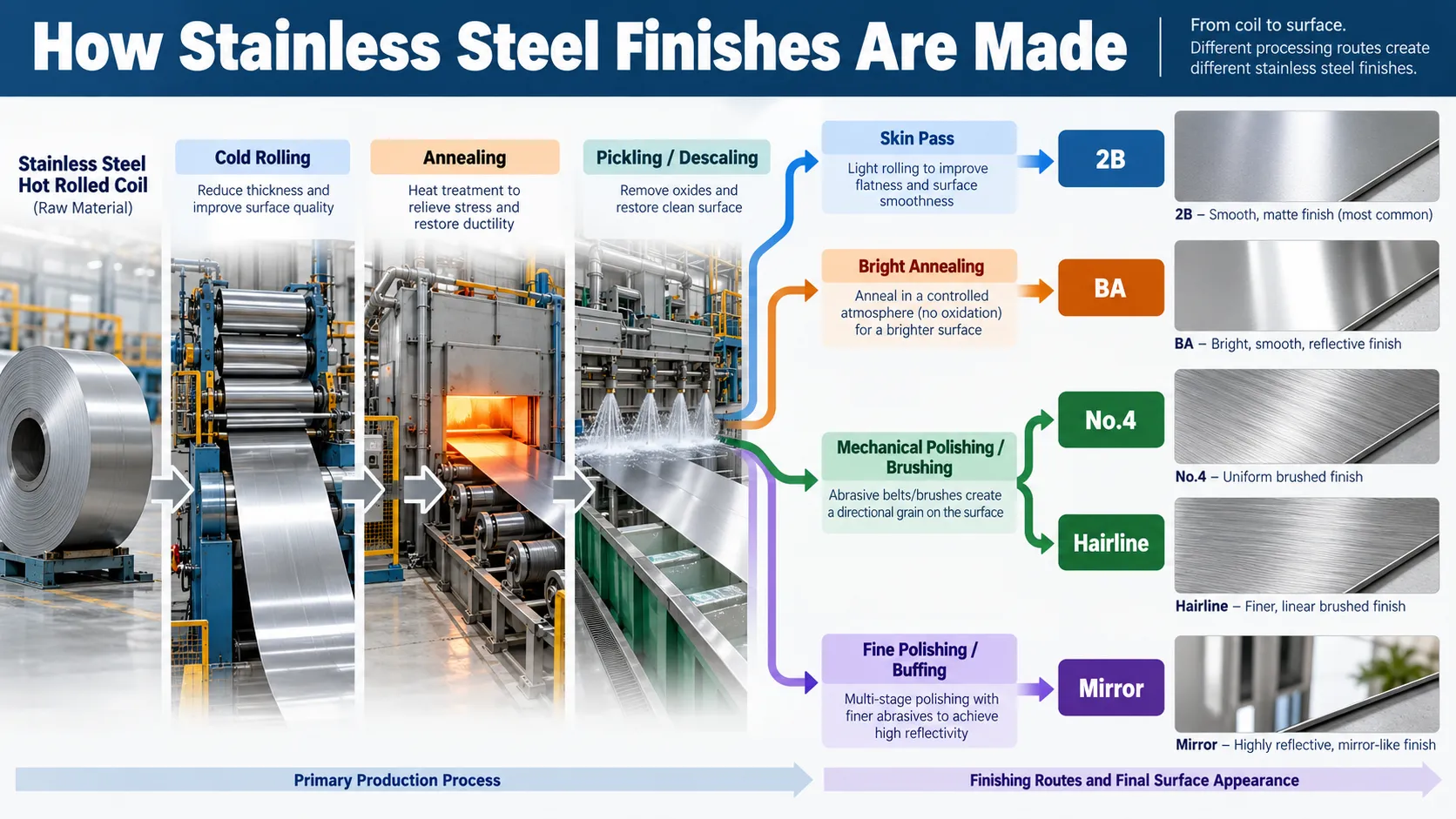
Simplified manufacturing illustration. BA production uses a controlled bright-annealing route rather than necessarily following the conventional pickling route used for 2B. Mechanical finishes may begin with suitable mill-finished material.
Mill Finishing
Mill finishes are produced as part of the stainless steel rolling and heat-treatment process.
示例包括:
- No.1 / 1D
- 二维
- 2B
- BA / 2R
The finish is closely associated with the manufacturing route.
Mechanical Finishing
Mechanical finishing uses abrasive processes to create a required surface appearance.
示例包括:
- Grinding
- 刷牙
- Satin polishing
- Fine polishing
- Buffing
These processes can be applied to suitable mill-finished sheet, coil, or fabricated components.
Decorative Surface Processing
Additional decorative treatments may include:
- Hairline finishing
- Mirror polishing
- Embossing
- Pattern rolling
- Etching
- Coloring
- Decorative surface coating
For example, brushed or mirror-polished stainless steel may be used as the base material for certain colored architectural products.
我们的 彩色不锈钢板 range includes decorative stainless surfaces for architectural and interior applications.
What Is No.4 Stainless Steel Finish?
No.4 is a mechanically finished stainless steel surface with a directional satin appearance.
It is one of the most familiar finishes in commercial kitchens, equipment manufacturing, and architectural interiors.
How Is No.4 Finish Produced?
A suitable stainless steel surface is mechanically finished using abrasive belts or other appropriate polishing equipment.
The process creates fine directional marks.
The appearance depends on:
- Abrasive grade
- Equipment configuration
- Belt condition
- Processing pressure
- Feed speed
- Number of polishing passes
- Final finishing method
A No.4 finish is often described as brushed or satin stainless steel.
However, terms such as “satin” and “brushed” do not completely define the final appearance.
What Does No.4 Stainless Steel Look Like?
Typical characteristics include:
- Fine directional polishing marks
- A relatively uniform satin appearance
- Moderate reflectivity
- 反射比 BA 或 Mirror 不太明显
- 近距离观察可见纹理
4 号的范围可以从相对精细和微妙到更明显的拉丝,具体取决于整理过程。
No.4表面处理的优点
第四种是装饰性外观和实际维护之间流行的折衷方案。
与高反射镜面相比,它可以使某些较小的表面标记在视觉上不那么明显。
制造商和加工商也很熟悉它,在某些情况下可以进行局部修复或混合。
然而,修复区域必须仔细匹配原始纹理和外观。
典型应用4
4号通常被选择用于:
- 商用厨房台面
- 不锈钢水槽
- 餐饮服务设备
- 设备柜
- 建筑装饰
- 内墙防护
- 电梯部件
- 一般装饰制造
Is No.4 Stainless Steel Food Grade?
No.4 is a surface-finish designation, not a food-contact certification.
Whether a stainless steel product is suitable for food processing depends on the material grade, measured surface condition, fabrication quality, cleanability, equipment design, and applicable hygiene requirements.
A No.4 surface may be suitable for many applications, but critical hygienic equipment may require a specifically defined surface roughness and finishing procedure.
What Is Hairline (HL) Stainless Steel Finish?
Hairline, commonly abbreviated HL, is a decorative stainless steel finish characterized by fine, continuous, directional linear marks.
It is particularly popular in architectural and interior design.
How Is Hairline Finish Produced?
Hairline finishing typically uses controlled brushing or abrasive finishing to produce a consistent linear grain.
The exact process varies between suppliers.
Some products have very fine, subtle lines.
Others have more pronounced directional patterns.
Unlike a universally quantified material property, the commercial term “Hairline” does not define one fixed surface texture or Ra value.
For decorative projects, buyers should approve an actual surface sample.
What Does Hairline Stainless Steel Look Like?
Typical characteristics include:
- Long and continuous directional grain
- Fine linear texture
- Satin or softly reflective appearance
- A consistent architectural effect
- A clearly identifiable polishing direction
The direction of the pattern becomes important when several panels are installed together.
Typical Hairline Applications
Hairline stainless steel is commonly used for:
- Elevator wall panels
- Lift doors
- Interior wall cladding
- Building entrance panels
- Decorative columns
- Retail interiors
- Architectural partitions
- Furniture and decorative trim
Why Does Hairline Direction Matter?
Imagine several Hairline stainless steel panels installed side by side.
If the grain direction is vertical on most panels but horizontal on one, the difference can become visually obvious under lighting.
Even when the panels use the same steel grade, inconsistent finishing direction can result in an unacceptable appearance.
For large architectural orders, always specify the required grain direction.
示例包括:
- Grain parallel to sheet length
- Grain parallel to sheet width
- Vertical grain after installation
- Horizontal grain after installation
Where multiple panels must visually match, supply an approved reference sample and a panel installation drawing.
No.4 vs. Hairline Stainless Steel: What’s the Difference?
No.4 and Hairline are sometimes confused because both are directional mechanically finished surfaces.
The key difference is usually the intended visual texture.
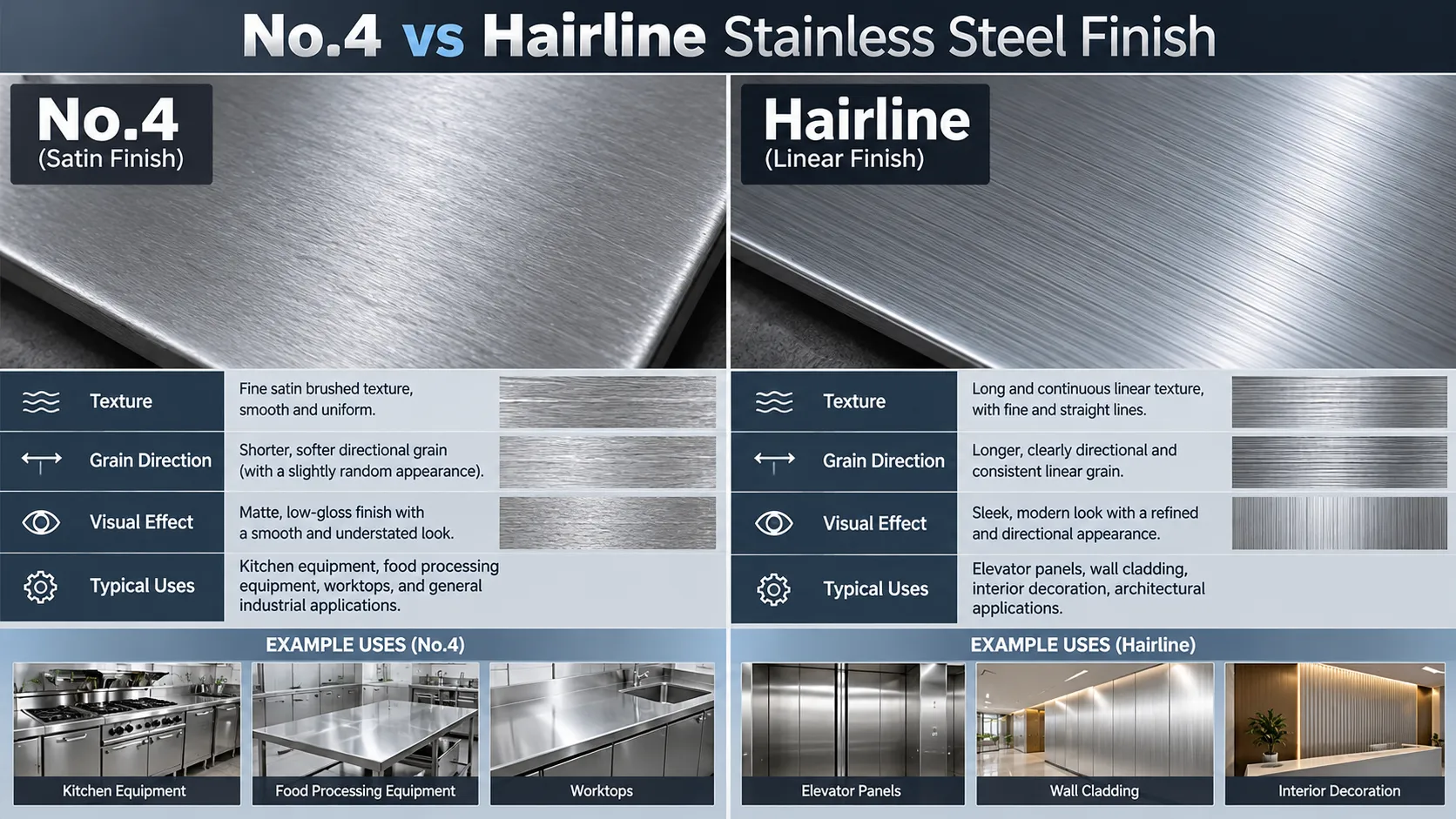
| 特征 | 4号 | 发际线 |
|---|---|---|
| Typical Appearance | Satin brushed | Fine linear brushed |
| Grain Pattern | Directional polishing marks | Long, visually continuous lines |
| Reflectivity | 缓和 | Variable |
| 典型的应用 | Kitchens and equipment | Elevators and architectural panels |
| Grain Matching | Important for visible surfaces | Especially important |
| Finish Consistency | Requires processing control | Often requires approved reference sample |
| Main Priority | Practical satin appearance | Decorative linear appearance |
These differences describe common commercial products rather than an absolute technical boundary.
A finely produced No.4 finish and a commercial Hairline finish may look similar.
Which Is Better for Kitchen Equipment?
No.4 is commonly chosen because its satin appearance is familiar and practical for many commercial kitchen applications.
However, measured roughness, cleaning requirements, and food-contact regulations may be more important than appearance.
Which Is Better for Elevator Panels?
Hairline is frequently selected for elevators and architectural interiors because its long linear grain gives a refined, consistent appearance.
No.4 can also be used.
The final choice is often architectural rather than a fundamental material-performance difference.
What Is Mirror Finish Stainless Steel?
Mirror-finished stainless steel is mechanically polished to produce a highly reflective surface with a high degree of image clarity.
It is commonly associated with No.8 in ASTM terminology and 2P bright-polished finishes under EN terminology.
In international commercial quotations, the term 8K is also frequently used.
However, commercial 8K does not necessarily define one globally uniform surface-quality requirement.
How Is Mirror Finish Produced?
Mirror polishing typically involves several stages of progressively finer surface preparation.
Depending on the original surface, these may include:
- Surface preparation
- Grinding or initial polishing
- Fine abrasive polishing
- Buffing
- 打扫
- Final visual inspection
Each stage reduces visible surface defects and improves reflectivity.
What Does Mirror Stainless Steel Look Like?
A high-quality mirror surface should produce clear reflections with minimal visible distortion.
However, actual image quality depends on:
- Base material quality
- 平坦
- Surface defects
- Polishing process
- Residual waviness
- 打扫
- Handling and packaging
Even a highly polished surface can show distortion if the underlying sheet is not sufficiently flat.
No.8 vs. 8K Stainless Steel
No.8 is a recognized mirror-polished finish description in ASTM terminology.
8K is a widely used commercial label.
When an order requires a particular reflection quality, it is advisable to specify:
- Mirror finish designation
- Reference sample
- Reflectivity or image clarity requirements, if relevant
- Permitted surface defects
- 保护膜
- Inspection conditions
BA vs. Mirror Stainless Steel
These finishes can appear similar at first glance.
However, they are produced differently.
| 财产 | BA / 2R | Mirror / No.8 |
|---|---|---|
| Main Production Route | Bright annealing | Fine mechanical polishing |
| Reflectivity | 高的 | 很高 |
| Image Clarity | Can be high | Intended to be very high |
| Abrasive Polishing Required | Not inherent to BA | 是的 |
| 表面质量 | Mill-controlled | Polishing- and substrate-dependent |
| 常用 | Appliances and bright sheet | Decorative and architectural panels |
If the final design depends on clear reflections, a conventional BA designation should not automatically be substituted for an approved mirror-polished product.
Typical Mirror Finish Applications
Mirror stainless steel is widely used in:
- Luxury interior panels
- Decorative ceilings
- Architectural feature walls
- Elevator interiors
- Retail displays
- Decorative columns
- High-reflectivity design features
Stainless Steel Surface Roughness (Ra) Explained
Surface roughness is one of the most important technical considerations when specifying stainless steel finishes.
Ra means arithmetic mean roughness.
It describes the average absolute deviation of a measured surface profile from its mean line over the evaluated length.
Ra is commonly expressed in micrometers (μm).
例如:
Ra ≤ 0.5 μm
means the measured roughness must not exceed the specified limit when evaluated according to the agreed measurement method and conditions.
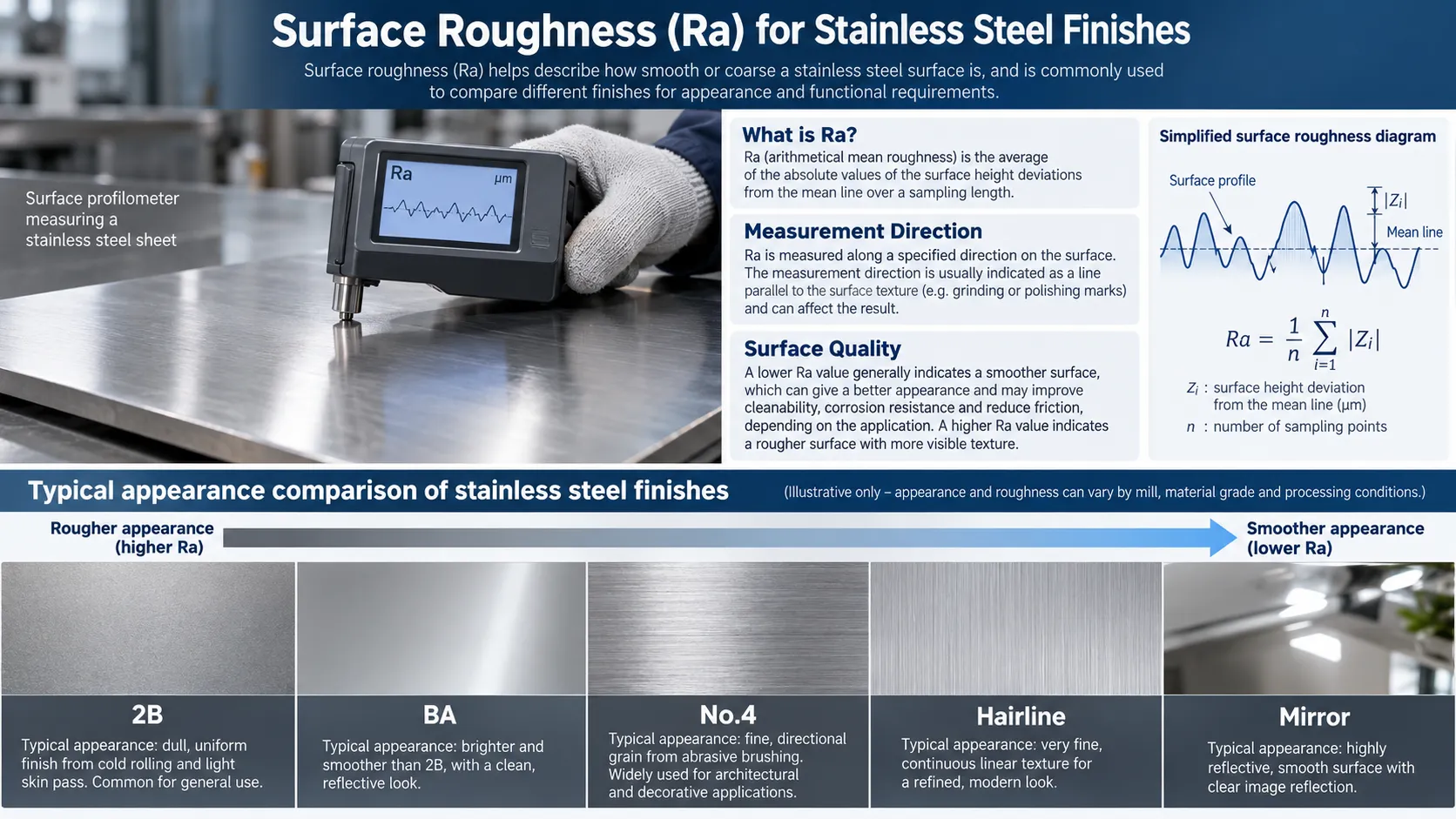
The image illustrates surface measurement concepts. It does not provide certified roughness results or establish a universal ranking of every finish. Measurement direction, method, and actual process conditions affect Ra.
Typical Ra Values for Stainless Steel Finishes
Published industry reference data provide the following indicative ranges.
| Finish / EN Designation | Indicative Ra | 笔记 |
|---|---|---|
| 2B | 0.1–0.5 μm | Typical cold-rolled mill finish |
| BA / 2R | 0.05–0.1 μm | Typical bright-annealed surface |
| Brushed / 2J | 0.2–1.5 μm | Broad range depending on polishing |
| Satin Polished / 2K | Below 0.5 μm | Specified transverse roughness requirement |
| Bright Polished / 2P | Typically below 0.1 μm | High-reflectivity polished finish |
These values are based on representative industry data and standard-finish descriptions.
They are not guaranteed values for every sheet, mill, or finish sold under these names.
Hairline does not have one universal Ra range. Commercial No.4 may vary within the wider category of mechanically brushed or polished finishes.
Why Ra Alone Is Not Enough
Two stainless steel surfaces can have similar Ra values but look completely different.
例如:
- One may have long directional grain.
- Another may have fine, non-directional polishing marks.
- One may reflect light uniformly.
- Another may appear cloudy.
- One may contain isolated scratches.
- Another may have a visually consistent pattern.
Ra is useful, but it does not fully describe:
- Visual appearance
- Grain direction
- Reflection clarity
- Isolated defects
- Surface waviness
- Color or tone consistency
For decorative architectural products, an approved physical sample is often essential.
How Is Ra Measured?
Surface roughness may be measured using a suitable contact profilometer or other validated instrument.
The inspection procedure should define:
- Measurement method
- Evaluation length
- Profile filtering settings
- Measuring direction
- Number of measurements
- 测量地点
- 接受限度
对于强方向性表面,当适合适用的表面纹理规范时,通常会横向于铺设进行测量。
沿纹理和跨纹理的测量可能会产生不同的结果。
因此,如果测量方法和方向很重要,仅指定“Ra ≤ 0.5 μm”的采购订单可能仍然不完整。
表面粗糙度与磨料粒度
另一个常见的错误是假设抛光粒度自动确定 Ra。
例如:
“使用 180 号粒度的 4 号表面处理”并不能保证一个精确的粗糙度值。
实际粗糙度取决于完整的精加工过程,包括磨料条件、压力、进给速度、接触时间和基材质量。
对于要求苛刻的项目,请指定所需的表面性能,而不是仅仅依赖最后的磨料粒度。
不锈钢表面光洁度会影响耐腐蚀性吗?
是的,表面状况会影响腐蚀性能。
然而, 不锈钢等级和使用环境仍然是根本。
不锈钢表面受到一层薄薄的富铬钝化氧化膜的保护。
损坏、污染、沉积物和不适当的表面处理会增加局部腐蚀的风险。
表面粗糙度和污染
粗糙的表面可能会有更多的地方残留水分或沉积物。
在某些条件下,这些区域可能会导致局部腐蚀。
适当光滑和清洁的表面更容易维护。
However, surface roughness alone does not fully predict corrosion resistance.
Mechanical Polishing and Surface Contamination
Mechanical finishing should use suitable equipment and clean abrasives.
Tools previously used on carbon steel can transfer iron contamination to stainless steel.
This may cause surface rust staining even when the stainless steel grade itself is appropriate.
For important architectural or hygienic products, finishing procedures and cleaning requirements should be agreed in advance.
Welding and Surface Restoration
Welding can produce heat tint and surface changes.
Depending on the application, suitable cleaning, pickling, passivation, or mechanical restoration may be necessary.
A visually attractive brushed finish does not automatically indicate that weld-affected areas have received adequate corrosion-related treatment.
Is Mirror Finish More Corrosion Resistant Than 2B?
A smooth, clean mirror-polished surface can provide corrosion-performance benefits in some environments because of its surface condition.
However, it is not correct to claim that mirror-polished 304 automatically outperforms every 2B stainless product in every corrosive environment.
Material composition, surface cleanliness, exposure severity, crevices, welding, and maintenance still determine performance.
In chloride-rich environments, choosing an appropriate grade such as 316L may be more important than choosing a more reflective finish on an unsuitable grade.
哪种表面处理更能防止划痕、指纹和清洁?
日常使用过程中,不同的表面表现不同。
| 结束 | 划痕可见性 | 指纹可见度 | 清洁注意事项 |
|---|---|---|---|
| 2B | 取决于照明和损坏 | 缓和 | 一般来说简单明了 |
| 学士 | 可能会看到细小的划痕 | 可以显示指纹 | 表面光滑 |
| 4号 | 谷物可以在视觉上掩盖一些痕迹 | 取决于表面和照明 | 顺着纹理清洁 |
| 发际线 | 纹理可以掩盖某些方向标记 | Variable | 颗粒搭配很重要 |
| 镜子 | 细小的划痕可能很明显 | 常常很显眼 | 需要小心处理 |
这些是一般的外观倾向,而不是实验室表现排名。
No.4比镜子更耐刮吗?
未必。
钢材的基本硬度和机械性能不会仅仅因为表面处理具有不同的外观而自动改变。
A No.4 surface may make small scratches less visually obvious.
A mirror surface can make similar scratches easier to notice.
Scratch visibility is not the same as scratch resistance.
Which Finish Is Easiest to Clean?
Cleaning performance depends on actual surface texture, contamination, design, and cleaning procedures.
A smooth surface may be easier to clean in many applications.
However, appropriate cleaning chemicals and techniques remain important.
Avoid using carbon-steel brushes or unsuitable abrasive cleaning tools on stainless steel.
For directional finishes such as No.4 and HL, cleaning and minor blending are generally performed in the direction of the visible grain.
How Surface Finish Affects Cutting, Bending and Welding
The finish should be considered before the fabrication process begins.
A polished stainless steel sheet may require additional protection during manufacturing.
激光切割
For laser-cut stainless steel sheet, buyers should consider whether a protective film is required.
The film must be compatible with the actual cutting process and machine requirements.
Not every protective film is suitable for laser processing.
Film type, adhesive, thickness, and removal conditions should be confirmed with the material supplier and fabricator.
弯曲
Bending can change how light reflects from a finished surface.
For brushed and Hairline sheet, the relationship between the bend line and grain direction can influence the final appearance.
In some applications, the grain direction may also interact with material anisotropy and forming behavior.
For visually critical fabricated panels, production samples may be necessary.
焊接
Welding can damage a prefinished decorative surface around the weld.
Restoring a uniform No.4 or Hairline appearance may require additional polishing or brushing.
Mirror-finished assemblies can be particularly demanding because polished surfaces may reveal distortion, unevenness, or local repair marks.
Should Stainless Steel Be Polished Before or After Fabrication?
There is no universal answer.
For simple cut panels, purchasing prefinished sheet may be more efficient.
For welded assemblies requiring continuous surface appearance, some finishing operations may be more appropriate after fabrication.
Consider:
- Final geometry
- Weld locations
- Surface accessibility
- Required appearance
- Equipment availability
- Risk of handling damage
- Total processing cost
ASTM A480 vs. EN 10088-2 Surface Finish Standards
International buyers frequently encounter different finish designations in quotations.
The two commonly referenced systems for stainless steel flat products include:
- ASTM finish descriptions, associated with ASTM A480/A480M
- European finish codes, specified through EN 10088-2
These systems overlap, but their terminology and definitions are not always interchangeable in every detail.
ASTM and EN Surface Finish Comparison
| Common Description | ASTM Terminology | EN 10088-2 | 笔记 |
|---|---|---|---|
| Hot-Rolled, Annealed and Pickled | 1号 | 1D | Common hot-rolled finish |
| Cold-Rolled, Annealed and Pickled | 二维 | 二维 | Duller than typical 2B |
| Cold-Rolled, Skin-Passed | 2B | 2B | Common mill finish |
| 明亮退火 | 学士 | 2R | Bright mill finish |
| Ground | 3号 | 2G | Approximate comparison |
| 拉丝/哑光抛光 | 4号 | 2J | Approximate comparison |
| 精细缎面抛光 | 6号 | 2K | 未经检查要求不得互换 |
| 光亮抛光/镜面 | No.8 | 2P | 高反射抛光表面 |
| 发际线 | HL,商业 | 项目定义;通常在定向特殊饰面内 | 建议批准样品 |
该表旨在作为实际比较。
买方不应仅仅因为两个名称系统具有相似的描述而认为最终的表面外观相同。
1号不锈钢怎么样?
No.1是常见的热轧表面处理。
它通常看起来比冷轧 2B 更粗糙且反射率更低。
它广泛用于装饰外观不是主要考虑的较重工业板材。
3号、6号、7号呢?
这些是额外的机械加工表面类别。
No.3 is generally a relatively coarse ground or polished finish.
No.6 refers to a fine satin-type finish.
No.7 refers to a highly reflective buffed finish that is not necessarily equivalent to the full image clarity expected from No.8 mirror polishing.
For procurement, refer to the relevant standard and confirm the actual finish requirements.
Why Approved Samples Matter
A surface designation may control a general production category without specifying every aspect of visual appearance.
Where an architectural project uses large panels from different production batches, even small differences in brushing pattern or reflectivity may be noticeable.
An approved sample establishes a clearer visual acceptance basis.
Which Stainless Steel Finish Should You Choose?
正确的表面处理取决于应用。
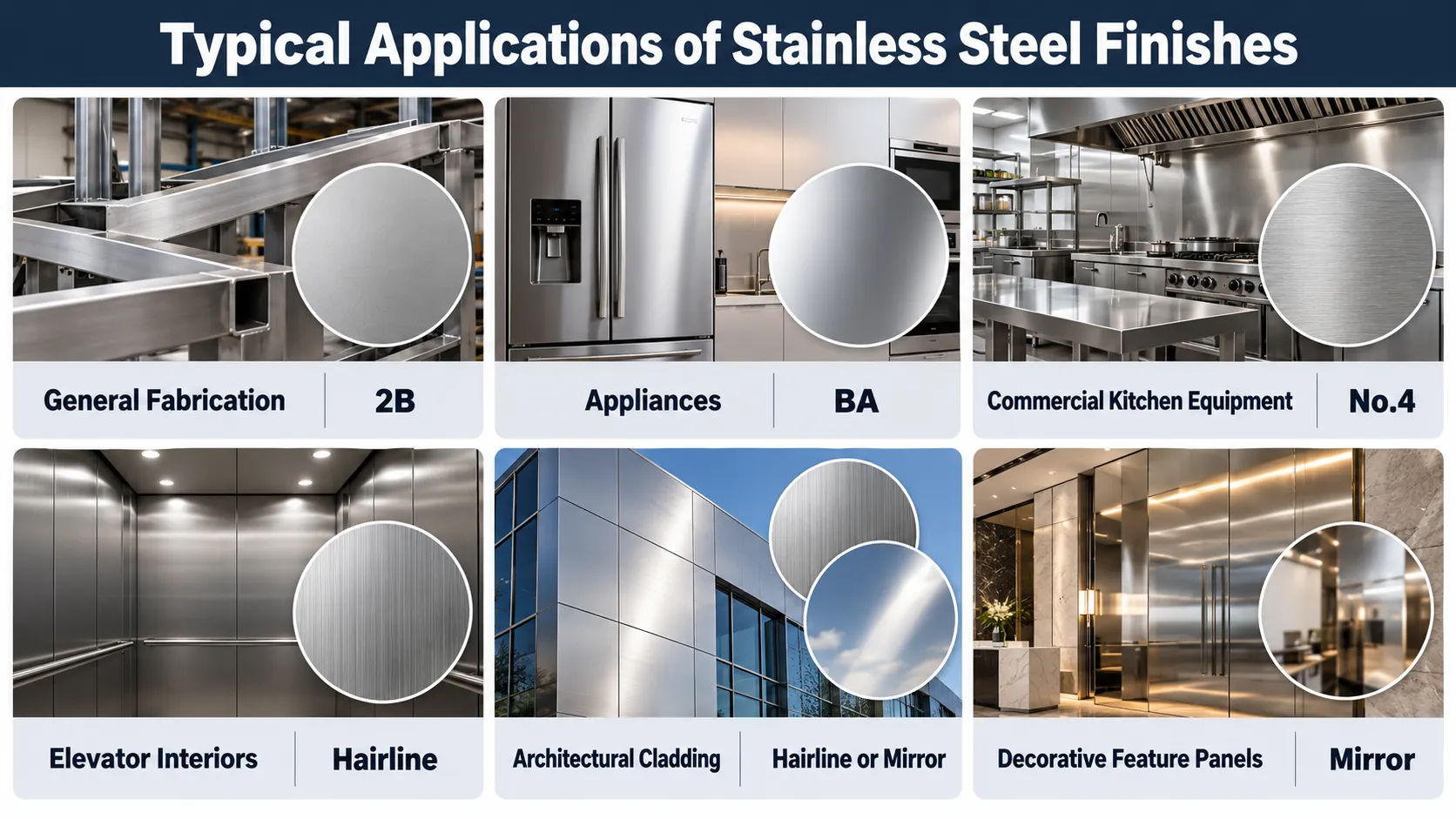
应用选型表
| 应用 | 共同的起始终点 | 原因 |
|---|---|---|
| 一般工业制造 | 2B | 经济、通用基材 |
| 钣金外壳 | 2B / 文学士 | 制造及外观要求 |
| 家电面板 | BA/拉丝 | 外观及清洁性 |
| 商用厨房设备 | No.4 / 指定光滑表面 | 实用表面和清洁 |
| 食品加工设备 | 2B / 指定抛光表面处理 | 测量的清洁度要求 |
| 电梯内饰 | HL / No.4 | 定向装饰纹理 |
| 建筑墙板 | HL/镜子 | 视觉设计 |
| 装饰功能板 | 镜子 | High reflectivity |
| 用于进一步精加工的不锈钢卷 | 2B / 文学士 | 适用加工基地 |
| 彩色装饰板 | HL / 镜面 / 其他认可底座 | 装饰加工要求 |
适用于商业厨房
第四种常见的是可见的厨房设备。
然而,在卫生要求至关重要的情况下,必须考虑实际材料、表面粗糙度、焊接质量和清洁设计。
用于电梯和室内装饰
发际线通常因其连续的线性外观而受到青睐。
4 号也可能适合需要缎面外观的情况。
对于大型面板安装,批次之间的一致性尤为重要。
适用于建筑镜面板
为了视觉冲击力,常选择镜面抛光板材。
指定参考样品、保护膜、面板平整度和外观要求。
等级还是要根据实际环境来选择。
用于工业制造
2B 通常是不需要装饰性饰面的实用选择。
如果需要直接从工厂获得光亮的表面,BA 可能是一种替代方案。
不锈钢表面处理成本比较
表面处理影响不锈钢的交货价格。
一般来说,额外的抛光阶段会增加加工要求。
然而,相对成本取决于等级、板材尺寸、轧机能力、可用性、订单数量和所需的质量。
| 结束 | 一般处理复杂度 | 共同成本考虑 |
|---|---|---|
| 2B | 标准磨机流程 | 对于一般应用来说通常很经济 |
| 学士 | 控制光亮退火路线 | 取决于工厂和产品的供应情况 |
| 4号 | 额外的机械精加工 | 磨料、劳动力和加工 |
| 发际线 | 受控定向整理 | 外观一致性和颗粒匹配 |
| 镜子 | 多个精细抛光阶段 | 加工、产量和表面保护 |
为什么镜面不锈钢价格更高
镜面抛光可能涉及:
- 多个抛光阶段
- 精细研磨材料
- 目视检查要求更高
- 额外的处理保护
- 可见缺陷的拒收风险较高
- 保护膜和精心包装
大型镜面板材在处理和运输过程中对外观损坏特别敏感。
为什么成品价格不能单独比较
假设买家比较 304 不锈钢板的两个报价。
供应商A提供No.4,具有标准的商业外观。
供应商 B 提供第四项:
- 受控参考样本
- 定义的表面粗糙度
- 单面光洁度要求
- 特殊保护膜
- 附加检查
- 严格的化妆品验收标准
这些不一定是等同的产品。
The lowest-priced quotation is not always the lowest-cost acceptable supply.
How to Specify Stainless Steel Sheet and Coil Finishes
This is one of the most important steps for buyers sourcing stainless steel internationally.
An incomplete finish specification can lead to:
- Incorrect surface appearance
- Wrong brushing direction
- Unexpected roughness
- Different reflectivity between batches
- Protective film problems
- Scratches during handling
- Disagreements over cosmetic acceptance
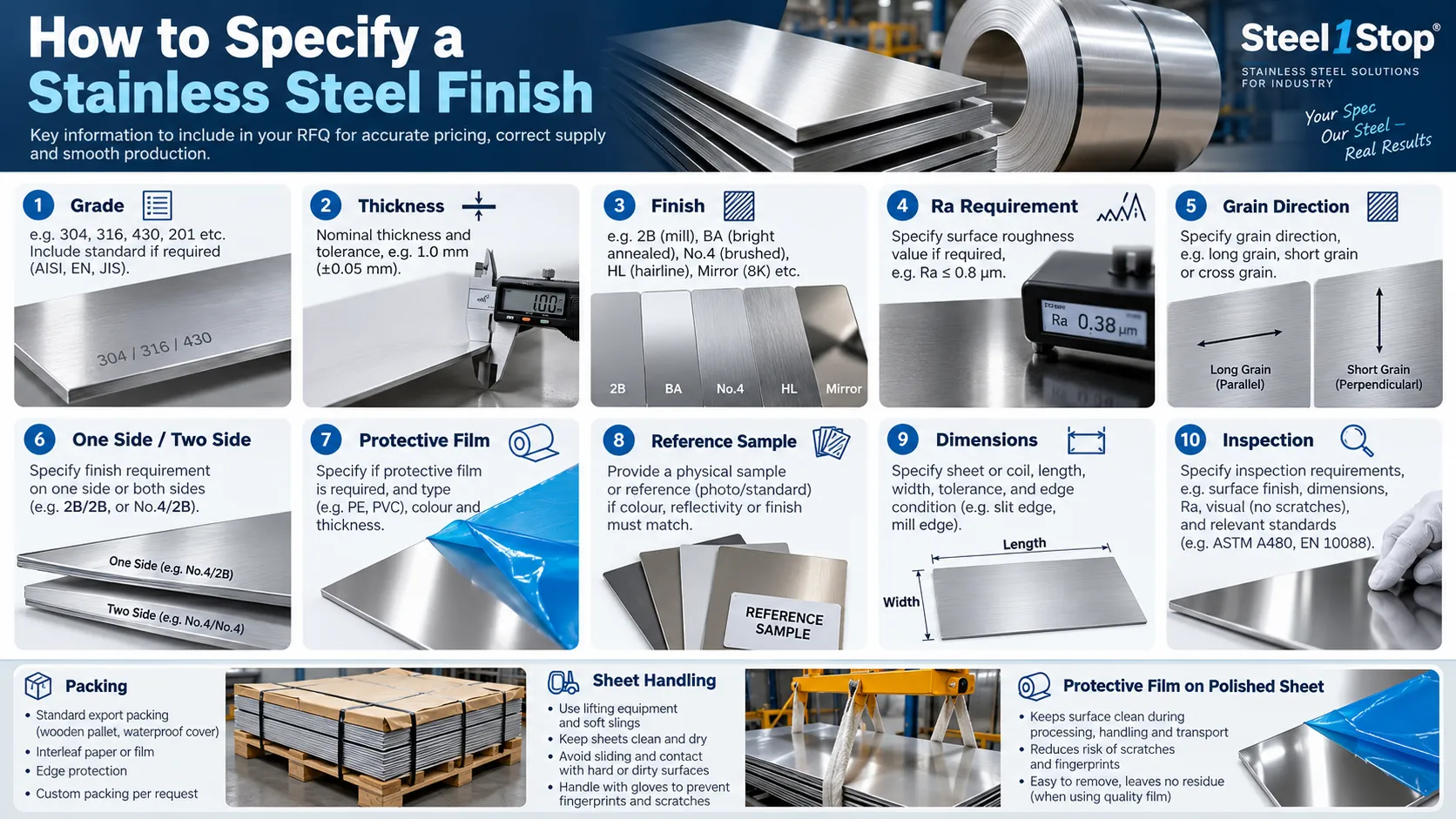
Stainless Steel Finish RFQ Checklist
| 物品 | What to Specify | 例子 |
|---|---|---|
| 年级 | Stainless steel grade / UNS | 304/S30400 |
| 标准 | Material and finish requirements | ASTM A240/A240M, A480/A480M |
| 产品形式 | Sheet, coil, plate or strip | 床单 |
| 厚度 | Nominal thickness and tolerance | 1.0 mm, applicable standard tolerance |
| 宽度 | Required width | 1219毫米 |
| 长度 | Required sheet length | 2438毫米 |
| 结束 | Surface designation | 4号 |
| Surface Side | One side or both sides | No.4 front / 2B back |
| Ra | Maximum roughness, if applicable | Ra ≤ 0.8 μm, measured as specified |
| Grain Direction | Orientation relative to dimensions | Parallel to sheet length |
| Appearance | Approved reference | Customer-approved sample |
| Protective Film | Type and coverage | PE film, agreed specification |
| 边缘 | Mill edge / slit edge | 根据需要 |
| 数量 | Pieces, coils or metric tons | 500 sheets |
| MTC | Inspection document requirements | As agreed |
| 包装 | Protection for transport | Export pallet with interleaving |
| 目的地 | 国家和港口 | Buyer to specify |
The values above illustrate how to prepare a quotation request. They do not represent a standard Steel1Stop stock item or a universal tolerance requirement.
Example RFQ: 304 No.4 Stainless Steel Sheet
A complete purchasing request might read:
Product: Stainless Steel Sheet
Grade: 304 / UNS S30400
Material Standard: ASTM A240/A240M
General Requirements: ASTM A480/A480M
厚度:1.0毫米
Width: 1219 mm
Length: 2438 mm
Surface Finish: No.4 on front side, 2B on reverse side
Grain Direction: Parallel to sheet length
Appearance: Match approved reference sample
Protective Film: PE protective film on finished face
Quantity: 500 sheets
Documentation: Mill Test Certificate as agreed
Inspection: Surface appearance, dimensions and finish requirements
Packing: Export packing with surface protection
This gives the supplier considerably more useful information than simply requesting:
“304 stainless steel sheet, brushed finish, best price.”
One-Side vs. Two-Side Finishing
Some buyers require a decorative surface on only one side.
例如:
No.4 / 2B
可以在指定面上标明No.4,在反面标明2B,但需与供应商确认。
其他项目可能要求双方都接受指定的装饰饰面。
双面精加工可能会增加加工成本并引入额外的处理要求。
始终确定安装后哪个表面仍可见。
不锈钢板与卷材的表面处理要求
成品板材和卷材产品可能会引入不同的购买考虑因素。
| 要求 | 不锈钢板 | 不锈钢线圈 |
|---|---|---|
| 方面 | 厚度、宽度、长度 | 厚度、宽度、线圈尺寸 |
| 成品面 | 前/后退 | 外/内面或定义侧面 |
| Grain Direction | 相对于板材尺寸 | 相对于轧制方向 |
| 表面保护 | 薄膜/交错 | 薄膜适用性和卷绕保护 |
| 处理 | 堆垛和起重 | 卷材处理和开卷 |
| 表面检测 | 单独的面板/样品 | Sampling across coil length and width |
| Additional Details | Flatness and panel appearance | Coil weight, ID, OD, edge and processing |
For coil orders, clarify whether the coil will be slit, cut to length, stamped, or further polished after delivery.
Why Protective Film Matters
Protective film can reduce surface damage during:
- 运输
- 切割
- 弯曲
- 安装
- Storage
But it must be suitable for the application.
Specify requirements such as:
- PE or other suitable film
- Adhesive characteristics
- 厚度
- Color, if relevant
- Laser-processing compatibility, if required
- Storage and removal conditions
- Residue restrictions
Protective film is not a guarantee against all scratches or handling damage.
How to Inspect Stainless Steel Surface Finish Before Acceptance
For large sheet or coil orders, inspection requirements should be agreed before shipment.
Visual Inspection
确认表面符合批准的表面处理规格和参考样品。
检查:
- 划痕
- 凹痕
- 变色
- 污渍
- 表面污染
- 抛光不均匀
- 颗粒不一致
- 不可接受的标记
- 保护膜缺陷
检查应使用商定的观看距离、照明条件和外观关键产品的验收标准。
晶粒方向检验
对于No.4和Hairline产品,确认抛光方向正确。
对于建筑面板,检查整个订单的视觉一致性。
粗糙度检测
当规定Ra时,采用约定的方法和取样计划进行测量。
不要将在任意位置进行的一次测量视为整个批次的证据。
尺寸检验
Check thickness, width, length, flatness, and edge condition against the required standard and purchase order.
Documentation Verification
Verify the material grade, heat number, and required test certificate.
A chemical composition certificate does not automatically certify cosmetic surface quality.
Surface acceptance should be assessed separately.
Stainless Steel Surface Finish FAQs
What is the most common stainless steel finish?
2B is one of the most common cold-rolled stainless steel mill finishes. It is widely used for general fabrication, industrial equipment, and products that require further processing.
What is the difference between 2B and BA stainless steel?
2B是通过冷轧、退火、除氧化皮和平整加工生产的。 BA是在受控气氛下通过光亮退火生产的。 BA通常具有较高的反射率。
BA和镜面加工一样吗?
未必。 BA 可以具有高反射性,但 No.8 镜面加工是通过机械精细抛光产生的,旨在实现高图像清晰度。
什么是4号不锈钢表面处理?
No.4 是一种定向机械抛光不锈钢饰面,具有缎面外观。它常见于厨房设备、工作台面和装饰工业应用。
No.4和拉丝不锈钢一样吗?
No.4 is commonly described as brushed stainless steel, but “brushed” is a broad commercial term. The final grain pattern and surface appearance must be verified.
What is Hairline stainless steel finish?
Hairline is a fine, continuous linear brushed finish used in elevator panels, architectural cladding, furniture, and decorative products.
Is Hairline better than No.4?
Neither is universally better. Hairline is often selected for its continuous architectural grain, while No.4 is widely used for satin-finished equipment and worktops.
What is 8K stainless steel?
8K is a commercial description commonly used for highly reflective mirror-polished stainless steel. Buyers should agree on the actual appearance and surface-quality requirements rather than relying only on the term 8K.
No.8和8K有什么区别?
No.8 是 ASTM 术语中公认的表面处理术语。 8K在商业上得到广泛应用。它们可能指的是类似的产品,但确切的外观验收应由规范和批准的样品来定义。
哪种不锈钢表面最容易清洁?
足够光滑、清洁且加工正确的表面有助于清洁。然而,可清洁性取决于实际粗糙度、表面缺陷、设备设计、污染物和清洁程序,而不仅仅是表面处理名称。
镜面不锈钢容易刮花吗?
镜面会使细小的划痕在视觉上变得明显。这并不一定意味着基材金属在机械性能上比采用另一种表面处理的同等级材料更软。
Which finish is best for stainless steel kitchen equipment?
No.4 is common for visible kitchen equipment, while 2B and other specified smooth surfaces may be used for different components. Hygiene requirements should be evaluated separately.
Which stainless steel finish is best for outdoor use?
The correct finish depends on the stainless steel grade, exposure environment, and maintenance conditions. A suitably smooth, clean finish can be beneficial, but finish selection cannot replace proper corrosion-resistant grade selection.
What does Ra mean for stainless steel?
Ra is the arithmetic mean roughness of a measured surface profile. It is commonly expressed in micrometers and helps quantify surface texture under a defined measurement procedure.
Does 180-grit polishing guarantee a No.4 finish?
No. Abrasive grit is only one processing parameter. The final appearance depends on other manufacturing conditions, including pressure, feed speed, abrasive condition, and finishing sequence.
Can 2B stainless steel be polished into Mirror finish?
Yes. Suitable 2B stainless steel can be further polished to produce a mirror-like finish. The achievable quality depends on material grade, substrate condition, flatness, defects, and polishing procedures.
What is the difference between ASTM and EN stainless steel finishes?
ASTM and EN use different surface designation systems. Some finishes have approximate equivalents, but buyers should confirm that the process, appearance, and acceptance requirements match.
What information should I include when ordering stainless steel finishes?
Specify grade, standard, thickness, dimensions, finish, finished side, grain direction, Ra when required, reference sample, protective film, quantity, inspection, and packing requirements.
Final Selection Guide: Which Stainless Steel Finish Is Best?
There is no single best stainless steel surface finish for every application.
Each serves a different purpose.
Choose 2B for general manufacturing, industrial components, or applications requiring a practical standard mill finish.
Choose BA when a bright, smooth and reflective mill surface is important.
Choose No.4 for a directional satin appearance commonly used in kitchens, worktops and commercial interiors.
Choose Hairline 当建筑外观取决于精细、连续的线性纹理时。
选择镜子/No.8 当高反光装饰外观和强烈的视觉冲击力是主要要求时。
购买时,饰面名称应与以下因素一起考虑:
牌号+产品形状+厚度+尺寸+光洁度+Ra+纹理方向+保护膜+参考样品+检验要求
在 Steel1Stop,我们为国际制造、建筑、工业和制造项目提供不锈钢产品。
买家可以探索我们的 不锈钢板材和薄板,,,, 304不锈钢板,,,, 201不锈钢板,,,, 316L不锈钢卷板, 和 彩色不锈钢板 产品页面。
请求报价时,请提供所需的材料等级、产品尺寸、表面名称、数量以及任何特殊外观或检验要求。
A clearly defined surface finish helps avoid purchasing misunderstandings, improves production consistency, and supports the successful delivery of stainless steel sheet and coil projects.
