
Stainless steel sheet thickness tolerance defines how much the actual thickness of a stainless steel sheet may differ from its specified thickness while still meeting the applicable manufacturing standard.
For buyers sourcing 304, 316L, 201, or other stainless steel sheets, understanding these tolerances is essential. A sheet ordered at 1.00 mm does not necessarily measure exactly 1.000 mm at every point. The permitted variation depends on the product standard, rolling process, specified thickness, width, and tolerance class.
There is no universal thickness tolerance for all stainless steel sheets. ASTM A480/A480M, ISO 9445, and other standards define different requirements for different products.
В этом руководстве объясняются таблицы толщины листов нержавеющей стали, преобразования размеров, допуски ASTM и ISO, холоднокатаная и горячекатаная продукция, процедуры измерения, а также информация, которую покупатели должны включать в международный заказ на поставку.
Stainless Steel Sheet Thickness & Tolerance at a Glance
Прежде чем выбрать лист из нержавеющей стали, важно отличить указанные размеры от допустимых вариантов изготовления.
| Элемент | Описание | Рассмотрение закупок |
|---|---|---|
| Указанная толщина | Толщина указана в заказе на поставку. | Выразить в мм или десятичных дюймах |
| Фактическая толщина | Измеренная толщина доставленного материала | Должен удовлетворять применимым требованиям допуска |
| Толерантность к толщине | Допустимое отклонение от указанной толщины | Зависит от стандарта, ширины и формы изделия |
| Верхнее отклонение | Максимально допустимое количество выше указанной толщины | May be positive or zero |
| Lower Deviation | Maximum permitted amount below specified thickness | May be negative or zero |
| Width Tolerance | Permitted variation in sheet width | Depends on edge condition and standard |
| Допустимость длины | Permitted variation in sheet length | Depends on cutting method and standard |
| Плоскостность | Permitted deviation from a flat reference plane | Important for cutting and fabrication |
| Edge Camber | Deviation of a strip edge from a straight line | Important for coil processing |
| Squareness | Deviation of a cut sheet from a rectangular shape | Important for assembly and cutting |
Quick Answers for Stainless Steel Buyers
What is the standard thickness tolerance for a 1 mm stainless steel sheet?
There is no single answer. You must identify the applicable standard, product type, width, and tolerance class.
Does 304 stainless steel have a different thickness tolerance from 316L?
Not necessarily. When both are ordered under the same applicable dimensional standard and equivalent product conditions, the same dimensional tolerance requirements may apply.
What is 16 gauge stainless steel thickness?
A commonly used U.S. stainless steel gauge chart gives 16 gauge as 0.0625 inches, approximately 1.59 mmПолем
Which standard covers stainless steel sheet tolerances?
ASTM A480/A480M is a principal ASTM reference for flat-rolled stainless steel products. ISO 9445-2 is a principal reference for continuously cold-rolled stainless steel wide strip and sheet/plate within its defined scope.
What Is Stainless Steel Sheet Thickness Tolerance?
Thickness tolerance is the permitted difference between the specified sheet thickness and the actual measured thickness.
The tolerance may be symmetrical or asymmetrical.
A symmetrical tolerance allows variation in both directions by the same amount.
An asymmetrical tolerance allows different positive and negative deviations.
Nominal Thickness vs. Actual Thickness
Consider a hypothetical stainless steel sheet specification:
1.00 mm ±0.05 mm
In this example:
- Specified thickness: 1.00 mm
- Maximum permitted thickness: 1.05 mm
- Minimum permitted thickness: 0.95 mm
- Upper deviation: +0.05 mm
- Lower deviation: -0.05 mm
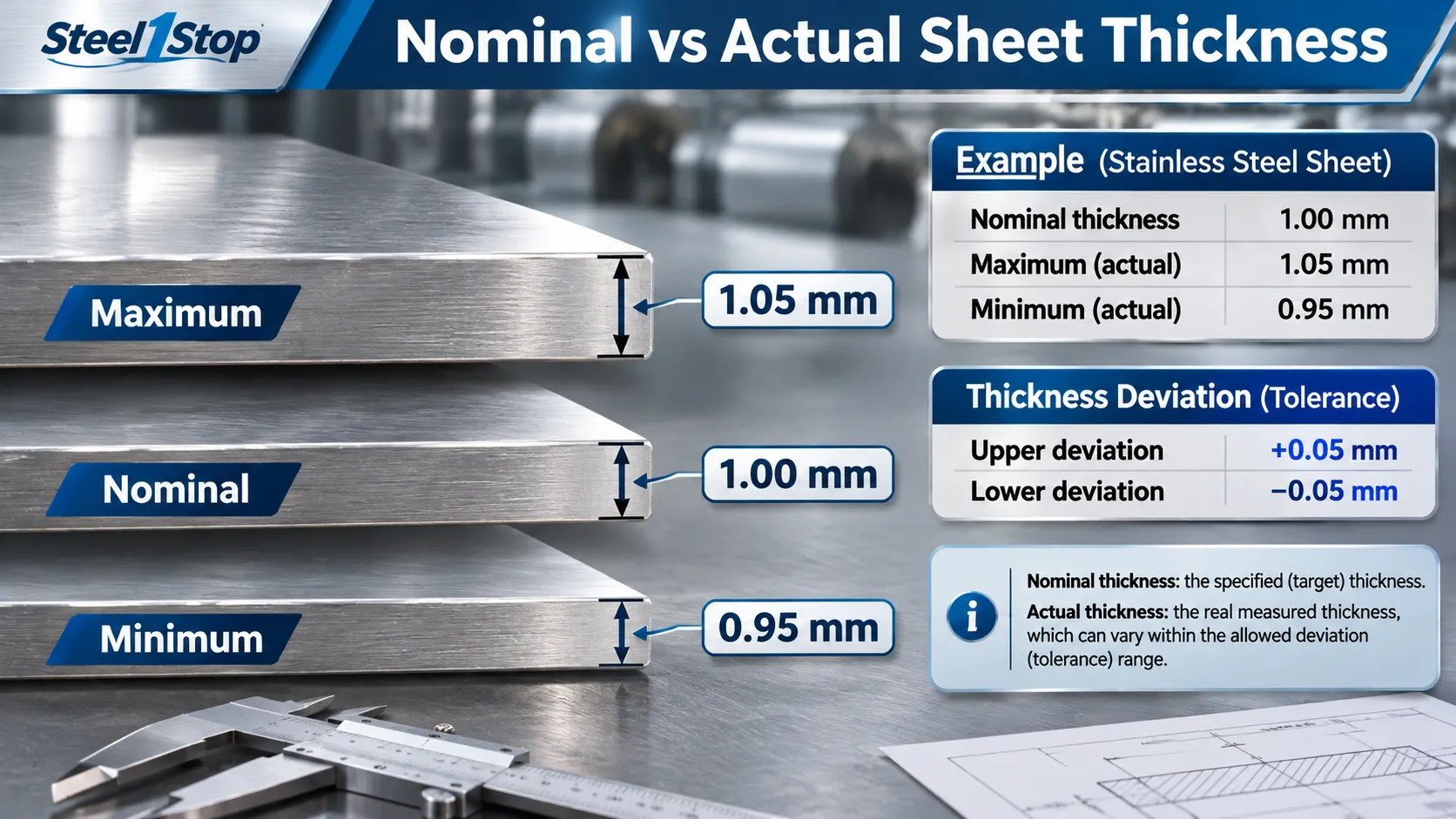
Важный: The ±0.05 mm value is an illustrative example, not a universal tolerance for 1 mm stainless steel sheets.
The actual permissible values must be obtained from the applicable specification.
How to Calculate Thickness Deviation
The basic calculation is:
Thickness Deviation = Actual Thickness − Specified Thickness
Например:
Specified thickness = 1.00 mm
Measured thickness = 0.97 mm
Thickness deviation = 0.97 − 1.00 = -0.03 mm
To determine whether the sheet is acceptable, compare the result with the specified tolerance limits.
If the permitted lower deviation is -0.05 mm, this measurement is within that illustrative tolerance.
However, if the permitted lower deviation is only -0.02 mm, the measurement would not meet that requirement.
What Is Minimum Guaranteed Thickness?
Some buyers require a minimum actual thickness rather than a conventional symmetrical tolerance.
For example, a project may require:
Actual thickness must not be less than 1.00 mm.
This is different from ordering a nominal 1.00 mm sheet with negative thickness tolerance.
The supplier may need to select a different nominal thickness or agree to a special tolerance arrangement to satisfy the minimum-thickness requirement.
When minimum thickness is critical for structural strength, pressure resistance, or component assembly, the purchase order should state it explicitly.
Standard Stainless Steel Sheet Thickness Chart
Stainless steel sheets are available in many nominal thicknesses.
Commonly specified metric thicknesses include:
| Specified Thickness (mm) | Approximate Thickness (inch) | Typical Product Consideration |
|---|---|---|
| 0.30 | 0.0118 | Thin sheet / strip |
| 0.40 | 0.0157 | Lightweight fabrication |
| 0.50 | 0.0197 | Thin panels and components |
| 0.60 | 0.0236 | Formed sheet-metal parts |
| 0.80 | 0.0315 | Appliance and enclosure parts |
| 1,00 | 0.0394 | General sheet fabrication |
| 1.20 | 0.0472 | Panels and equipment |
| 1,50 | 0.0591 | Fabricated equipment |
| 2.00 | 0.0787 | Equipment panels and covers |
| 2.50 | 0.0984 | Industrial fabrication |
| 3.00 | 0.1181 | Heavier sheet-metal components |
| 4.00 | 0.1575 | Plate and structural fabrication |
| 5.00 | 0.1969 | Industrial plate applications |
| 6.00 | 0.2362 | Heavy-duty fabricated components |
| 8.00 | 0.3150 | Plate applications |
| 10.00 | 0.3937 | Промышленная плита |
The applications listed are illustrative, not engineering thickness recommendations.
A 1.5 mm sheet may be appropriate for one fabricated component but completely unsuitable for another component with different loading, span, or environmental conditions.
Common Stainless Steel Sheet Sizes
International stainless steel buyers frequently request dimensions such as:
| Ширина (мм) | Длина (мм) | Approximate Commercial Description |
|---|---|---|
| 1000 | 2000 | Metric standard sheet |
| 1219 | 2438 | 4 ft × 8 ft |
| 1250 | 2500 | Metric sheet |
| 1500 | 3000 | Large metric sheet |
| 1524 | 3048 | 5 ft × 10 ft |
| 1500 | 6000 | Long sheet / plate |
| 2000 | 6000 | Wide plate |
Actual availability depends on stainless steel grade, manufacturing route, thickness, and supplier capabilities.
These dimensions are nominal purchasing formats, not guaranteed tolerances.
Are Stainless Steel Sheet and Plate the Same?
Sheet and plate are both flat-rolled products, but they are not always manufactured or specified using the same standards.
Cold-rolled sheet is commonly produced from continuously rolled strip.
Heavy stainless steel plate may be manufactured through different hot-rolling routes.
Therefore, a tolerance table intended for cold-rolled sheet cannot automatically be applied to hot-rolled quarto plate.
Stainless Steel Gauge Chart: Gauge to mm and Inch
Gauge is a traditional method of identifying sheet-metal thickness.
However, gauge is not a direct metric measurement.
Different sheet-metal materials may use different gauge conventions.
A 16-gauge stainless steel sheet is not necessarily the same thickness as a 16-gauge carbon steel or aluminum sheet.
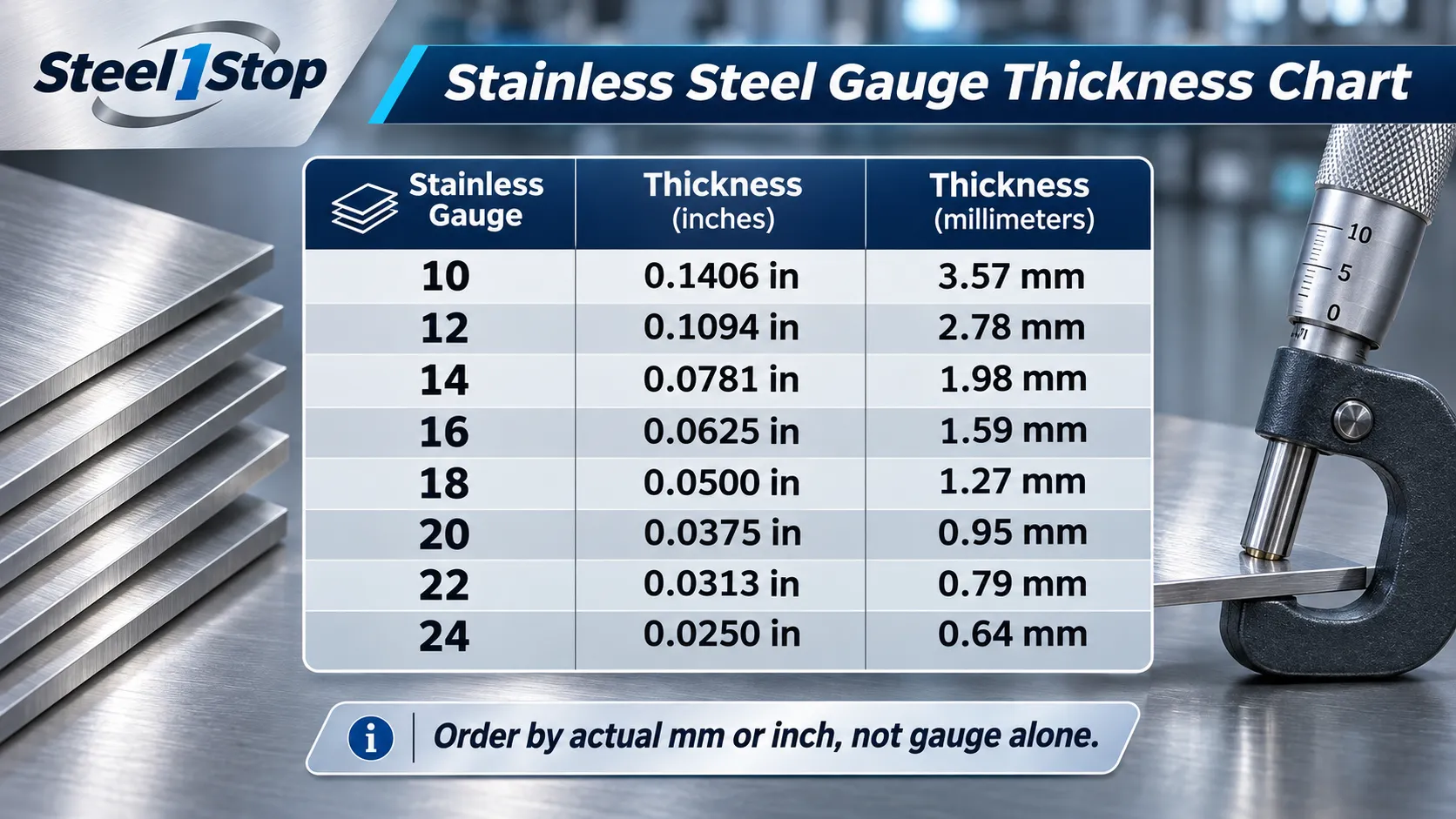
Stainless Steel Gauge Thickness Conversion Table
| Stainless Gauge | Thickness (inch) | Approximate Thickness (mm) |
|---|---|---|
| 7 | 0.1875 | 4.76 |
| 8 | 0.1719 | 4.37 |
| 9 | 0.1563 | 3.97 |
| 10 | 0.1406 | 3.57 |
| 11 | 0.1250 | 3.18 |
| 12 | 0.1094 | 2.78 |
| 13 | 0.0938 | 2.38 |
| 14 | 0.0781 | 1.98 |
| 15 | 0.0703 | 1,79 |
| 16 | 0.0625 | 1.59 |
| 17 | 0.0563 | 1.43 |
| 18 | 0.0500 | 1,27 |
| 19 | 0.0438 | 1.11 |
| 20 | 0.0375 | 0.95 |
| 21 | 0.0344 | 0.87 |
| 22 | 0.0313 | 0.79 |
| 23 | 0.0281 | 0.71 |
| 24 | 0.0250 | 0.64 |
| 26 | 0.0188 | 0.48 |
This table presents commonly used U.S. stainless steel gauge nominal equivalents. Millimeter figures are rounded. Gauge numbers do not define the manufacturing tolerance, and supplier conventions should be confirmed.
What Is 16 Gauge Stainless Steel in mm?
16 gauge stainless steel is commonly listed as:
0.0625 inches = 1.5875 mm
Rounded to two decimal places:
16 Gauge ≈ 1.59 mm
However, specifying 1.50 mm or 1.60 mm is not necessarily equivalent to ordering 16 gauge.
If manufacturing dimensions are critical, state the required decimal thickness.
Stainless Steel Gauge vs. Carbon Steel Gauge
The same gauge number can correspond to different nominal thicknesses.
Например:
| Gauge | Нержавеющая сталь | Углеродистая сталь |
|---|---|---|
| 10 | 3.57 mm | 3.42 mm |
| 12 | 2.78 mm | 2.66 mm |
| 14 | 1.98 mm | 1.90 mm |
| 16 | 1.59 mm | 1.52 mm |
| 18 | 1.27 mm | 1.21 mm |
| 20 | 0.95 mm | 0.91 mm |
This difference matters when converting designs between materials.
If a component drawing was originally prepared for 16-gauge carbon steel, using 16-gauge stainless steel without checking the dimensions may change the actual sheet thickness.
That can affect bending allowances, part fit, clearances, and assembly.
Best Practice for International Purchasing
For export orders, specify thickness in:
- Millimeters, or
- Decimal inches
Gauge may be included as a secondary reference, but it should not be the only thickness requirement.
Например:
304 Stainless Steel Sheet, 1.50 mm, 2B Finish
is more explicit than:
304 Stainless Steel Sheet, 16 Gauge
ASTM A480 Stainless Steel Thickness Tolerances
ASTM A480/A480M is one of the most important references for stainless steel sheet and plate procurement.
It provides general requirements applicable to specified flat-rolled stainless steel products, including dimensional tolerances.
ASTM A240 vs. ASTM A480
These two standards serve different functions.
| Стандартный | Main Purpose |
|---|---|
| АСТМ А240/А240М | Material requirements for applicable chromium and chromium-nickel stainless steel plate, sheet and strip |
| АСТМ А480/А480М | General requirements for specified flat-rolled stainless steel products, including dimensional tolerances |
ASTM A240 covers matters such as chemical composition and mechanical properties.
ASTM A480 provides general requirements that apply in conjunction with relevant product standards, unless superseded by the applicable requirements.
For purchasing 304 stainless steel sheet, both may be relevant.
ASTM A480 vs. ASTM A480M
This distinction is especially important for international orders.
ASTM A480/A480M contains separate inch-pound and SI dimensional tolerance systems.
The standard specifies that the systems are to be used independently.
A purchaser should not simply convert the inch-pound tolerance table into millimeters and present that result as the official A480M tolerance.
For metric procurement, the applicable SI requirements must be used.
What Determines ASTM Thickness Tolerance?
Relevant factors can include:
- Specified thickness
- Product type
- Sheet or plate width
- Cold-rolled or hot-rolled condition
- Applicable dimensional table
- Edge condition
- Agreed special requirements
Some hot-rolled plate tolerance systems use asymmetric upper and lower deviations.
Therefore, not every stainless steel thickness tolerance is expressed as ± the same value.
ASTM A480 Procurement Example
A purchasing specification might state:
304 / UNS S30400 Stainless Steel Sheet
ASTM A240/A240M and applicable ASTM A480/A480M requirements
Thickness: 1.00 mm
Ширина: 1219 мм
Длина: 2438 мм
Финиш: 2Б
The buyer should then confirm which exact dimensional requirements apply to the specified product and whether any additional minimum-thickness requirement is necessary.
If a tighter thickness range is required, it must be agreed with the supplier and documented in the purchase order.
ISO 9445 Stainless Steel Thickness Tolerances
ISO 9445 provides dimensional tolerance requirements for continuously cold-rolled stainless steel products.
The two relevant parts distinguish narrow and wide strip products.
| Стандартный | Main Scope |
|---|---|
| ISO 9445-1 | Continuously cold-rolled narrow strip and applicable cut lengths |
| ISO 9445-2 | Непрерывно холоднокатаная широкая полоса и производимый из нее лист. |
ISO 9445-2 охватывает определенные холоднокатаные широкие полосы и листы из нержавеющей стали толщиной от 0,30 мм до 8,00 мм и шириной прокатки от 600 мм до 2100 мм.
ISO 9445-2. Метод A и метод B.
ISO 9445-2 предусматривает два метода определения допусков по толщине широких полос.
В методах используются разные таблицы допусков и положения измерений.
Согласно опубликованному резюме BSSA:
Метод А
- Измерение толщины более 20 мм от кромок разреза
- Измерение толщины более 30 мм от кромок фрезы
Метод Б
- Измерение толщины более 15 мм от кромок разреза
- Измерение толщины более 25 мм от кромок фрезы
Эти требования не следует заменять общей инструкцией по измерению фиксированного расстояния от каждого края.
ISO 9445-2 Method A Thickness Tolerance Chart
The following table is an extract of normal tolerance values for cold-rolled wide strip, Method A, nominal width greater than 1000 mm and less than 1300 mmПолем
All dimensions are in millimeters.
| Specified Thickness Range | Normal Thickness Tolerance |
|---|---|
| 0.30 < t < 0.50 | ± 0,04 |
| 0.50 < t < 0.60 | ± 0,05 |
| 0.60 < t < 0.80 | ± 0,05 |
| 0.80 < t < 1.00 | ± 0,06 |
| 1.00 < t < 1.20 | ± 0,07 |
| 1.20 < t < 1.50 | ± 0,08 |
| 1.50 < t < 2.00 | ±0.09 |
| 2.00 < t < 2.50 | ± 0,10 |
| 2.50 < t < 3.00 | ±0.12 |
| 3.00 < t < 4.00 | ±0.14 |
| 4.00 < t < 5.00 | ±0.15 |
| 5.00 < t < 6.50 | ±0.15 |
| 6.50 < t < 8.00 | ±0.17 |
These values apply only to the stated Method A, width band, and normal tolerance conditions. They are not a universal stainless steel tolerance chart. For thickness values exactly at table boundaries, other width bands, or special tolerances, consult the complete applicable standard.
Example: 1.10 mm Thick, 1219 mm Wide Sheet
Учитывать:
- Specified thickness: 1.10 mm
- Nominal width: 1219 mm
- Product: Continuously cold-rolled stainless steel wide strip/sheet
- Standard: ISO 9445-2
- Method: A
- Tolerance class: Normal
This falls within the thickness band:
1.00 < t < 1.20 mm
and width band:
1000 < w < 1300 mm
The normal thickness tolerance is:
±0.07 mm
Поэтому:
Minimum thickness = 1.10 − 0.07 = 1.03 mm
Maximum thickness = 1.10 + 0.07 = 1.17 mm
Measurements must be taken in accordance with the applicable standard’s location requirements.
What If Special Thickness Tolerance Is Required?
ISO 9445 also provides special tolerance values for certain products and thickness ranges.
For the same 1.10 mm and 1219 mm Method A example, the published special tolerance value is ±0.045 mmПолем
This demonstrates why buyers must identify both the standard and the required tolerance level.
A special tolerance should not be assumed automatically.
It should be requested and confirmed at the quotation and purchase-order stage.
ASTM vs. ISO Stainless Steel Thickness Tolerances
ASTM and ISO are both widely used in international metal procurement.
However, their structure and terminology differ.
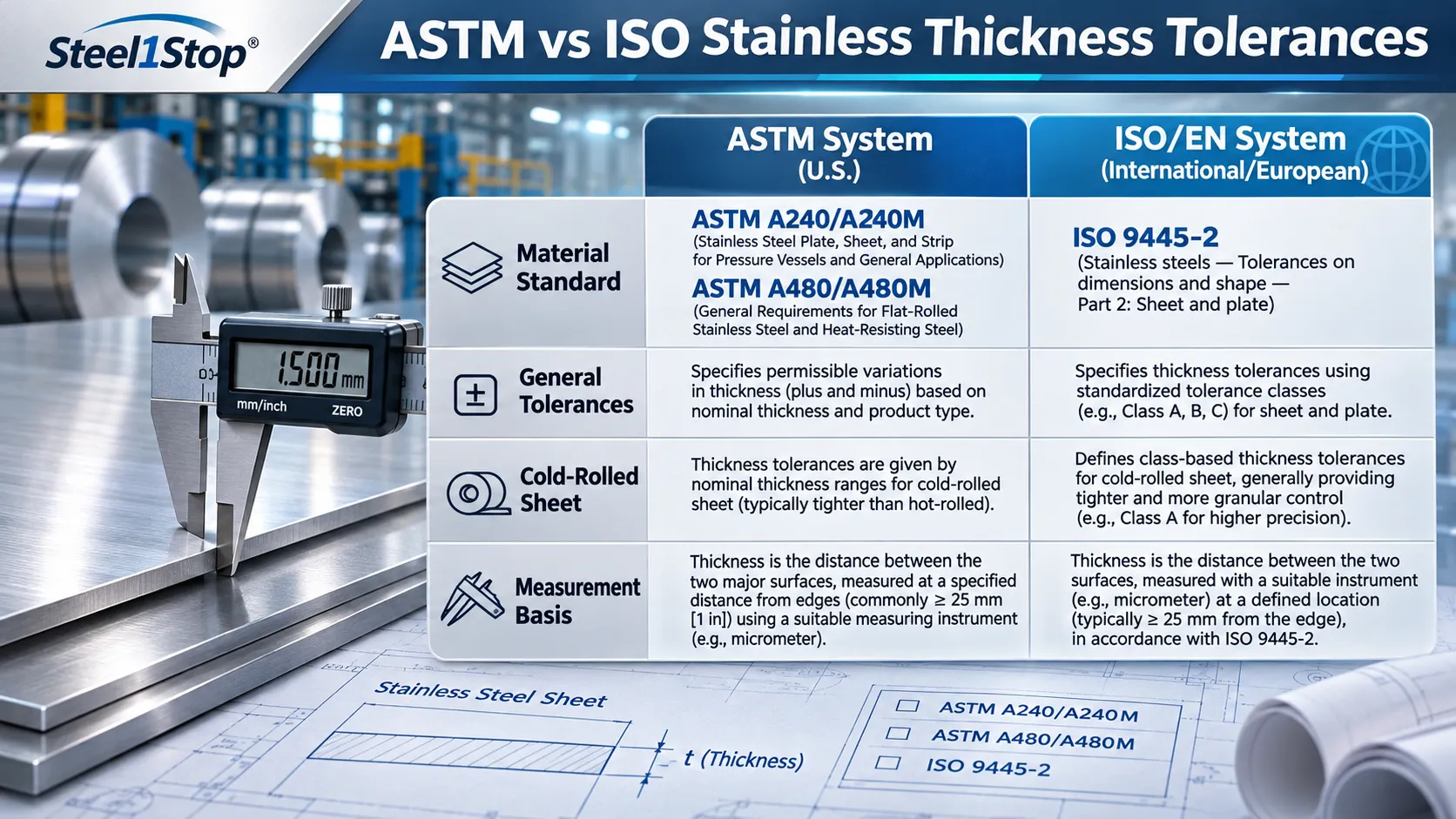
| Сравнение | ASTM System | ISO System |
|---|---|---|
| Material Specification | АСТМ А240/А240М | Applicable product/material standard |
| General Flat-Rolled Requirements | АСТМ А480/А480М | Product-specific dimensional standards |
| Cold-Rolled Wide Strip / Sheet | Applicable ASTM A480 provisions | ISO 9445-2 |
| Cold-Rolled Narrow Strip | Applicable ASTM provisions | ISO 9445-1 |
| Continuous Hot-Rolled Wide Strip | Applicable ASTM provisions | ISO 9444-2 |
| Hot-Rolled Quarto Plate | Applicable ASTM provisions | ISO 18286 |
| Measurement Rules | Defined by applicable provisions | Defined by applicable product and method |
| Tolerance Requirements | Product and dimensional table dependent | Product, width, thickness and method dependent |
These systems should not be mixed without a documented technical agreement.
Can ASTM and ISO Tolerances Be Used Interchangeably?
Not automatically.
Even when the specified thickness and width are identical, allowable deviations and measurement requirements can differ.
A sheet that meets one dimensional specification may not necessarily meet another.
For an export project, the purchase order should identify one governing standard or clearly define how multiple requirements are to be applied.
Which Standard Should Overseas Buyers Choose?
The answer depends on the project’s design specifications, destination market, end-user requirements, and available material.
ASTM standards are common in North American and international industrial procurement.
ISO and EN standards are common in European and global projects.
The most important requirement is that the supplier and purchaser agree on the exact applicable standard and edition.
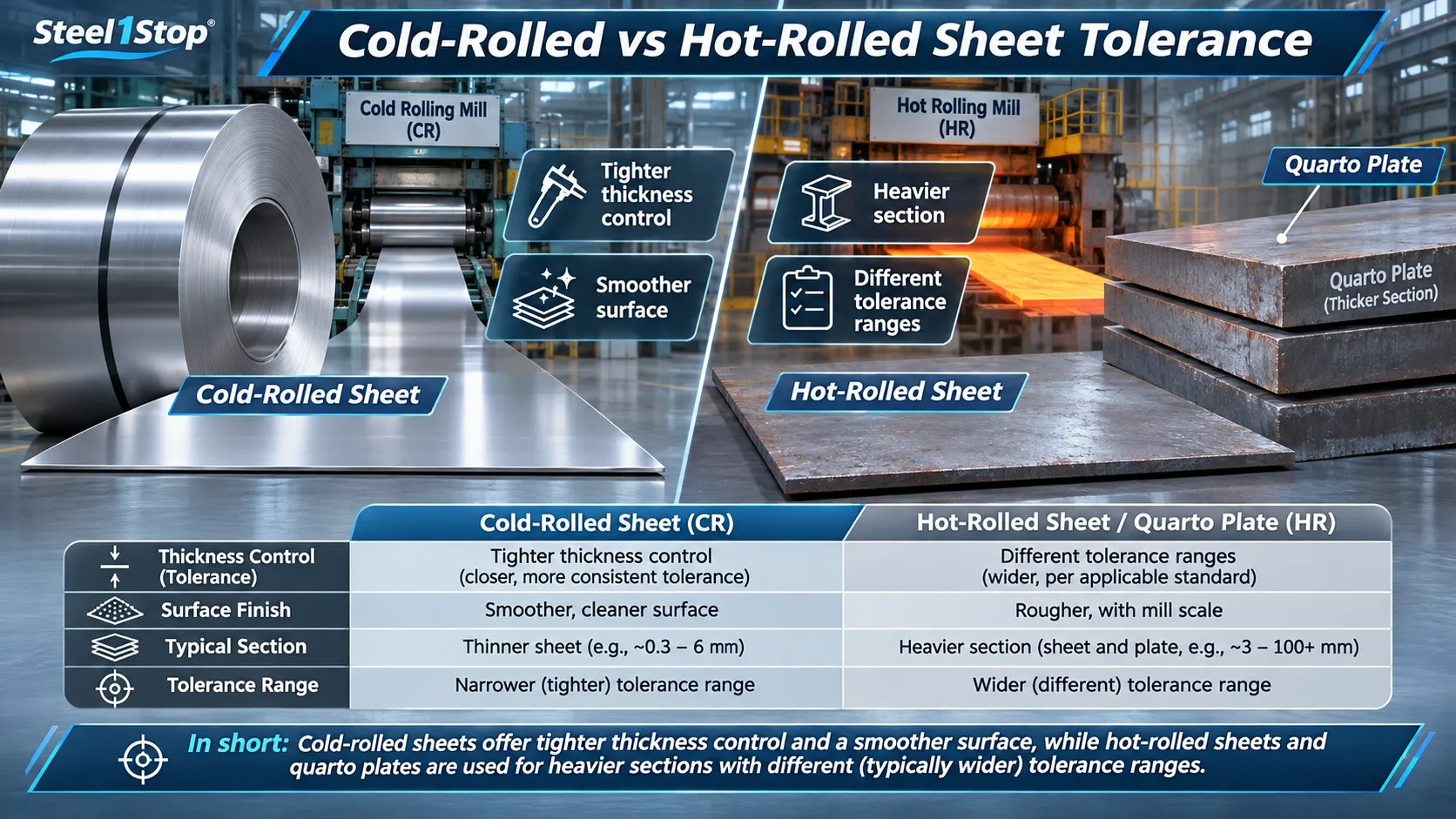
Cold-Rolled vs. Hot-Rolled Stainless Steel Tolerances
The manufacturing route has a major influence on stainless steel dimensions, surface finish, and tolerance requirements.
Cold-Rolled Stainless Steel Sheet
Cold-rolled stainless steel sheet is processed to its final thickness through cold reduction and associated finishing operations.
It is commonly used for:
- Технические приборы
- Kitchen equipment
- Decorative sheet
- Sheet-metal enclosures
- Precision fabrication
- Components requiring a relatively smooth surface
Cold-rolled products often offer better thickness control and surface finish than comparable hot-rolled products.
However, the actual tolerance must still be specified.
Hot-Rolled Stainless Steel Sheet and Plate
Hot-rolled stainless steel is processed at elevated temperatures.
It is widely used for industrial plate, heavy equipment, tanks, structural components, and other demanding applications.
Hot-rolled stainless products may have different surface characteristics and tolerance requirements than cold-rolled sheet.
Continuous Hot-Rolled Plate vs. Quarto Plate
A critical distinction is the production route.
Continuously hot-rolled sheet/plate is produced through a continuous rolling route.
Quarto plate is produced on a reversing plate mill.
These products should not automatically use the same dimensional tolerance tables.
| Продукт | Typical Manufacturing Route | Relevant ISO Reference |
|---|---|---|
| Cold-Rolled Wide Strip / Sheet | Continuous cold rolling | ISO 9445-2 |
| Hot-Rolled Wide Strip / Sheet | Continuous hot rolling | ISO 9444-2 |
| Hot-Rolled Quarto Plate | Reversing plate mill | ISO 18286 |
ISO 18286 covers specified hot-rolled stainless quarto plates with nominal thicknesses from 4 mm to 250 mm and nominal widths of at least 600 mm.
It does not apply to every product commercially described as a plate.
Why Quarto Plate Tolerances Are Different
Heavy plate production involves different rolling and dimensional-control conditions.
The tolerance requirements may include asymmetric upper and lower deviations.
Therefore, an ISO 9445 cold-rolled sheet tolerance chart should never be used to evaluate heavy quarto plate simply because both products are made from stainless steel.
304 vs. 316L Stainless Steel Sheet Thickness
304 and 316L are two widely used austenitic stainless steel grades.
The main difference between them is chemical composition and corrosion-related performance, not a separate universal thickness gauge system.
Does Stainless Grade Affect Thickness Tolerance?
A stainless steel grade does not by itself determine every dimensional tolerance.
For example, if 304 and 316L sheets are supplied under the same applicable flat-product dimensional specification, using the same product form and dimensions, they may be subject to the same thickness-tolerance provisions.
However, different material conditions, product forms, or special requirements can change the applicable rules.
304 лист нержавеющей стали
304 is widely used for general industrial fabrication, equipment, architectural components, and applications requiring a balance of corrosion resistance and manufacturability.
For purchasing options, see Лист нержавеющей стали 304Полем
316L Stainless Steel Sheet and Coil
316L contains molybdenum and generally provides improved resistance to localized chloride corrosion compared with 304.
It is commonly used for chemical equipment, selected process systems, and applications requiring higher corrosion resistance.
Изучите наш Змеевик из нержавеющей стали 316L product information.
Is 1 mm 304 Stainless Steel Stronger Than 1 mm 316L?
This is a separate mechanical-properties question.
Thickness alone does not determine material strength.
The required sheet thickness must consider:
- Applied load
- Support spacing
- Material yield strength
- Allowable deflection
- Forming requirements
- Corrosion allowance, where applicable
- Design code or application requirements
Thickness tolerance defines acceptable manufacturing variation. It does not replace engineering design calculations.
Thickness Tolerance vs. Width and Length Tolerance
Stainless steel sheet procurement requires more than thickness control.
Width and length tolerances are also important, especially for automated cutting, stamping, and assembly.
Width Tolerance
Actual sheet width may differ from the specified width within the limits allowed by the relevant standard.
The requirement may depend on:
- Форма продукта
- Толщина
- Specified width
- Mill edge or slit edge
- Normal or special tolerance
Some standards use positive-only width tolerances for certain products.
Therefore, do not assume every width specification uses a symmetrical tolerance.
Mill Edge vs. Slit Edge
Mill Edge
An edge retained from the rolling process without subsequent longitudinal trimming.
Slit Edge
An edge produced by slitting the material to a required width.
The distinction matters because edge condition can affect the applicable width and measurement requirements.
Допустимость длины
Cut-to-length stainless sheet may be subject to positive-only length tolerances under certain specifications.
A nominal 2438 mm length does not necessarily imply symmetrical ± variation.
The purchase order should identify whether standard length tolerances are sufficient or special cut-to-length requirements are necessary.
When Are Special Dimensions Necessary?
More restrictive dimension control may be required for:
- Precision equipment enclosures
- Automated production
- Close-fit assemblies
- Large architectural panels
- Laser-cut component blanks
- Products with limited trimming allowance
Where special tolerances are required, confirm manufacturing feasibility before placing the order.
Flatness, Edge Camber and Squareness
Thickness is only one part of stainless steel dimensional quality.
A sheet can satisfy its thickness tolerance and still create fabrication problems because of poor flatness or geometry.
Плоскостность
Flatness describes how closely a sheet conforms to a flat reference surface.
Poor flatness can affect:
- Laser cutting
- CNC punching
- Automated feeding
- Welding fixtures
- Large panel installation
- Assembly tolerances
A specified flatness tolerance should identify the applicable measurement method and acceptance conditions.
Edge Camber
Edge camber is the deviation of a strip edge from a straight reference line over a specified length.
It matters in:
- Coil slitting
- Automated feeding
- Roll forming
- Progressive stamping
- Strip processing
Excessive edge camber can create tracking problems during production.
Squareness
Squareness concerns whether the edges of a cut sheet form the required rectangular geometry.
It can be assessed using specified dimensional methods, including differences between diagonal lengths where the applicable standard permits.
For fabricated assemblies, squareness may matter as much as thickness.
Edge Waviness
Edge waviness describes repeated wave-like distortions along the edge of sheet or strip.
This can influence flatness, feeding, and forming performance.
When sheet appearance or precision fabrication is critical, specify the required flatness and edge quality rather than relying only on thickness.
How to Measure Stainless Steel Sheet Thickness Correctly
Thickness inspection should follow a consistent procedure.
An incorrectly measured sheet may be accepted or rejected for the wrong reasons.
1. Select the Appropriate Measuring Instrument
Common instruments include:
- Digital outside micrometer
- Mechanical micrometer
- Suitable precision thickness gauge
- Calibrated thickness-measuring equipment
The selected instrument should have sufficient resolution, accuracy, measuring-force control, and an appropriate measurement range.
For example, a calibrated digital micrometer with 0.001 mm resolution may be useful for thin sheet inspection, provided the instrument’s actual measurement uncertainty is suitable for the required tolerance.
Resolution is not the same as accuracy.
2. Check Calibration
Before measurement, confirm that the instrument is calibrated and suitable for the inspection.
Check the measuring faces and zero setting.
Any instrument defect, contamination, or incorrect zero setting may affect the result.
3. Clean the Measuring Surfaces
Remove loose debris, oil deposits, and particles that could interfere with contact between the measuring instrument and the stainless steel.
Do not alter the product or remove required coatings without an agreed inspection procedure.
4. Identify Measurement Locations
Measurement locations must follow the applicable standard.
For example, ISO 9445-2 Method A and Method B prescribe different distances from the edges.
A generic practice of measuring only at the sheet edge is not an adequate substitute for these requirements.
For additional quality control, the purchaser and supplier may agree on a sampling plan covering multiple locations.
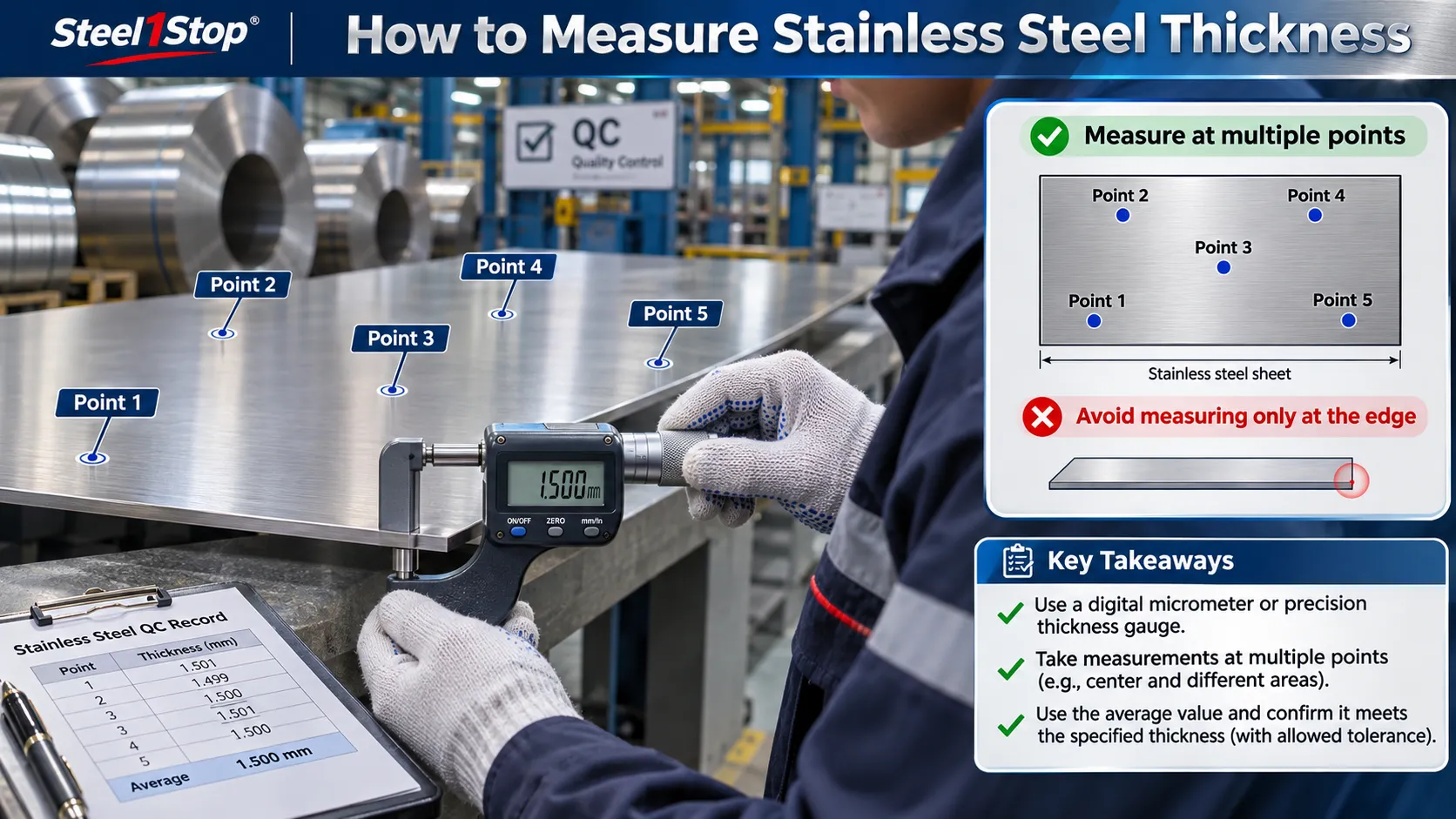
5. Measure at Multiple Points
Depending on the inspection plan, measurements may be taken at several positions across the sheet.
A representative internal QC plan could include points near the center and different areas across the product, while respecting standard-defined measurement exclusions.
These additional points can help identify thickness variation.
Однако, an average thickness within tolerance does not mean every individually regulated measurement is acceptableПолем
Each required measurement must satisfy the applicable acceptance criteria.
6. Record the Measurements
A thickness inspection record may include:
| Inspection Item | Пример |
|---|---|
| Материал | 304 лист нержавеющей стали |
| Указанная толщина | 1.10 mm |
| Стандартный | ISO 9445-2 |
| Метод | А |
| Ширина | 1219 мм |
| Normal Tolerance | ±0.07 mm |
| Minimum Permitted Thickness | 1.03 mm |
| Maximum Permitted Thickness | 1.17 mm |
| Measurement 1 | 1.08 mm |
| Measurement 2 | 1.11 mm |
| Measurement 3 | 1.09 mm |
| Measurement 4 | 1.10 mm |
| Measurement 5 | 1.07 mm |
| Результат | All example measurements within limits |
This example is illustrative and assumes the locations and product conditions conform to the specified standard. It is not an actual Steel1Stop inspection report.
7. Evaluate the Results
Compare each applicable measurement with the specified tolerance limits.
If measurements fall outside the required limits, follow the agreed inspection, verification, and nonconformance procedures.
Do not automatically approve material based only on a batch average.
Why Sheet Thickness Tolerance Matters in Manufacturing
Thickness variation may affect manufacturing in different ways.
Лазерная резка
Cutting settings depend partly on material thickness.
Changes in thickness can influence cutting speed, cut quality, and process stability.
For precision components, material variability should be considered during process planning.
Press Brake Bending
Sheet thickness is a major input in bending calculations.
It affects:
- Bend allowance
- Bend deduction
- Required force
- Tooling selection
- Inside bend geometry
- Dimensional repeatability
A bending program developed for one sheet thickness may produce different results if the actual material thickness changes.
Сварка
Different sheet thicknesses can require adjustments to welding parameters and joint design.
Thickness variation may affect heat input requirements and dimensional distortion.
Equipment Enclosures
Sheet-metal equipment enclosures often require accurate fit between panels, frames, fasteners, and formed components.
Unexpected material thickness can cause clearance or alignment problems.
Pressure Equipment
For pressure-related applications, design calculations may depend on minimum required wall or plate thickness.
An acceptable nominal purchasing thickness does not necessarily satisfy the minimum-thickness design requirement.
The design code, material standard, corrosion allowance, and fabrication requirements must be considered.
How Thickness Tolerance Affects Sheet Weight and Cost
Stainless steel is often purchased by weight.
Thickness therefore affects theoretical sheet weight and the amount of material supplied.
Stainless Steel Sheet Weight Formula
For a rectangular sheet:
Weight (kg) = Thickness (mm) × Width (mm) × Length (mm) × Density (g/cm³) ÷ 1,000,000
For a calculation using a density of 8.00 g/cm³:
Weight (kg) = Thickness × Width × Length × 8.00 ÷ 1,000,000
The exact density varies with stainless steel grade.
Example: 304 Stainless Steel Sheet
Assume:
- Thickness: 1.00 mm
- Ширина: 1219 мм
- Длина: 2438 мм
- Density: 8.00 g/cm³
The theoretical weight is:
1.00 × 1219 × 2438 × 8.00 ÷ 1,000,000
Theoretical weight ≈ 23.78 kg per sheet
Effect of Thickness Variation
Using the same width, length, and density:
| Толщина | Theoretical Weight per Sheet |
|---|---|
| 0.95 mm | 22.59 kg |
| 1.00 mm | 23.78 kg |
| 1.05 mm | 24.96 kg |
This example illustrates how a 5% change in thickness results in approximately a 5% change in theoretical sheet weight when the other variables remain constant.
It does not establish the permitted thickness range under a particular standard.
What Is the Weight per Square Meter?
For a density of 8.00 g/cm³:
| Толщина | Theoretical Weight (kg/m²) |
|---|---|
| 0.50 mm | 4.00 |
| 0.80 mm | 6.40 |
| 1.00 mm | 8.00 |
| 1.20 mm | 9.60 |
| 1.50 mm | 12.00 |
| 2.00 mm | 16.00 |
| 3.00 mm | 24.00 |
| 4.00 mm | 32.00 |
| 5.00 mm | 40.00 |
| 6.00 mm | 48.00 |
These are theoretical values based on the stated density.
Actual shipment weight can differ due to actual thickness, actual dimensions, material density, and other factors.
Does Lower Actual Thickness Mean Lower Purchase Cost?
Не обязательно.
Commercial pricing depends on the agreed pricing basis.
Some orders are quoted per metric ton.
Others may be quoted per sheet, per piece, or per processed component.
Buyers should understand whether the quoted price is based on:
- Theoretical weight
- Actual measured weight
- Sheet count
- Processed parts
- Agreed invoicing quantity
The contract should define the pricing basis and weight-verification arrangements.
Standard vs. Precision Thickness Tolerance
Tighter tolerances can improve consistency, but they may also increase manufacturing difficulty and cost.
When Standard Tolerance May Be Sufficient
Normal tolerance requirements are often appropriate for general fabrication when the product design can accommodate the allowed dimensional variations.
Typical considerations include:
- General sheet-metal components
- Non-precision covers
- Industrial fabrication
- Декоративные панели
- Components with sufficient assembly clearance
When Special Tolerances May Be Required
More restrictive tolerances may be justified for:
- Precision stamping
- Close-tolerance forming
- Automated coil feeding
- Critical equipment components
- Controlled assembly clearances
- Special minimum-thickness requirements
How to Request a Tighter Tolerance
A request should state:
- Applicable material and dimensional standard
- Specified thickness
- Required tolerance class or agreed limits
- Product width
- Required measurement method
- Sampling and inspection requirements
- Minimum acceptable actual thickness, if applicable
Do not assume that every sheet size or grade is commercially available with the same precision tolerance.
How to Specify Stainless Steel Sheet Thickness in an RFQ
A well-written Request for Quotation reduces ambiguity between the buyer and supplier.
The request should define the material, dimensions, manufacturing standard, tolerance requirements, and inspection expectations.
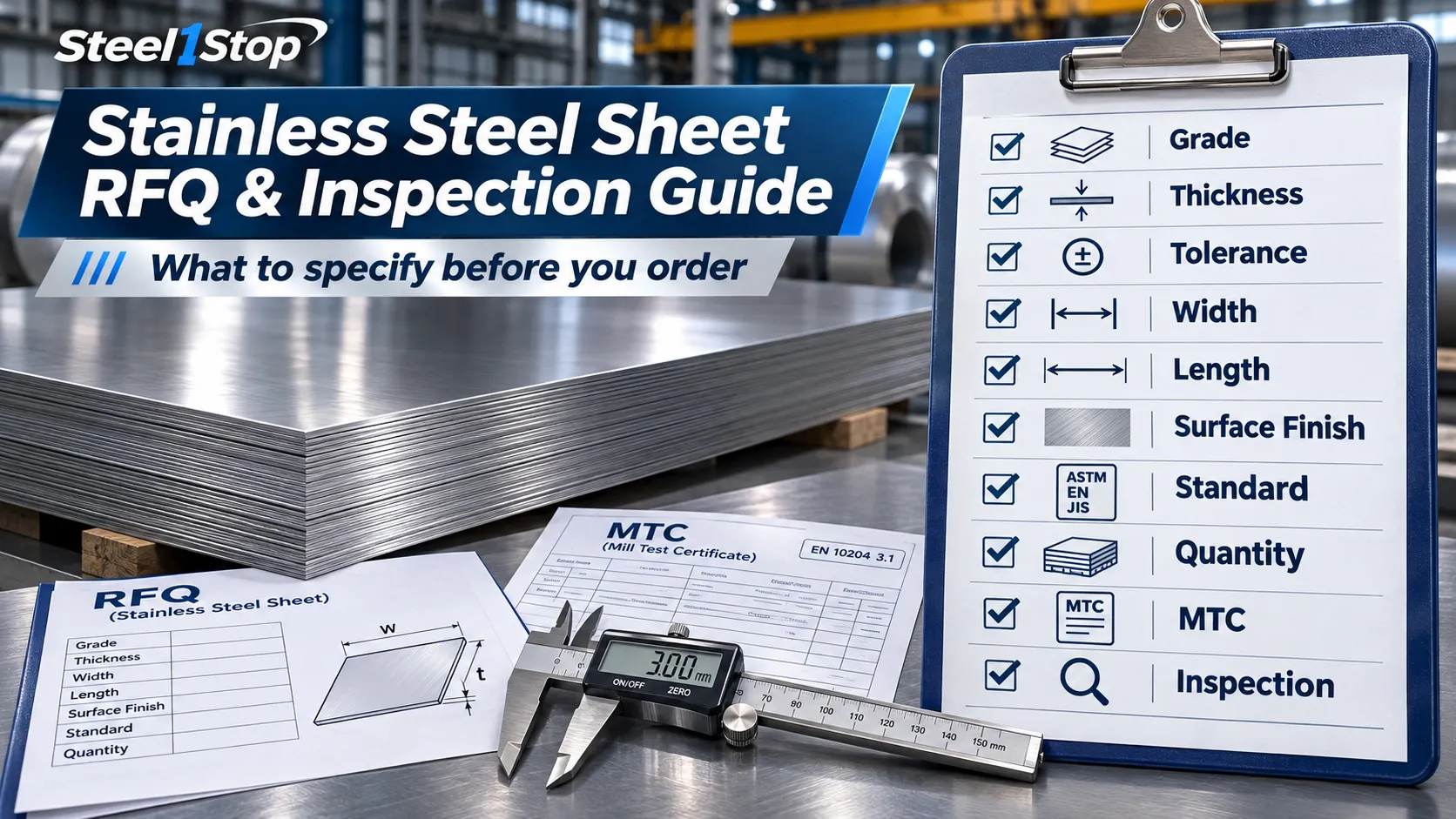
Stainless Steel Sheet RFQ Checklist
| Элемент | Required Information | Пример |
|---|---|---|
| Продукт | Sheet / Plate / Coil | Лист нержавеющей стали |
| Оценка | Material designation | 304 / UNS S30400 |
| Material Standard | Applicable specification | АСТМ А240/А240М |
| Dimensional Standard | Applicable tolerance requirements | АСТМ А480/А480М |
| Указанная толщина | Nominal order thickness | 1.00 mm |
| Толерантность к толщине | Standard or agreed special limits | Per applicable specification |
| Ширина | Требуемая ширина | 1219 мм |
| Длина | Требуемая длина | 2438 мм |
| Поверхностная отделка | Требование к завершению | 2Б |
| Edge Condition | Mill / Slit / Cut | As specified |
| Плоскостность | Standard or special | По мере необходимости |
| Количество | Pieces / MT | 500 листов |
| МТС | Inspection documentation | Specified certificate type |
| Осмотр | Dimensions and other acceptance items | According to agreement |
| Упаковка | Export protection | Export pallet |
| Условия доставки | Incoterms | FOB / CIF as agreed |
| Место назначения | Страна и порт | Покупатель указать |
Example RFQ: 304 Stainless Steel Sheet
A suitable quotation request might read:
Продукт: Лист нержавеющей стали 304
Оценка: UNS S30400
Стандарт материала: ASTM A240/A240M
Общие требования: ASTM A480/A480M.
Thickness: 1.00 mm
Ширина: 1219 мм
Длина: 2438 мм
Финиш: 2Б
Edge: As agreed
Thickness Tolerance: According to applicable metric specification
Количество: 500 листов
Documentation: Mill Test Certificate
Inspection: Dimensions, thickness and surface condition
Packing: Export packaging
Направление: Уточняется
If the project requires a guaranteed minimum thickness, specify that requirement separately.
Например:
Minimum actual thickness: 1.00 mm at the locations and under the conditions defined in the approved inspection specification.
This requirement must be agreed with the supplier, and may call for a different nominal order thickness.
Should Buyers Specify ASTM or ISO?
Choose the system required by the project or end customer.
Avoid writing unclear specifications such as:
“ASTM / ISO tolerance, standard quality.”
Instead, identify the specific applicable standard and edition.
For custom projects, Steel1Stop can review drawings and material requirements before confirming a suitable supply and processing route.
See our customized steel solutions page for project-based material requirements.
Incoming Inspection and Material Acceptance
Incoming inspection helps buyers verify that delivered stainless steel matches their purchase order.
The inspection plan should be established before shipment or receipt.
Step 1: Verify the Material Documents
Check:
- Product description
- Оценка
- Стандартный
- Номер плавки
- Размеры
- Количество
- Required MTC
- Traceability information
Step 2: Confirm Product Identity
Verify that the delivered material matches the purchase order and relevant documentation.
For critical projects, material identification testing may be specified separately.
Step 3: Inspect Thickness
Use calibrated measurement equipment and the measurement locations required by the applicable standard.
Take the agreed number of measurements.
Compare each relevant result with the applicable acceptance limits.
Step 4: Inspect Width and Length
Measure the sheet dimensions using suitable calibrated instruments.
Check the permitted deviations under the agreed standard.
Step 5: Check Flatness and Edge Quality
Where required, inspect:
- Плоскостность
- Edge camber
- Squareness
- Edge damage
- Cut quality
- Состояние поверхности
Step 6: Inspect Packaging and Surface Protection
Confirm that the material is protected against transportation and storage damage.
For polished or decorative stainless steel, protective film and interleaving may be particularly important.
Step 7: Document Nonconformities
If the delivered material does not meet the agreed requirements, record the relevant measurements, identification, and supporting evidence.
The buyer and supplier should then follow the agreed nonconformance procedure.
A Mill Test Certificate alone is not always sufficient to verify every dimensional requirement of every delivered sheet.
Appropriate dimensional inspection may still be necessary.
Часто задаваемые вопросы
What is the thickness tolerance of a 1 mm stainless steel sheet?
There is no universal value. The permitted deviation depends on the applicable standard, product form, width, rolling condition, and tolerance class.
Is 1 mm stainless steel sheet exactly 1.00 mm thick?
Not necessarily. Actual thickness may vary within the applicable manufacturing tolerance.
What is the difference between nominal and actual thickness?
Nominal or specified thickness is the ordered dimension. Actual thickness is the measured thickness of the supplied material.
What is 16 gauge stainless steel in millimeters?
A common U.S. stainless gauge chart gives 16 gauge as 0.0625 inches, approximately 1.59 mm.
What is 18 gauge stainless steel thickness?
18 gauge stainless steel is commonly equivalent to 0.0500 inches, approximately 1.27 mm.
What is the difference between stainless and mild steel gauge?
The same gauge number can represent different nominal thicknesses in stainless steel and carbon steel gauge systems.
Does ASTM A480 specify stainless steel sheet tolerances?
Yes. ASTM A480/A480M provides general requirements, including dimensional tolerances, for flat-rolled stainless products within its scope.
Is ASTM A240 the same as ASTM A480?
No. ASTM A240/A240M is primarily a material specification, while ASTM A480/A480M provides applicable general requirements.
What is ISO 9445-2?
ISO 9445-2 specifies dimensional and form tolerances for continuously cold-rolled stainless steel wide strip and sheet/plate within its defined product range.
What is the difference between ISO 9445 Method A and Method B?
The two methods use different thickness tolerance tables and measurement-location requirements.
Does 304 have a different thickness tolerance from 316L?
Not inherently. The dimensional requirements depend primarily on the applicable product and tolerance specifications, as well as the specified product conditions.
Is cold-rolled stainless steel more accurate than hot-rolled stainless steel?
Cold-rolled products commonly offer tighter dimensional control, but actual tolerances depend on the relevant standard and product specification.
Can I order stainless steel sheet with zero negative tolerance?
A special minimum-thickness requirement may be possible by agreement. The supplier must confirm the available manufacturing and tolerance options.
Where should stainless steel thickness be measured?
At locations required by the applicable standard. Some standards specify different distances from slit edges and mill edges.
Can I use an average thickness to accept a sheet?
Not if the applicable acceptance criteria require individual measurements to remain within specified limits. An acceptable average does not automatically establish compliance.
Does sheet thickness affect weight?
Yes. For fixed sheet dimensions and density, theoretical sheet weight is directly proportional to thickness.
What is the theoretical weight of a 1 mm 304 stainless steel sheet?
At a density of 8.00 g/cm³, a 1 mm thick sheet measuring 1219 × 2438 mm weighs approximately 23.78 kg.
What tolerance should I specify for laser cutting?
The required tolerance depends on the part design, material, cutting process, and assembly requirements. Confirm the applicable material tolerance and the separate finished-part requirements with the fabricator.
What is flatness tolerance?
Flatness tolerance defines the permitted deviation from a specified flat reference condition according to the applicable standard and measurement procedure.
How can I avoid receiving undersized stainless steel sheets?
Specify the applicable standard, required nominal thickness, any minimum actual thickness requirement, measurement method, and inspection criteria in the purchase order.
Final Buying Guide: Choosing the Right Stainless Steel Sheet Thickness
Selecting the correct stainless steel sheet involves more than choosing a nominal thickness.
Buyers should identify the applicable material and dimensional standards, confirm whether the product is cold-rolled or hot-rolled, and understand how the actual thickness may vary.
For purchasing, the most important principles are:
1. Specify actual dimensions. Use millimeters or decimal inches rather than relying only on Gauge.
2. Identify the governing standard. ASTM A480/A480M, ISO 9445, and other specifications have different scopes and dimensional requirements.
3. Confirm the tolerance requirements. Normal tolerance may be sufficient for general applications, while precision manufacturing can require stricter limits.
4. Consider the manufacturing process. Thickness, flatness, width and length can affect cutting, bending, welding, and assembly.
5. Establish inspection criteria. Measurement locations, instruments, sampling and acceptance limits should be defined before delivery.
At Steel1Stop, we support international customers sourcing stainless steel sheet, plate, coil, and other metal products for industrial manufacturing, fabrication, and construction projects.
Изучите наш Лист нержавеющей стали 304В 201 лист нержавеющей стали, и Змеевик из нержавеющей стали 316L product pages for relevant material information.
For customized procurement, provide the required grade, dimensions, standard, tolerance, quantity, surface finish, and inspection requirements.
A complete thickness and tolerance specification reduces purchasing uncertainty, improves manufacturing consistency, and helps ensure that delivered stainless steel meets the intended application.
