
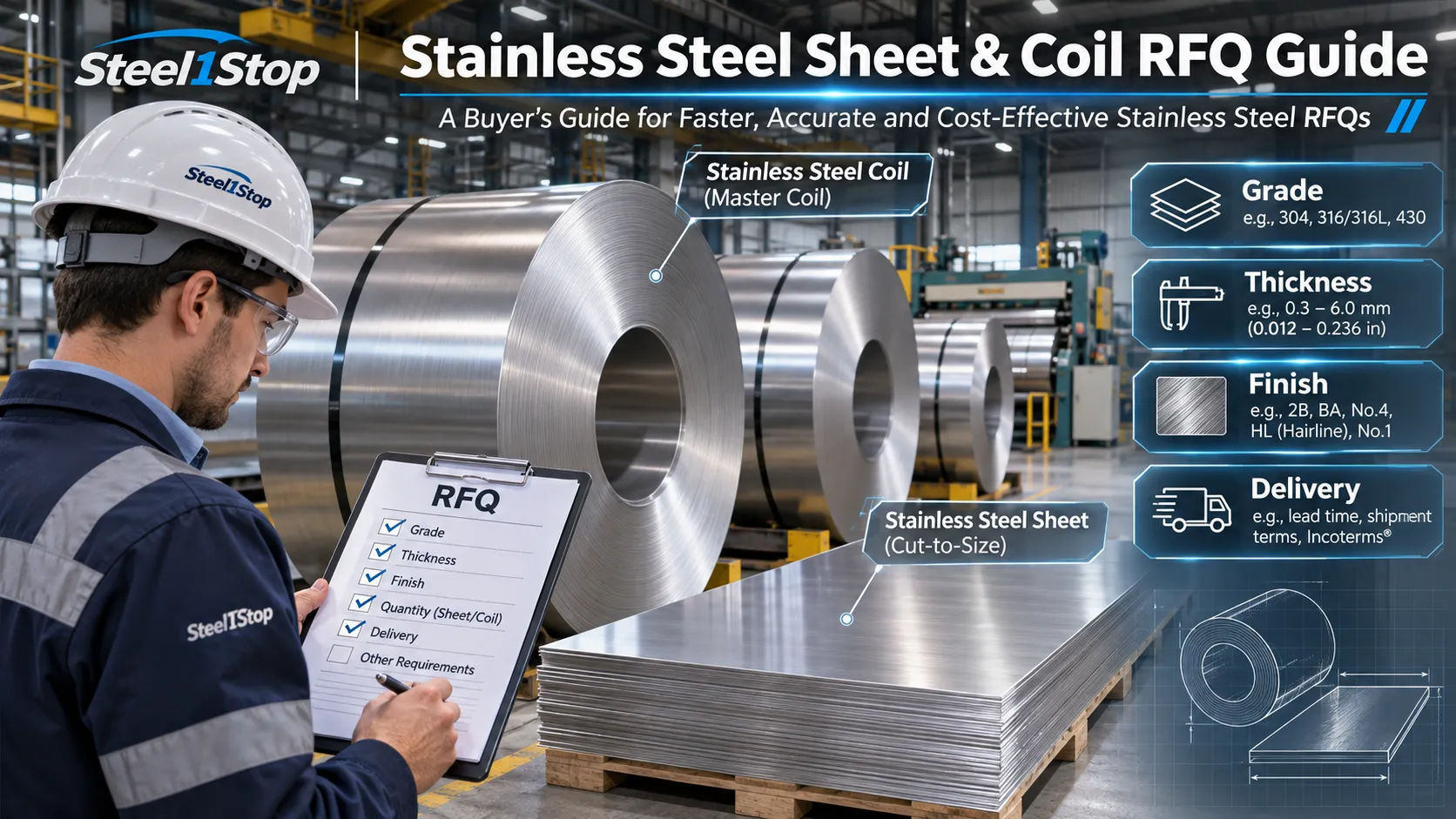
A stainless steel request for quotation (RFQ) is more than a request for a price per ton. It is the technical and commercial specification that tells a supplier exactly what material is required, how it will be processed, how it should be inspected, and where it needs to be delivered.
A request such as “304 stainless steel, 1.5 mm” is not enough for a reliable quotation. The supplier still needs to know whether the buyer wants sheet, plate, master coil or slit coil; which product standard applies; what width and length are required; which surface finish is acceptable; and whether special tolerances, inspection documents or packaging are needed.
A complete stainless steel RFQ reduces assumptions, avoids repeated clarification, and makes quotations from different suppliers easier to compare. This guide explains the information to prepare for stainless steel sheet and coil enquiries and provides copy-ready RFQ templates for buyers, importers, fabricators and procurement teams.
1. What Is a Stainless Steel RFQ?
RFQ stands for Request for Quotation. In steel purchasing, an RFQ is a formal enquiry sent to a supplier to obtain pricing, availability, processing details, lead time and delivery terms for a defined material requirement.
A useful RFQ gives the supplier enough information to evaluate the material and supply route before quoting. It should describe both the product and the conditions under which the product will be accepted.
A stainless steel RFQ normally includes:
- Product form: sheet, plate, master coil, slit coil or cut-to-length material.
- Grade and material standard.
- Thickness, width, length and applicable tolerances.
- Surface finish and protective film requirements.
- Edge condition and processing requirements.
- Quantity and size distribution.
- Inspection documents and traceability.
- Packaging, destination and delivery terms.
The exact fields depend on the product form. A cut sheet needs a length specification, while a coil enquiry needs coil build information such as inside diameter, maximum outside diameter and maximum or target coil weight.
Why an Incomplete RFQ Causes Quotation Problems
If a buyer does not specify the product form, two suppliers may quote different supply routes. If the finish or protective film is omitted, the quoted material may not meet the appearance requirements. If coil weight or ID is missing, the supplier may propose a coil that cannot be handled by the buyer’s uncoiling line.
| Missing Information | Possible Quotation or Supply Problem |
|---|---|
| 제품형태 | Supplier quotes coil when the buyer needs cut sheets, or vice versa |
| Grade and standard | Material designation or permitted substitution is unclear |
| Thickness tolerance | Suppliers use different tolerance assumptions |
| Finished width | Master coil width is quoted instead of required slit width |
| 표면 마무리 | Appearance and processing expectations are inconsistent |
| Coil ID / OD / weight | Coil may not fit the buyer’s handling or processing equipment |
| Edge and burr requirements | Slit material may not meet downstream production needs |
| Inspection scope | Certificate and testing expectations are unclear |
| Packing and delivery | Freight and handling costs are not comparable |
The goal is not to make every RFQ unnecessarily complicated. It is to state the requirements that affect material suitability, processing, acceptance and total delivered cost.
2. Choose the Correct Product Form: Sheet, Plate, Master Coil or Slit Coil
Start by identifying the product form. Sheet, plate and coil are not interchangeable descriptions. They represent different supply and processing arrangements, and each requires different information in an RFQ.
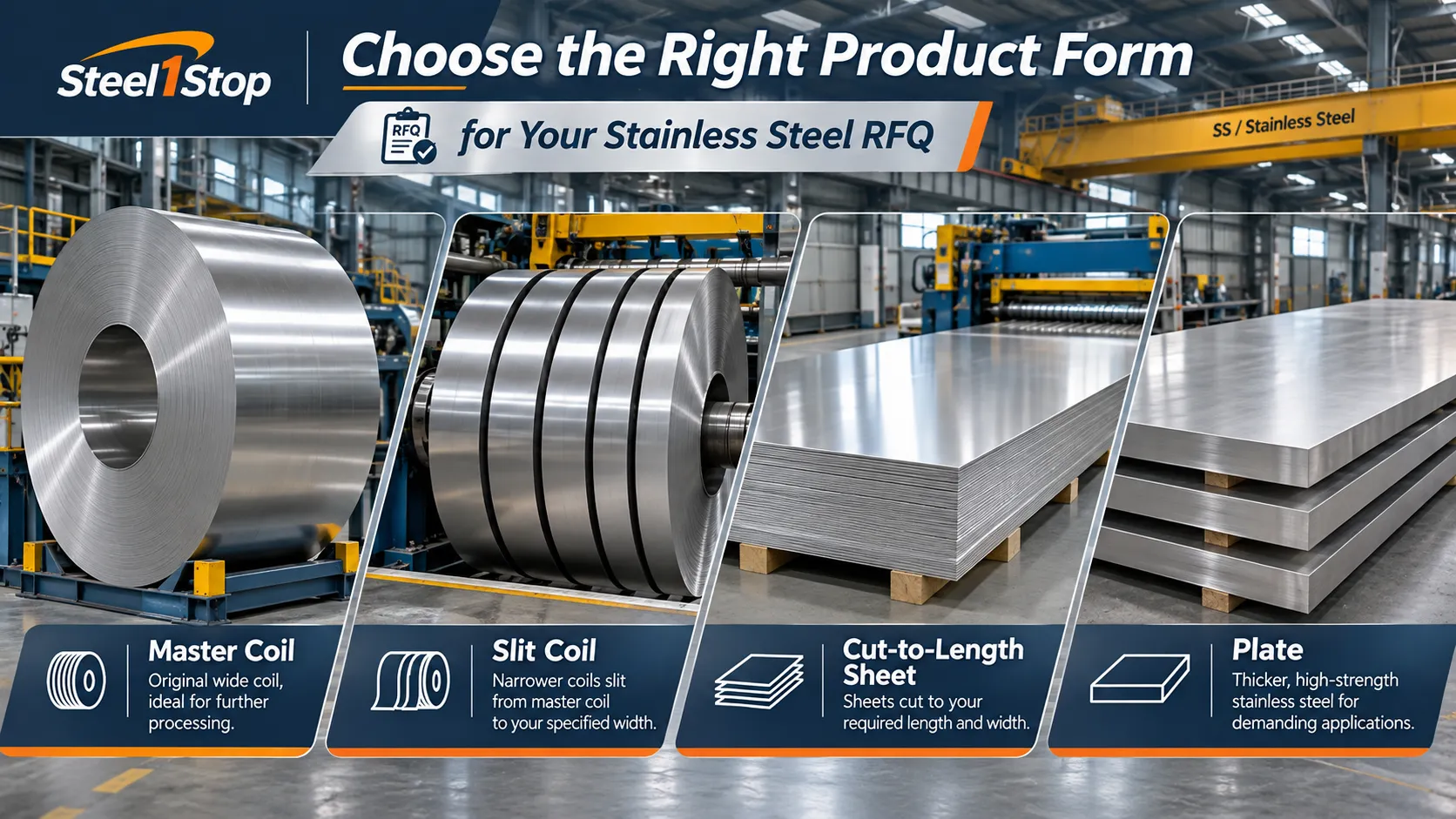
| 제품 양식 | 설명 | Main Dimensions to Specify |
|---|---|---|
| 스테인레스 스틸 시트 | Flat material supplied in cut pieces | 두께×폭×길이 |
| 스테인레스 강판 | Flat product supplied to plate specifications | 두께×폭×길이 |
| Master Coil | Wide continuous coil before slitting or cut-to-length processing | Thickness × width × coil weight, ID and OD |
| Slit Coil | Narrower coil produced by slitting a master coil | Thickness × finished slit width, ID, OD and coil weight |
| Cut-to-Length Sheet | Flat sheets cut from coil to a specified length | Thickness × width × finished length |
Product naming and the sheet/plate boundary can vary by product standard, market and manufacturing route. Do not rely only on a general thickness rule. State the required product specification and the intended delivery form.
Sheet or Plate RFQ
For sheet and plate, specify the finished thickness, width and length. If the supplier is expected to cut the material, clarify whether the dimensions refer to the supplied blank or the finished cut piece.
Master Coil RFQ
For a master coil, specify the nominal thickness and width, coil weight range, inside diameter, maximum outside diameter, edge condition and winding or packaging requirements where relevant.
Slit Coil RFQ
For slit coil, specify the parent coil information and the final slit plan. The finished slit widths, width tolerances, number of strips, edge quality and individual coil weight can affect processing feasibility and cost.
Cut-to-Length RFQ
For cut-to-length material, provide the finished sheet width and length, dimensional tolerances, flatness requirements where controlled, quantity per size and surface protection requirements.
3. Specify Stainless Steel Grade and Material Standard
The grade identifies the stainless steel alloy, while the material standard defines the applicable technical requirements for the product. An RFQ should state both wherever possible.
Common stainless steel grades requested for flat-rolled products include:
| 등급 | Common Designation | Typical Purchasing Consideration |
|---|---|---|
| 201 | UNS S20100, where applicable | Confirm the exact grade and service environment |
| 304 | UNS S30400 | General-purpose austenitic stainless steel |
| 304L | UNS S30403 | Low-carbon 304 variant |
| 316 | UNS S31600 | Molybdenum-bearing austenitic grade |
| 316L | UNS S31603 | Low-carbon 316 variant |
| 430 | UNS S43000 | 페라이트계 스테인리스강 |
These designations are examples, not a recommendation to substitute one grade for another. Grade selection must follow the application, corrosion environment, forming and welding requirements, governing specification and customer approval.
State the Governing Standard
Depending on the product and purchase requirements, buyers may encounter standards such as:
| 기준 | General Role in Procurement |
|---|---|
| ASTM A240/A240M | Product specification for chromium and chromium-nickel stainless steel plate, sheet and strip for pressure vessels and general applications |
| ASTM A480/A480M | General requirements applicable to specified flat-rolled stainless and heat-resisting steel products |
| EN 10088-2 | Technical delivery conditions for sheet, plate and strip of corrosion-resisting stainless steels for general purposes |
| ISO 9445-1 | Dimensional and form tolerances for specified continuously cold-rolled narrow strip and cut lengths |
| ISO 9445-2 | Dimensional and form tolerances for specified continuously cold-rolled wide strip and plate/sheet |
The standards above have different scopes. For example, ISO 9445-2 applies to defined continuously cold-rolled wide strip and plate/sheet dimensions; it is not a universal tolerance standard for every stainless steel product. ASTM A480/A480M provides general requirements in conjunction with the applicable ASTM product specification. Confirm the correct standard, edition and product scope for the order.
If an equivalent grade is acceptable, state that explicitly and require written approval before substitution. If the grade is fixed by a drawing, code or end customer, mark it as mandatory.
Include Product Condition When It Matters
Some orders require additional condition details, such as annealed condition, hardness or temper, mechanical property requirements, or a specific delivery condition. Include these only when they are relevant to the application or contract. Do not assume that a grade designation alone defines every required property.
4. Define Thickness, Width, Length and Tolerances
Dimensions should be stated with units and a clear tolerance basis. For sheet and plate, the basic dimensions are thickness, width and length. For coil, the basic dimensions are thickness and width, supplemented by coil build and weight limits.
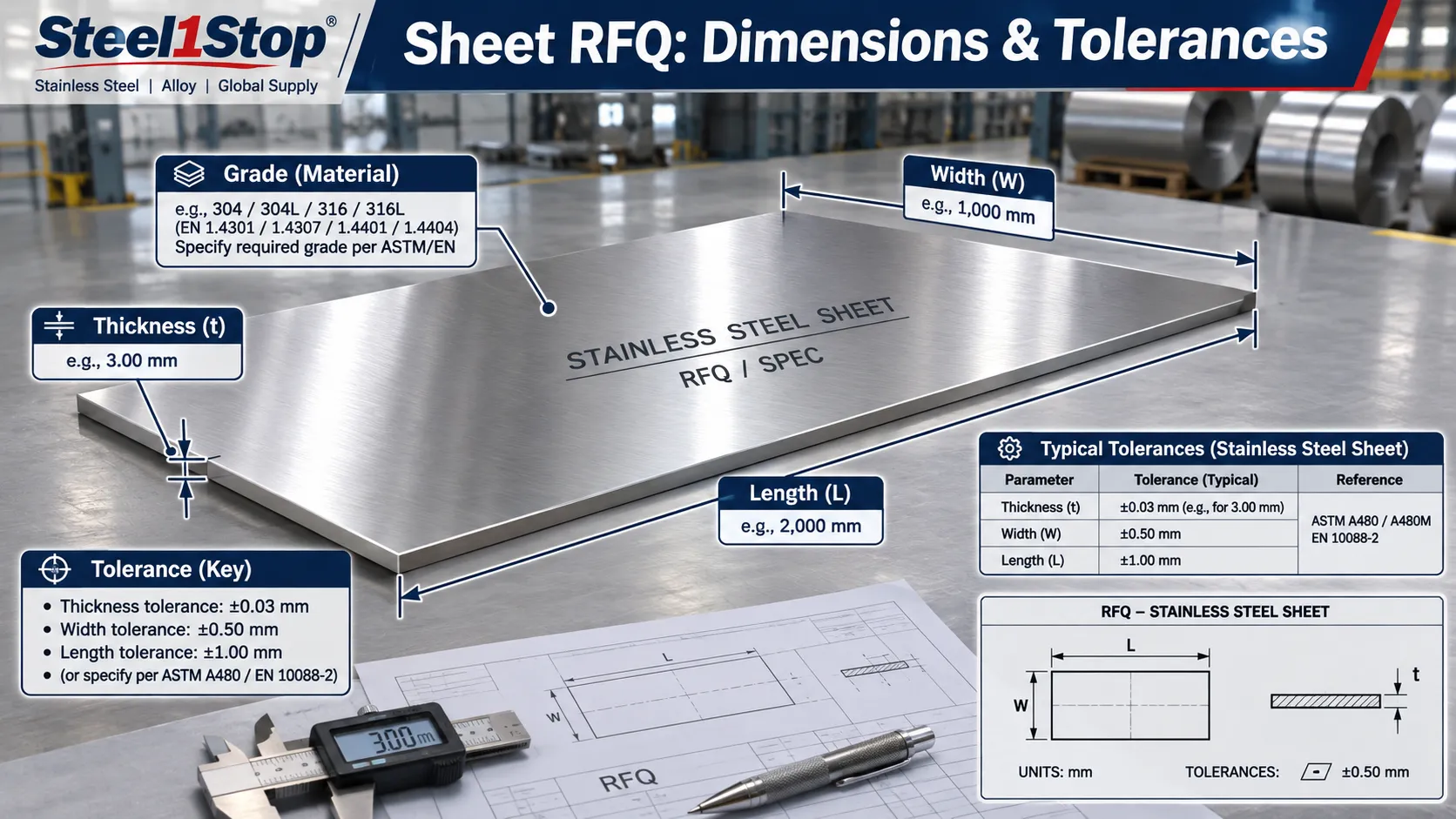
| 매개 변수 | 지정할 내용 | Example Format |
|---|---|---|
| 두께 | Nominal thickness and unit | 1.50mm |
| 두께 내성 | Applicable standard, class or agreed limit | Per specified standard / agreed limit |
| 너비 | Finished or master width | 1250mm |
| 폭 공차 | Applicable tolerance basis | Per specified standard / agreed limit |
| 길이 | 필요한 시트 길이 | 2500mm |
| 길이 내성 | Applicable tolerance basis | Per specified standard / agreed limit |
| 평탄 | Requirement and inspection basis, if critical | Per drawing / agreed specification |
| 직각도 | Requirement, if critical | Per drawing / agreed specification |
Avoid writing only “standard tolerance.” Different standards, product forms, dimensions and rolling routes can have different requirements. Name the governing standard and edition where required, and identify any tighter project-specific limit.
Nominal Thickness vs. Minimum Actual Thickness
Nominal thickness is the ordered reference dimension. The actual measured thickness may vary within the permitted tolerance of the applicable specification.
If a project requires a minimum actual thickness, state that requirement separately. Do not assume that an order for a nominal thickness automatically guarantees that every measurement will be equal to or greater than the nominal value.
Specify the Measurement and Acceptance Basis
For critical dimensions, clarify:
- The applicable dimensional standard and edition.
- Whether normal, special, restricted or precision tolerances are required, where the standard provides such options.
- Measurement locations and method when they affect acceptance.
- Sampling frequency or inspection plan.
- How nonconforming dimensions will be handled.
For cold-rolled stainless steel, ISO 9445-1 and ISO 9445-2 cover different product-width scopes. Select the applicable part rather than referencing ISO 9445 generically when a precise dimensional requirement is needed.
For additional background, see the Steel1Stop guide to Stainless Steel Sheet Thickness and Tolerance.
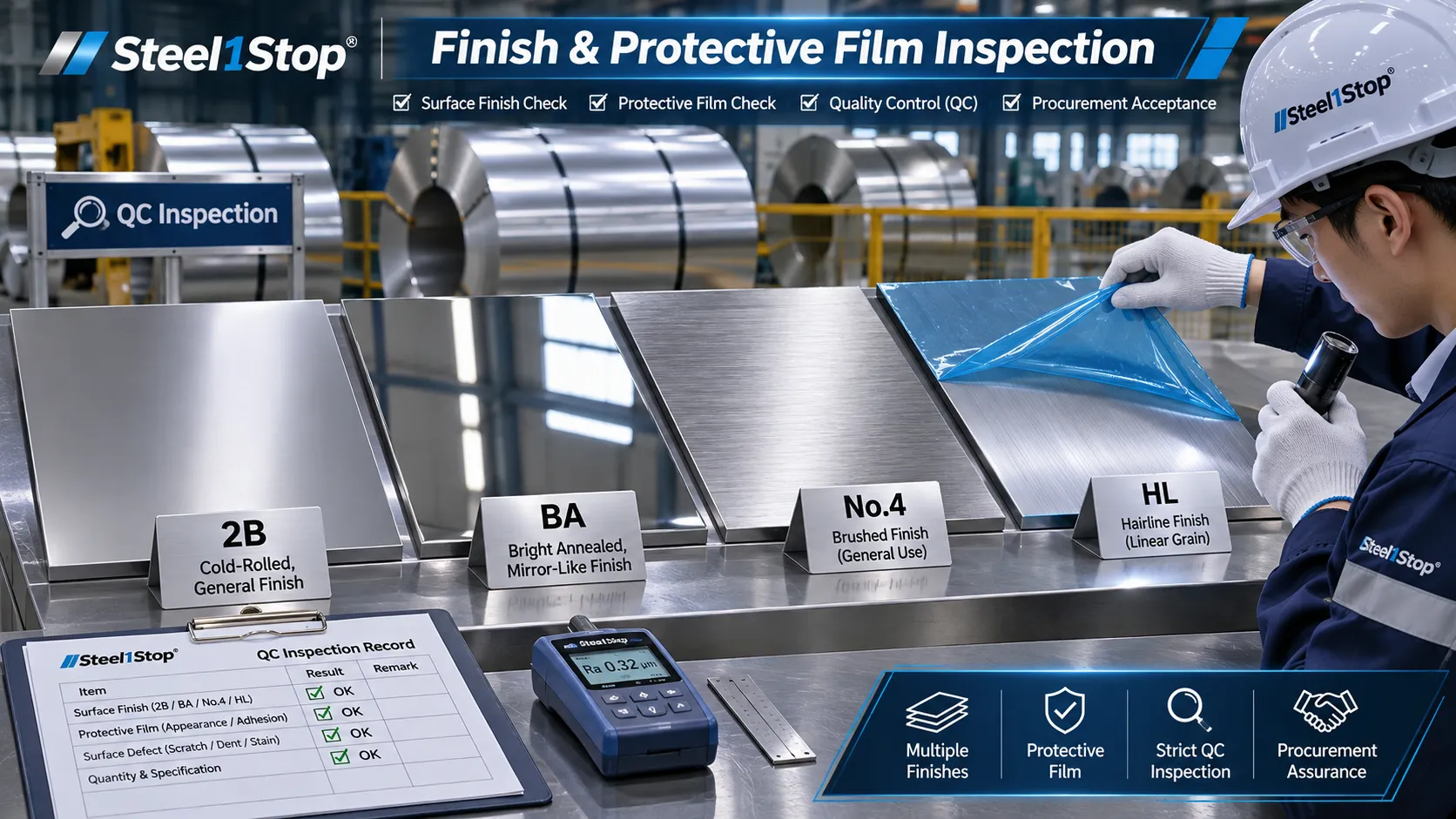
5. Specify Surface Finish and Protective Film
Surface finish is a separate requirement from stainless steel grade. Two products with the same grade and dimensions may have different appearances and processing requirements because of their finish.
| Finish Designation | Common Purchasing Description | RFQ Details to Confirm |
|---|---|---|
| 2B | Common smooth cold-rolled finish | Appearance, surface condition and film |
| 학사 / 2R | 밝은 단련 마무리 | Reflectivity and surface protection |
| No. 1 / 1D | 열간압연, 단련 및 산세 마무리 | Surface condition and application |
| 4번 | 브러시 마감 | Abrasive appearance and grain direction |
| HL | Hairline finish | Directional grain and consistency |
| 거울 | Polished reflective finish | Required reflectivity, protection and inspection sample |
Finish terminology and availability depend on the product standard and processing route. If appearance is important, attach a reference sample, drawing or approved finish description rather than relying on a broad phrase such as “polished.”
Protective Film Requirements
For decorative, architectural or appearance-sensitive material, specify whether protective film is required and which face must be protected.
Include the following details when relevant:
- Film required or not required.
- Protected face: one side or both sides.
- Film type or agreed supplier recommendation.
- Required film adhesion or removal behavior, if controlled.
- Whether film must remain in place during cutting or forming.
- Restrictions on film marking or residue.
- Surface inspection conditions and approved reference sample.
For brushed or hairline material, also specify grain direction. The direction should remain consistent across components that will be installed next to each other.
6. Stainless Steel Coil Specifications: ID, OD and Weight
Coil enquiries require additional information because the coil must fit the buyer’s storage, lifting, transport and processing equipment. A quote based only on grade, thickness and width may not confirm that the proposed coil can be handled at the receiving facility.
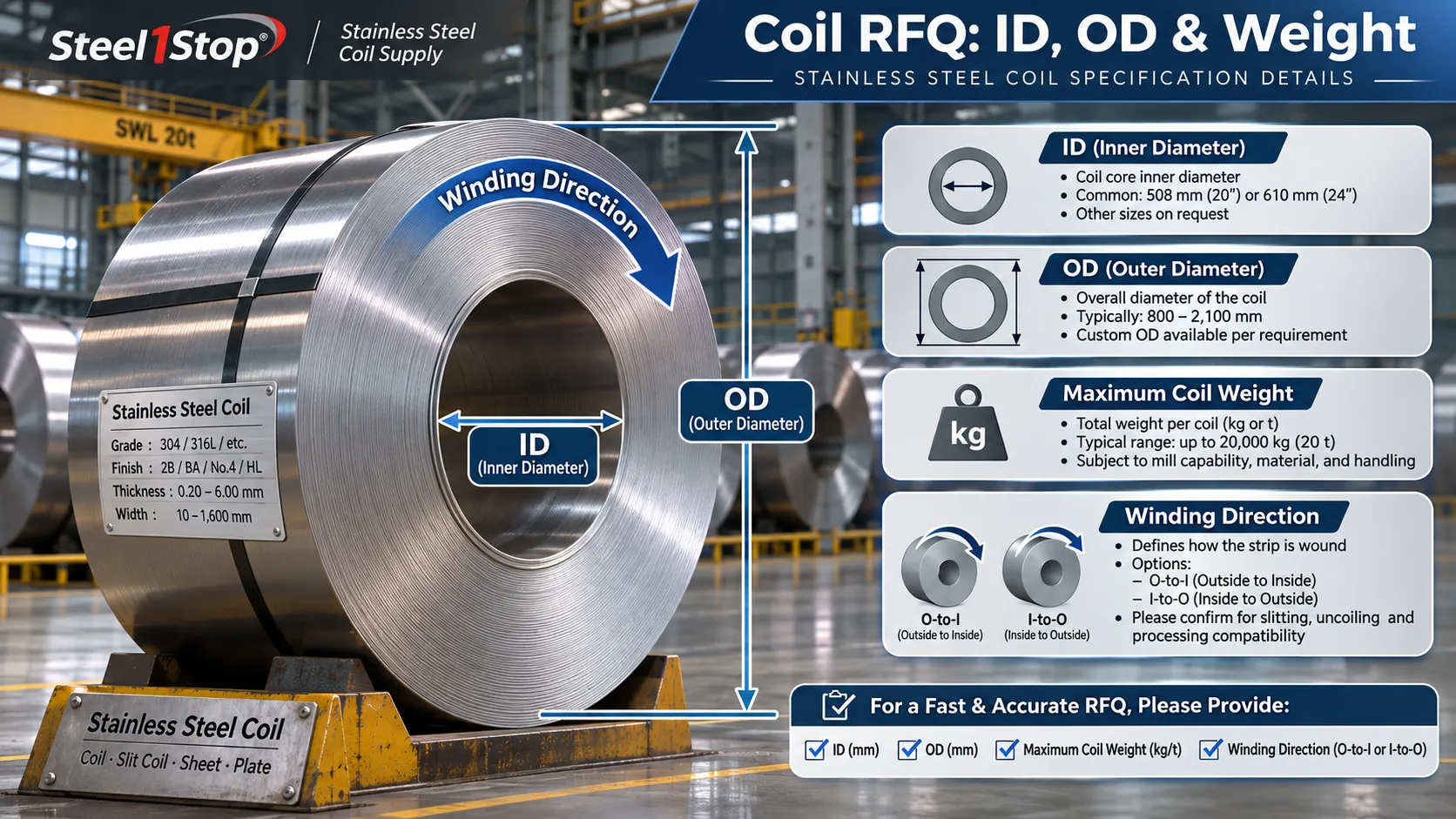
| Coil Parameter | 의미 | What the Buyer Should State |
|---|---|---|
| 코일 ID | Inside diameter of the coil | Required core or inside diameter |
| Coil OD | Outside diameter of the coil | Maximum acceptable outside diameter |
| 코일 무게 | Net weight of an individual coil | Target or maximum weight range |
| Coil Width | Width of the master or slit coil | Required width and tolerance |
| 두께 | Nominal strip thickness | Required thickness and tolerance basis |
| 가장자리 | Original or processed edge | Mill edge, slit edge or other agreed condition |
| Winding Direction | How the strip is wound | Required orientation if the line needs it |
| Coil Build | Coil arrangement and handling configuration | Any equipment or handling restrictions |
Coil ID: Inside Diameter
Coil ID is the diameter of the opening at the center of the coil. It matters when the coil is mounted on an uncoiler, mandrel or handling system.
Specify the required ID based on the receiving equipment. Do not assume that one standard ID will suit every production line.
Coil OD: Outside Diameter
Coil OD is the overall outside diameter of the wound coil. The maximum OD may be limited by the buyer’s uncoiler, storage rack, transport arrangement or lifting equipment.
If there is a strict maximum, state it in the RFQ and confirm that the supplier can meet it.
Maximum Coil Weight
Maximum coil weight affects crane capacity, forklift handling, coil cars, uncoiling equipment and transport planning.
If the buyer needs several smaller coils instead of one heavy coil, provide the target weight range per coil and the number of coils required. Distinguish total order tonnage from individual coil weight.
Winding Direction and Coil Orientation
If the receiving line requires a particular winding direction or coil orientation, provide a drawing or clear description. Terms such as eye-to-sky and eye-to-wall are commonly used for coil packaging orientation, but the buyer should confirm the required arrangement with the supplier and logistics team.
7. Mill Edge vs. Slit Edge: What Buyers Must Specify
Edge condition is important for coil and strip products. A master coil supplied with mill edges is not the same as a slit coil produced by longitudinal cutting.
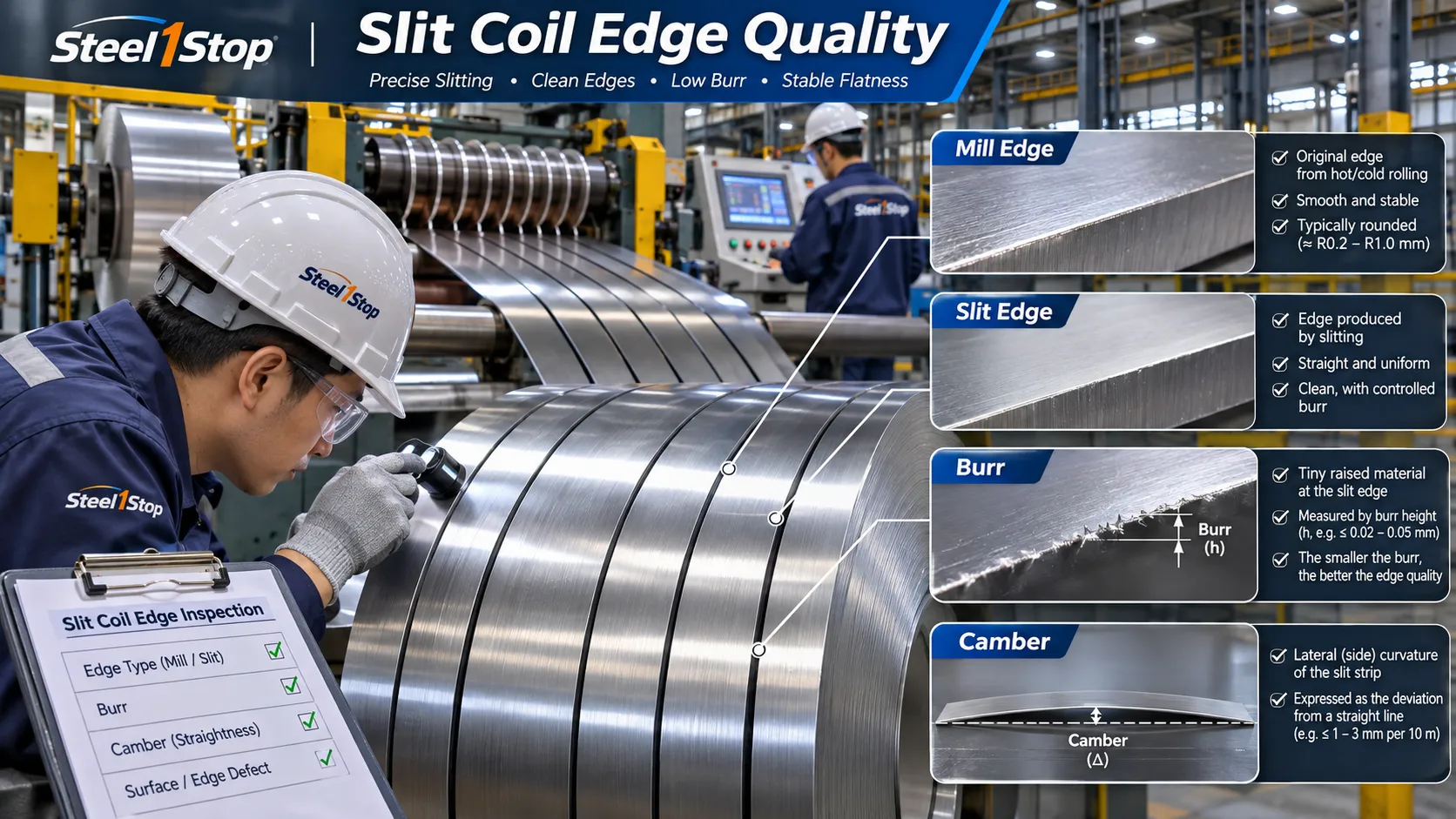
| Edge or Quality Item | 설명 | RFQ Requirement |
|---|---|---|
| 밀 엣지 | Original edge from the rolling process | State if mill edge is acceptable |
| 슬릿 엣지 | Edge created by longitudinal slitting | State finished slit width and edge quality |
| Trimmed Edge | Edge processed to remove or regularize the original edge | State finished width and edge condition |
| 규석 | Raised material or sharp projection at a cut edge | Specify a measurable limit if critical |
| 캠버 | Sideways deviation of strip edge from a straight line | State limit and measurement length if critical |
| Edge Damage | Nicks, dents or other edge defects | Define acceptable condition if relevant |
What to Include in a Slit Coil RFQ
A slit coil enquiry should identify:
- Parent coil grade, standard, thickness and width.
- Finished slit widths and quantity for each width.
- Slit width tolerance.
- Required edge condition.
- Burr limit and measurement method, if controlled.
- Camber limit and measurement length, if controlled.
- Coil ID, maximum OD and individual coil weight.
- Winding direction and packaging requirements.
- Surface finish and protected face.
- Total quantity and delivery schedule.
If the slit material will feed an automated line, stamping press or roll-forming machine, explain the receiving process. The supplier can then review whether the proposed slit dimensions and edge requirements are suitable for that operation.
Do not use an arbitrary burr or camber value as a universal acceptance limit. The correct limits depend on strip thickness, width, downstream process and the buyer’s equipment.
8. Cut-to-Length, Slitting and Other Processing Requirements
A buyer should state whether the material is required in mill supply condition or needs additional processing before delivery.
| Processing Requirement | Information to Include |
|---|---|
| Slitting | Parent width, finished slit widths, slit count and tolerances |
| 길이에 맞게 절단 | Finished sheet length, length tolerance and quantity per size |
| 전단 | Finished dimensions, edge condition and squareness |
| Leveling | Flatness requirement and inspection basis |
| Polishing / Brushing | Finish designation, grain direction and reference sample |
| 보호필름 | Protected face, film requirement and removal conditions |
| 맞춤형 절단 | Drawing, cutting file, finished dimensions and tolerance |
For laser cutting or other downstream fabrication, state whether the supplier is responsible only for supplying the raw sheet or also for cutting the finished components. If a drawing is available, attach the latest revision and identify critical dimensions.
Clarify whether the quoted dimensions apply before or after processing. A 1250 mm master coil that is slit into narrower strips should not be described as a 1250 mm finished slit coil.
9. Quantity, Coil Weight and Order Distribution
Quantity should be stated in a clear commercial unit and broken down by product size or processing requirement.
For sheet and plate, provide the number of pieces or total weight for each dimension. For coil, state total tonnage and the desired weight range per coil.
| 제품 | Quantity Information |
|---|---|
| 시트 | Pieces per thickness, width, length and grade |
| Plate | Pieces or metric tons per dimension and grade |
| Master Coil | Total metric tons, coil count and target weight range |
| Slit Coil | Total metric tons, finished width distribution and target weight per coil |
| 길이에 맞게 절단 | Quantity per finished size and total order quantity |
If the order contains multiple dimensions, attach a size schedule instead of combining everything into one total tonnage.
For repeat purchasing, also provide estimated monthly or annual demand, expected order frequency and whether partial shipments are acceptable. These details can help suppliers evaluate production planning and commercial terms.
Minimum order quantity (MOQ), production batch size and available stock vary by supplier, grade, thickness, finish and processing route. Ask the supplier to confirm the applicable MOQ for each line item.
10. Quality Inspection, MTC and Traceability
Inspection requirements should describe what needs to be checked, which documents are required and what acceptance criteria apply. A general request for “full inspection” may not tell the supplier which characteristics are critical.
Mill Test Certificate (MTC)
If a material certificate is required, state the required certificate type and the applicable product standard. EN 10204 Type 3.1 is commonly requested for metallic products when the buyer requires specific inspection results validated by the manufacturer’s authorized inspection representative independent of the manufacturing department.
A certificate type is not a substitute for the product standard. The RFQ should separately identify the material specification and the inspection document required.
Inspection Requirements
| 검사 항목 | What to Confirm |
|---|---|
| Material Identification | Grade, heat number, coil or batch identification |
| 화학 성분 | Required elements and applicable product specification |
| 기계적 특성 | Required tests and acceptance criteria |
| Thickness and Width | Measurement method, locations and tolerance basis |
| Length and Flatness | Requirements for cut sheets or plate |
| Surface Condition | Finish, visible defects and inspection conditions |
| 슬릿 엣지 | Burr, camber and edge quality where relevant |
| PMI | Whether positive material identification is required |
| Third-Party Inspection | Inspection agency, scope, timing and cost responsibility |
| Traceability | Link between material, package marks and certificate |
Do not automatically add every possible test to every order. Tests such as PMI, intergranular corrosion testing, impact testing or third-party inspection should be specified when required by the application, governing standard, project specification or contract.
Traceability and Document Matching
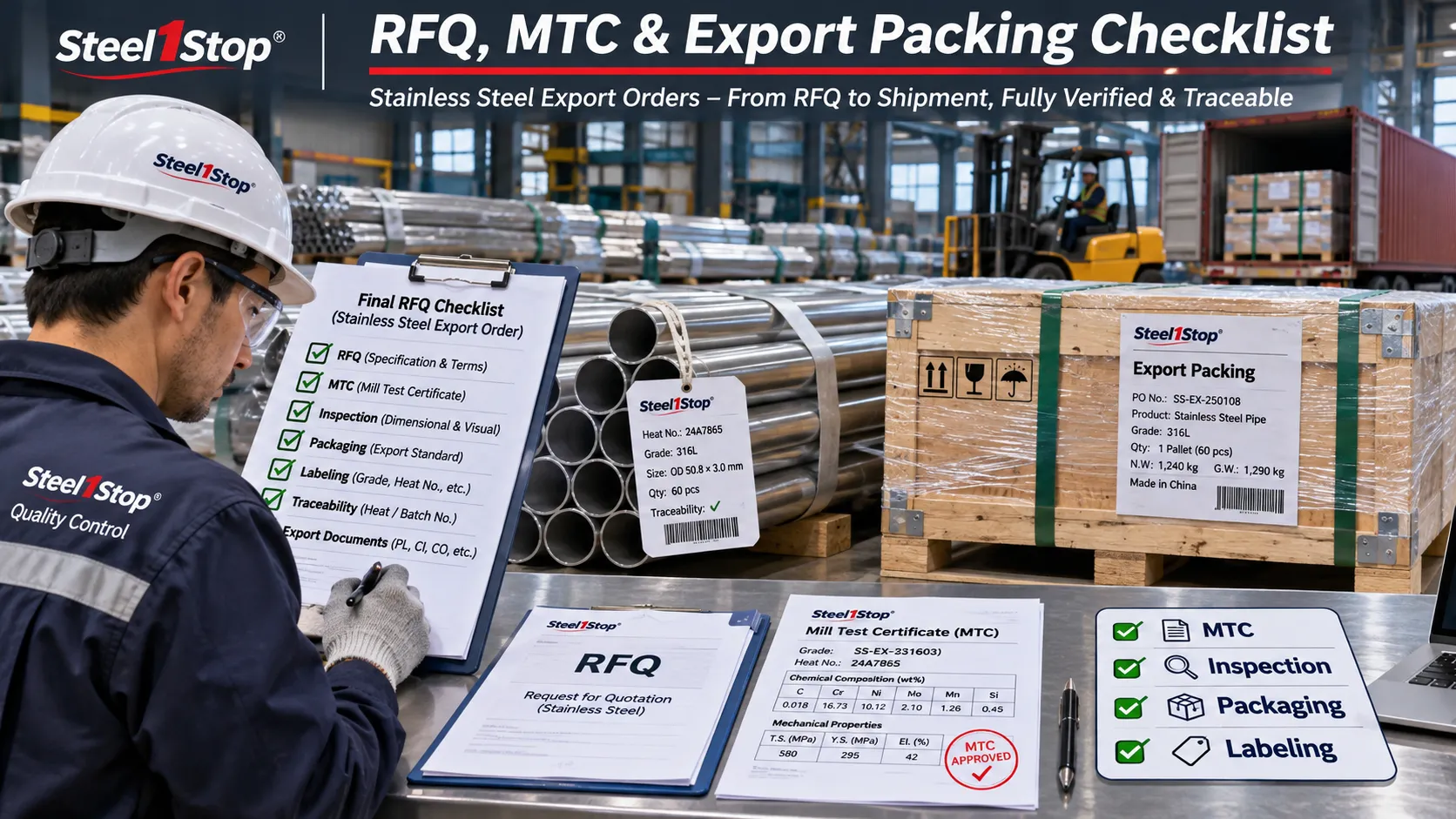
The MTC should be traceable to the material supplied. Confirm that heat numbers, coil numbers, bundle labels and shipping documents can be linked to the relevant material certificate.
If the supplier performs slitting or cut-to-length processing, clarify how the original heat and coil traceability will be maintained on the processed material and its packaging.
11. Packaging, Shipping and Incoterms
Packaging should protect the material during storage, handling and transport. Requirements depend on product form, surface finish, coil weight, destination and shipping route.
| 제품 | Packaging Details to Confirm |
|---|---|
| 시트 | Stack support, surface separators, protective film, edge protection and pallet requirements |
| Plate | Skid or support arrangement, lifting access, edge protection and bundle security |
| Master Coil | Coil orientation, saddle or skid, eye protection, strapping and moisture protection |
| Slit Coil | Individual coil support, edge protection, coil separation, labels and winding security |
| Polished / Decorative Material | Protected face, interleaving, film and handling precautions |
Shipping Information
Include the destination country and port, delivery point, required delivery date, preferred shipment arrangement and any unloading restrictions.
For coil shipments, confirm package dimensions, gross weight, coil orientation and lifting method. For sheet and plate shipments, confirm bundle dimensions, stack height and unloading equipment.
Incoterms and Commercial Delivery Basis
State the agreed Incoterm and named place or port. For example, an RFQ may request an FOB quotation for a named Chinese port or a CIF quotation for a named destination port.
Use the correct Incoterms edition in the purchase documents and make sure all suppliers quote on the same basis. Freight, insurance, export clearance and destination charges should not be assumed to be included unless the selected trade term and quotation clearly say so.
12. Commercial Terms to Include in an RFQ
Technical details define what is being purchased. Commercial details define how the transaction will be quoted and delivered.
| Commercial Item | Information to Request |
|---|---|
| Unit Price | Price per metric ton, kilogram, sheet, piece or coil |
| Currency | USD or another agreed currency |
| Quantity Basis | Confirm whether price is based on theoretical or actual weight, where relevant |
| 모크 | Minimum order quantity by grade, size or processing route |
| Lead Time | Production or dispatch lead time after order confirmation |
| Quotation Validity | Date or period during which the price remains valid |
| 지불 조건 | Proposed payment method and schedule |
| Incoterm | Named place or port and applicable edition |
| Shipment | Full or partial shipment, if permitted |
| 포장 | Whether export packing is included |
| Processing Charges | Slitting, cutting, polishing, leveling or other additional work |
| 선적 서류 비치 | MTC, inspection report, packing list and other agreed documents |
When comparing suppliers, do not compare only the headline price per ton. A lower price may exclude slitting, protective film, inspection, export packing or freight. Ask each supplier to identify included services, exclusions and deviations from the RFQ.
13. Copy-Ready Stainless Steel Sheet or Plate RFQ Template
Use this template for a cut sheet or plate enquiry. Replace the bracketed fields with the actual project requirements and remove fields that do not apply.
Stainless Steel Sheet / Plate RFQ
Subject: RFQ – Stainless Steel Sheet / Plate

Product Form: Stainless Steel Sheet / Plate
Application: [Describe the end use]
Grade: [304 / 304L / 316L / 201 / 430 / Other]
Material Standard: [ASTM A240/A240M / EN 10088-2 / JIS / Other]
Product Condition: [If specified]
Production Route: [Cold Rolled / Hot Rolled / As Required]

Thickness: [ ] mm
Thickness Tolerance: [Standard / Class / Agreed Limit]
Width: [ ] mm
Width Tolerance: [Standard / Agreed Limit]
Length: [ ] mm
Length Tolerance: [Standard / Agreed Limit]
Flatness / Squareness: [If Required]
Edge Condition: [Mill Edge / Trimmed / Other]

Surface Finish: [2B / BA / No.1 / No.4 / HL / Mirror / Other]
Protective Film: [Not Required / One Side / Both Sides / Specify]
Grain Direction: [If Required]

Quantity: [ ] Sheets / [ ] MT
Quantity by Size: [Attach Size Schedule]
Processing: [Cut-to-Size / Shearing / Leveling / Other]
Inspection: [Dimensions / Surface / Other]
Certificate: [MTC / EN 10204 Type 3.1 / Other Agreed Document]
Traceability: [Heat / Batch / Package Marking Requirements]

Packaging: [Export Packing / Special Requirements]
Destination Port: [ ]
Destination Country: [ ]
Incoterm: [FOB / CFR / CIF / Other + Named Place]
Required Delivery: [ ]
Quotation Validity: [Please State]
Payment Terms: [Please Quote]

Please confirm material availability, applicable tolerances,
processing capability, lead time, packing details and any
deviations from the above requirements.
Example: 304 Stainless Steel Sheet RFQ
Product Form: Cold-Rolled Stainless Steel Sheet
Grade: 304 / UNS S30400
Material Standard: ASTM A240/A240M
Thickness: 1.50 mm
Width: 1250 mm
Length: 2500 mm
Surface Finish: 2B
Edge Condition: To Be Confirmed
Protective Film: One Side, Subject to Confirmation
Quantity: 500 Sheets
Inspection Document: MTC, Type to Be Confirmed
Packaging: Export Packing
Destination: [Port / Country]
Incoterm: [Named Incoterm and Place]
This is an example of how to organize an enquiry, not a universal purchasing specification. Confirm the applicable tolerance, finish, certificate and packaging requirements for the actual project.
14. Copy-Ready Stainless Steel Coil RFQ Templates
A coil RFQ should distinguish master coil from slit coil. The two products require different dimensional and processing information.
Template A: Stainless Steel Master Coil RFQ
Subject: RFQ – Stainless Steel Master Coil

Product Form: Master Coil
Application: [Describe the receiving process]
Grade: [304 / 304L / 316L / 201 / 430 / Other]
Material Standard: [ASTM / EN / JIS / Other]
Product Condition: [If Specified]
Production Route: [Cold Rolled / Hot Rolled]

Thickness: [ ] mm
Thickness Tolerance: [Standard / Class / Agreed Limit]
Coil Width: [ ] mm
Width Tolerance: [Standard / Agreed Limit]
Edge Condition: [Mill Edge / Other]
Surface Finish: [2B / BA / No.1 / Other]
Protective Film: [If Required]

Coil ID: [ ] mm
Maximum Coil OD: [ ] mm
Target Coil Weight: [ ] MT
Maximum Coil Weight: [ ] MT
Winding Direction: [If Required]
Coil Orientation for Packing: [Eye-to-Wall / Eye-to-Sky / Other]

Total Quantity: [ ] MT
Number of Coils: [If Specified]
Inspection: [Required Inspection Scope]
Certificate: [MTC / EN 10204 Type 3.1 / Other Agreed Document]
Traceability: [Heat / Coil Marking]

Packaging: [Export Packing Requirements]
Destination Port: [ ]
Destination Country: [ ]
Incoterm: [Named Incoterm and Place]
Required Delivery: [ ]

Please confirm available coil dimensions, individual coil weight,
lead time, inspection documents and any deviations.
Template B: Stainless Steel Slit Coil RFQ
Subject: RFQ – Stainless Steel Slit Coil

Product Form: Slit Coil
Application: [Stamping / Roll Forming / Slitting / Other]
Grade: [ ]
Material Standard: [ ]
Production Route: [Cold Rolled / Hot Rolled]

Parent Coil Thickness: [ ] mm
Thickness Tolerance: [ ]
Parent Coil Width: [ ] mm
Finished Slit Widths:
- [ ] mm × [ ] strips
- [ ] mm × [ ] strips
- [ ] mm × [ ] strips

Slit Width Tolerance: [ ]
Edge Condition: Slit Edge
Burr Requirement: [Limit and Measurement Method, If Required]
Camber Requirement: [Limit and Measurement Length, If Required]
Surface Finish: [ ]
Protective Film: [ ]
Protected Face: [If Required]

Coil ID: [ ] mm
Maximum Coil OD: [ ] mm
Target Individual Coil Weight: [ ] kg / MT
Maximum Individual Coil Weight: [ ] kg / MT
Winding Direction: [If Required]

Total Quantity: [ ] MT
Quantity by Finished Width: [Attach Slit Schedule]
Inspection: [Dimensions / Edge / Surface / Other]
Certificate: [MTC / Other Agreed Document]
Traceability: [Heat / Parent Coil / Slit Coil Identification]

Packaging: [ ]
Destination Port: [ ]
Destination Country: [ ]
Incoterm: [Named Incoterm and Place]
Required Delivery: [ ]

Please confirm slitting feasibility, finished width tolerances,
edge quality, coil build, packing and processing lead time.
For repeat slit-coil orders, attach a slit schedule or drawing showing every finished width and the quantity required for each width. This helps prevent misunderstandings about the number of strips, individual coil weights and total order tonnage.
15. Common Stainless Steel RFQ Mistakes
A well-structured RFQ should prevent avoidable assumptions. Review these points before sending the enquiry.
| Common Mistake | Better Practice |
|---|---|
| Writing only “304 stainless steel” | State grade, designation and applicable product standard |
| Using gauge as the only thickness description | State the required decimal thickness and unit |
| Writing “standard tolerance” | Identify the governing standard, edition and required tolerance |
| Requesting a coil without ID or weight limits | Confirm ID, maximum OD and individual coil weight |
| Specifying only master coil width for a slit order | List every finished slit width and quantity |
| Writing “good surface” | State the finish, protected face and approved appearance reference |
| Omitting edge requirements | State mill edge, slit edge or trimmed edge as required |
| Asking for “full inspection” | List the inspection characteristics, documents and acceptance criteria |
| Omitting packaging orientation | Confirm coil orientation, supports and handling restrictions |
| Combining all sizes into one tonnage | Attach a size and quantity schedule |
| Comparing FOB and CIF prices directly | Compare quotations using the same Incoterm and named place |
| Allowing unapproved grade substitution | State whether alternatives are permitted and require written approval |
16. How to Compare Stainless Steel Supplier Quotations
Once quotations arrive, compare them against the original RFQ rather than comparing only the total price.
| Comparison Item | Supplier A | Supplier B | Supplier C |
|---|---|---|---|
| Grade and Standard | |||
| 제품 양식 | |||
| Thickness and Tolerance | |||
| Width / Length or Coil Build | |||
| Surface Finish and Film | |||
| Edge and Processing | |||
| Inspection and Certificate | |||
| Quantity and Weight Basis | |||
| 포장 | |||
| Unit Price and Currency | |||
| Processing Charges | |||
| Incoterm and Named Place | |||
| Lead Time | |||
| 지불 조건 | |||
| Quotation Validity | |||
| Exceptions / Deviations |
Ask suppliers to list any deviations clearly. A quotation that does not meet the requested grade, dimensions, finish, tolerance or inspection scope should not be treated as technically equivalent simply because its price is lower.
For a fair comparison, normalize the price basis, quantity, currency, processing scope, packing, freight and delivery terms. Confirm whether weight is theoretical or actual and how any weight difference will be invoiced.
17. Frequently Asked Questions About Stainless Steel RFQs
What information is required for a stainless steel RFQ?
At minimum, provide product form, grade, material standard, thickness, width, length or coil dimensions, surface finish, quantity and destination. Add tolerances, edge condition, processing, inspection, certificate and packaging requirements when they affect the order.
What is the difference between a sheet RFQ and a coil RFQ?
A sheet RFQ normally specifies thickness, width and length. A coil RFQ also needs coil-specific information such as inside diameter, maximum outside diameter, individual coil weight, edge condition and winding or packaging orientation where relevant.
What does MTC mean in stainless steel purchasing?
MTC means Mill Test Certificate. It is a material document containing information such as material identification and test results required by the applicable specification and order. If a specific document type is needed, state it in the RFQ.
What is an EN 10204 Type 3.1 certificate?
EN 10204 Type 3.1 is an inspection certificate that records specific inspection results and is validated by the manufacturer’s authorized inspection representative independent of the manufacturing department. State this requirement separately from the material product standard.
What is the difference between mill edge and slit edge?
Mill edge is the original edge from the rolling process. Slit edge is produced when a wider coil is cut longitudinally into narrower strips. If slit edge quality is important, specify the finished width tolerance, burr requirement and camber requirement.
What are coil ID and coil OD?
Coil ID is the inside diameter of the coil opening. Coil OD is the overall outside diameter of the wound coil. Both can affect handling, storage and compatibility with the buyer’s processing equipment.
Should I specify maximum coil weight?
Yes, if the receiving facility or production line has a handling limit. State the target or maximum individual coil weight, not only the total order tonnage.
Do I need to specify surface finish separately from grade?
Yes. Grade identifies the alloy, while finish describes the surface condition. State both, and include protective film and grain direction requirements when relevant.
Can I request a custom stainless steel sheet size?
Custom dimensions may be available depending on the supplier’s stock, production route and processing capability. Specify finished dimensions, tolerances, quantity per size and any cutting or leveling requirements.
Can a supplier offer an equivalent stainless steel grade?
A supplier may propose an alternative, but it should not be substituted without buyer approval. Confirm chemical, mechanical, corrosion, fabrication and code requirements before accepting an alternative.
How can I get a more accurate stainless steel quotation?
Send one complete RFQ to each supplier, including the same product form, grade, standard, dimensions, tolerances, finish, processing, inspection, quantity, packaging and delivery terms. Attach drawings, a size schedule or an approved finish sample when relevant.
18. Prepare Your Stainless Steel RFQ with Steel1Stop
A clear RFQ helps buyers receive quotations that are easier to evaluate and convert into purchase orders. Before sending your enquiry, confirm the product form, grade, standard, dimensions, surface finish, tolerances, quantity, inspection documents, packaging and destination.
Steel1Stop supplies stainless steel products for international buyers, distributors, fabricators and industrial projects. Explore our 스테인레스 스틸 코일 그리고 스테인레스 강판 및 시트 product categories to review available product options.
To request a quotation, send your specification, size schedule, drawings or reference documents together with the destination port and required delivery schedule. If a field is not yet confirmed, identify it as “to be confirmed” rather than leaving a critical requirement ambiguous.
A complete stainless steel RFQ gives both the buyer and supplier a clear basis for material selection, processing, inspection, pricing and delivery.
Standards and Technical References
- ASTM A240/A240M – Chromium and Chromium-Nickel Stainless Steel Plate, Sheet, and Strip
- ASTM A480/A480M – General Requirements for Flat-Rolled Stainless and Heat-Resisting Steel Plate, Sheet, and Strip
- ISO 9445-1 – Continuously Cold-Rolled Stainless Steel: Narrow Strip and Cut Lengths
- ISO 9445-2 – Continuously Cold-Rolled Stainless Steel: Wide Strip and Plate/Sheet
- EN 10204 – Types of Inspection Documents
